Accession Number
1954.680
Medium
red and black chalk
Dimensions
Sheet: 35.2 x 25.4 cm (13 7/8 x 10 in.); Secondary Support: 35.2 x 25.4 cm (13 7/8 x 10 in.)
Classification
Drawing
Credit Line
The Norweb Collection
Tags
Drawing Baroque (1600–1750) German Color: Gold
Background & Context
Background Story
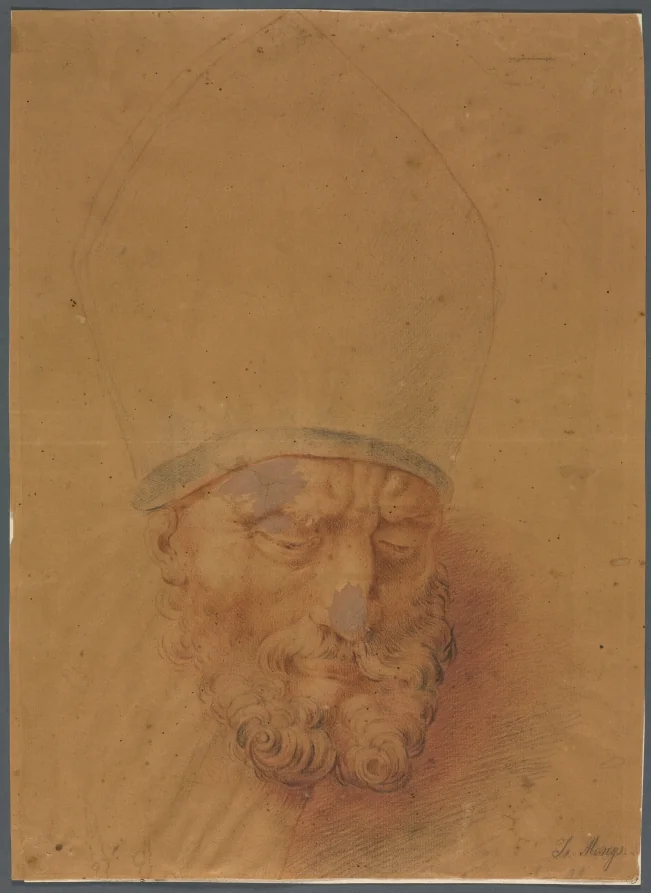
Head of a Bishop is a preparatory drawing by Mengs in red and black chalk—a combination that allows the artist to build up tonal values in two registers: the warm tones in red chalk and the cool tones in black. Mengs's preparatory drawings were central to his working method because his neoclassical compositions required meticulous planning before the painting was begun. The head study demonstrates the careful observation and controlled execution that Mengs brought to every aspect of his work, from the overall composition to the individual heads that populate it.
Cultural Impact
Mengs's chalk drawings are important documents in the history of neoclassical drawing practice because they demonstrate the meticulous preparation that underlay his apparently effortless neoclassical compositions. The combination of red and black chalk was a standard preparatory medium for 18th-century history painters, and Mengs's handling of it shows the careful tonal planning that went into every head in his finished paintings.
Why It Matters
Head of a Bishop is Mengs's neoclassical preparation in action: red and black chalk building up tonal values in two registers, the warm and the cool, for a head that will appear in a finished painting with the compositional clarity and emotional restraint that define Mengs's neoclassical approach. The drawing demonstrates the meticulous planning behind the apparent effortlessness.