Description
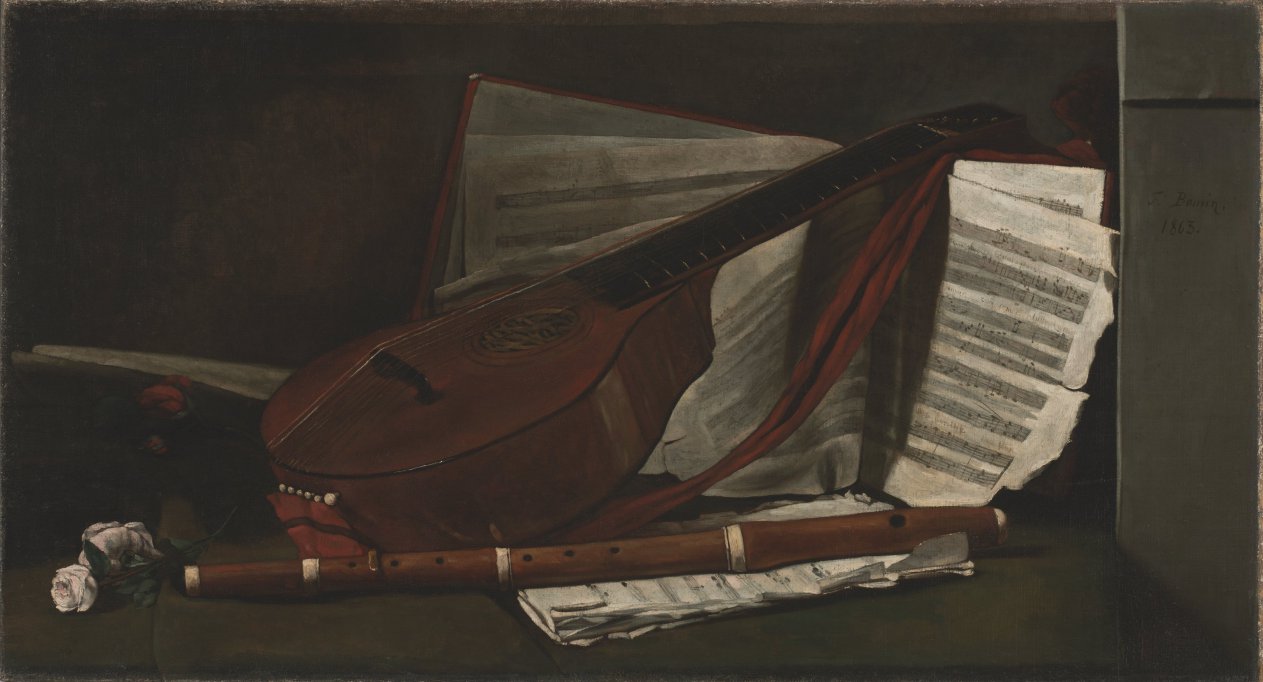
Bonvin was fascinated by the realism of 17th-century Dutch, Flemish, and Spanish still life paintings. He was also aware of the French Realist movement, a highly candid, straightforward style with political overtones. This work embodies both the realism for which Bonvin was famous and the still life paintings of earlier periods. The woman in the painting is Louison Köhler (1850–?), the artist's mistress. After two failed marriages, Bonvin met her in 1870, and she remained with him until his death, appearing in several of his paintings. The image of the reclining woman hanging directly over Louison's head probably suggests the carnal nature of their relationship. Bonvin borrowed this image—a swooning, overjoyed female—from the famous painting Bacchanal by Titian (1485–1576), now in the Prado Museum in Madrid.
Provenance
(Sale, Hôtel Drouot, December 19, 1973 (lot 213) (1973); Vachet collection, Paris (?); Robert Caby [1905-1992], Paris, sold to Noah L. and Muriel S. Butkin (After 1973); Noah L. [1918-1980] and Muriel S. Butkin [1915-1908], Cleveland, OH, given to the Cleveland Museum of Art (Until 1977); The Cleveland Museum of Art, Cleveland, OH (1977-)
Accession Number
1977.124
Medium
oil on fabric
Dimensions
Framed: 70.5 x 62.2 x 7.6 cm (27 3/4 x 24 1/2 x 3 in.); Unframed: 54.9 x 46 cm (21 5/8 x 18 1/8 in.)
Classification
Painting
Credit Line
Gift of Mr. and Mrs. Noah L. Butkin
Tags
Painting Impressionist & Modern (1851–1900) Oil Painting French Color: Red Color: Brown
Background & Context
Background Story
Young Woman with a Mandolin, Portrait of Louison Köhler (c. 1860-1870) combines portraiture with the musical-instrument tradition that connected Bonvin's Realism to the broader history of music painting. The mandolin, with its associations of folk music and popular entertainment, distinguishes this portrait from the more conventional keyboard-instrument subjects that dominated domestic music painting. The instrument's presence connects the sitter to a musical tradition that was less formal than the spinet or the piano, suggesting a more popular and accessible form of musical expression. Louison Köhler, the portrait's subject, holds the mandolin with the ease that suggests genuine familiarity—she is not merely posing with an instrument prop but is depicted as someone who actually plays. Bonvin's treatment of the portrait combines his Realist precision with the character insight that his best work achieved: the woman's expression, her posture, and her handling of the mandolin together create an impression of personality that goes beyond mere resemblance. The 1860-70 date places this during Bonvin's most productive period, when his portraits were receiving the recognition that his genre scenes had earlier achieved. The mandolin subject also reflects the 19th-century interest in folk instruments that was part of the broader Romantic movement—the mandolin, associated with Italian popular culture and with the folk traditions of Mediterranean Europe, carried associations that the piano did not.
Cultural Impact
Bonvin's musical portraits influenced how folk instruments were represented in 19th-century French art, connecting popular music traditions to the portrait tradition. The paintings influenced later Realist portraitists who similarly found significance in their sitters' musical activities. Young Woman with a Mandolin influenced how the connection between portraiture and music was represented, arguing that the instrument a person plays reveals character that appearance alone does not.
Why It Matters
This painting matters because it combines portraiture with the musical-instrument tradition in a way that reveals the sitter's character through her relationship with the mandolin—the folk instrument that suggests a more accessible and popular form of musical expression than the piano or spinet that domestic music painting traditionally featured.