Provenance
all according to Weisberg 1979, p. 277, cat. no. 275: M.A. Bellino (not stamped, not in Lugt); [his sale, Paris, Gallerie Georges Petit, 20 May 1892]. Georges Martin du Nord, Paris (not stamped, not in Lugt). [Shepherd Gallery, New York]
Accession Number
1978.128
Medium
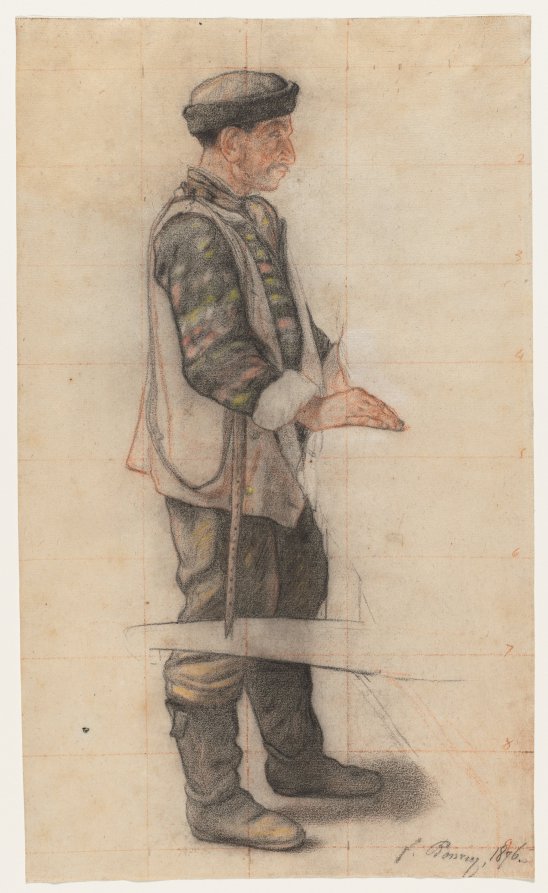
black chalk and brown crayon
Dimensions
Sheet: 42.1 x 31.1 cm (16 9/16 x 12 1/4 in.); Secondary Support: 41.1 x 31.1 cm (16 3/16 x 12 1/4 in.)
Classification
Drawing
Credit Line
Gift of Muriel S. Butkin
Tags
Drawing Impressionist & Modern (1851–1900) French Color: Orange Color: Brown
Background & Context
Background Story
Water Carrier Seated on His Yoke (c. 1860-1870) depicts one of the most characteristic working-class figures of 19th-century France—the water carrier who transported water from wells and fountains to households without their own water supply. The yoke—.wooden beam with buckets suspended from each end—was the water carrier's essential tool, and its weight and the physical effort it required made water carrying one of the most demanding forms of unskilled labor. Bonvin's treatment of the seated water carrier demonstrates his ability to find dignity in the most modest working subjects: the man, resting on his yoke, is rendered with the same attention that Academic tradition reserved for more prestigious subjects. The 1860-70 date places this during the period when Realist painting was challenging the Academic hierarchy that assigned different value to different subjects—the hierarchy that placed history painting above genre scenes and both above the depiction of working-class life. Bonvin's water carrier, seated on his yoke in a moment of rest, embodies the Realist argument that working-class subjects deserve the same artistic attention that mythology and history traditionally received. The man's physical fatigue, his simple clothing, and his yoke—the tool that defined his labor—are all rendered with the observational precision that gives the scene its documentary authenticity.
Cultural Impact
Bonvin's working-class genre paintings influenced how labor was represented in 19th-century French art, challenging the Academic hierarchy that devalued working subjects. The paintings influenced later Realist and Social Realist painters who similarly found dignity in manual labor. The Water Carrier influenced how the physical demands of unskilled labor were documented, connecting working-class experience to artistic significance.
Why It Matters
This painting matters because it embodies the Realist argument that working-class subjects deserve the same artistic attention that mythology and history traditionally received—the water carrier, seated on his yoke in a moment of rest, is rendered with the observational precision and the dignity that Academic painting reserved for more prestigious subjects, arguing that artistic significance lies in the quality of seeing rather than in the social status of what is seen.