Provenance
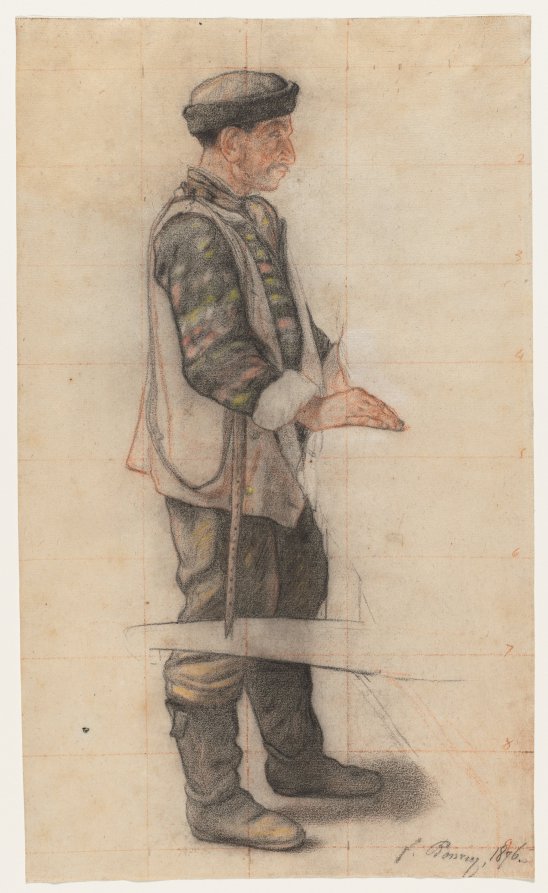
M. Marmontel ? (not stamped, not in Lugt) (according to departmental card). Mme. Paul Brodin, Paris (according to Weisberg 1979, p. 307, cat. no. 341). [Galerie Fischer-Kiener, Paris] (according to Weisberg 1979, p. 307, cat. no. 341)
Accession Number
1979.24
Medium
black, white, and red crayon
Dimensions
Sheet: 41.7 x 30.5 cm (16 7/16 x 12 in.)
Classification
Drawing
Credit Line
Donated by friends of Moselle Taylor Meals in her memory
Tags
Drawing Impressionist & Modern (1851–1900) French Color: Gray
Background & Context
Background Story
The Letter of Admission, Interior of a Convent (c. 1860-1870) depicts the moment when a woman receives or presents a letter of admission to a convent—one of the most significant transitions in 19th-century French religious life. Bonvin's treatment of the convent interior demonstrates his ability to render the specific atmosphere of enclosed religious spaces: the sparse furnishings, the quality of light filtered through windows, and the specific quiet that convents maintained. The letter of admission—the document that authorized a woman's entry into religious life—was the material instrument of a spiritual transformation, and Bonvin's painting connects the document to the space where the transformation would occur. The 1860-70 date places this during the period when religious communities were a significant presence in French society, and when the decision to enter a convent carried social and spiritual implications that Bonvin's Realist method rendered with his characteristic observational precision. The painting's interior—the convent's plain architecture, its limited furnishings, and the quality of northern light that characterized these spaces—creates an atmosphere of contemplative simplicity that distinguishes religious Realism from the more dramatic religious art of the Academic tradition.
Cultural Impact
Bonvin's convent paintings influenced how enclosed religious life was represented in Realist art, documenting the specific atmosphere of contemplative spaces. The paintings influenced later French artists who similarly found subjects in religious institutions. The Letter of Admission influenced how the material instruments of spiritual transitions were represented, connecting documents to the spaces where transformations occurred.
Why It Matters
This painting matters because it renders the convent interior with the observational precision that Realist painting brought to everyday experience—the letter of admission connects the material document to the spiritual transformation it authorizes, and the spare convent interior creates an atmosphere of contemplative simplicity that more dramatic religious art could not achieve.