Provenance
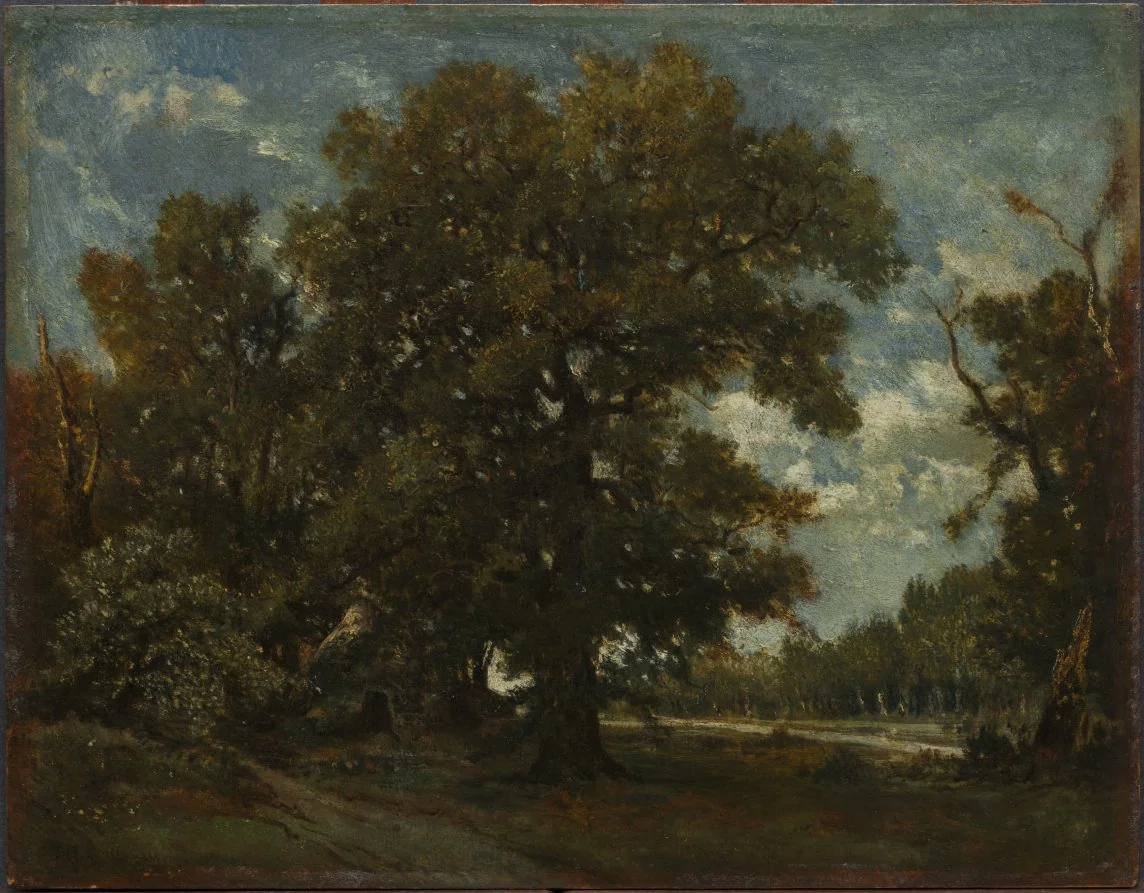
Charles Edwards. His sale, Paris, Drouot, 7 March 1870 (lot 33), "Sortie de forêt au coucher du soleil (site du Bas-Bréau), 1.07 x 1.30 m; 1851, Exposition Universelle 1855," illustrated catalogue, 104 (repr.), ff 17,900 (sold to Saulnier according to annotated copy in the Frick Art Reference Library, N.Y.; sold to Brame according to an annotated copy in the Bibliothèque Nationale, Paris). Ferdinand Barbedienne, Paris. Bought by Durand-Ruel & Cie (stock number 873), 12 March 1891, together with Corot's Cavaliers dans une allée, on behalf of James J. Hill, St. Paul. (Sent with the Corot to New York 18 March 1891.) Walter J. Hill, Livingston, Montana. Supposedly sold by Knoedler & Co., New York, in 1952 to a private collector in Beverly Hills, but the Knoedler stock book for 1952 does not list the painting. In the 1957 stock book, however, on 12 January, no. 5150, a Rousseau painting entitled "Wooded Landscape, 51œ x 43," was bought by Knoedler from Mrs. Charles McWilliams Jr. Sold to Richard L. Feigen for Edward D. Mittchell, Beverly Hills, on 16 January 1957. Sold by Richard L. Feigen & Co., on behalf of Mittchell, through Colnaghi, New York, to the CMA in 1983.
Accession Number
1983.70
Medium
oil on fabric
Dimensions
Framed: 143 x 165 x 13 cm (56 5/16 x 64 15/16 x 5 1/8 in.); Unframed: 109.1 x 130.2 cm (42 15/16 x 51 1/4 in.)
Classification
Painting
Credit Line
John L. Severance Fund
Tags
Painting Impressionist & Modern (1851–1900) Oil Painting French Color: Orange
Background & Context
Background Story
Leaving the Forest, Fontainebleau: Setting Sun, painted in 1851, captures the liminal moment when day transitions to evening in the forest that was Rousseau's home and principal subject. The title suggests a specific vantage point: the forest's edge, where the viewer stands about to leave the trees' shelter and enter the open country, looking back at the forest silhouetted against the setting sun. This boundary between forest and field, between cover and exposure, between the natural world and the cultivated landscape, was one Rousseau explored repeatedly—it defined the Barbizon School's geography and, metaphorically, its artistic position between tradition and modernity. The 1851 date is significant: this was the year Rousseau finally achieved some critical recognition after nearly two decades of Salon rejection. The painting's sunset—a conventional symbol of endings—may carry biographical resonance, but Rousseau's treatment transcends personal symbolism to address the universal experience of transition. His handling of the setting sun demonstrates the color sophistication of his mature work: the warm light of sunset is rendered not as generalized orange but as a complex interaction of gold, rose, and violet that responds to the specific atmospheric conditions of a summer evening in Fontainebleau.
Cultural Impact
This painting influenced how sunset and forest-edge subjects were treated in French landscape painting. The specific moment—leaving the forest as the sun sets—became a recurring motif in Barbizon-influenced art, appearing in works by Daubigny, Corot, and later in American Tonalist painting. The painting also influenced the broader cultural perception of Fontainebleau as an artistic landscape, contributing to the forest's identity as a site where French painting tradition and natural beauty intersect.
Why It Matters
Leaving the Forest matters because it captures the experience of transition—in landscape, in light, and implicitly in the history of French painting—that defined the Barbizon moment. Rousseau stands at the forest's edge, looking back at the trees that sustained his art, as the Impressionists were preparing to push beyond the Barbizon achievement into full modernity. The painting thus documents not just a sunset but a turning point in art history.