Description
Min Zhen, who was orphaned at age 12 and developed an eccentric personality, was trained by Tang Yin (1682–1756), a writer, playwright, and superintendent of the imperial porcelain workshops in Jingdezhen. The connection to him may have enabled Min to stay in Beijing for a decade from around 1773. It is not clear whether he ever resided in Yangzhou, but his style is in many instances reminiscent of that of Yangzhou artist Huang Shen.
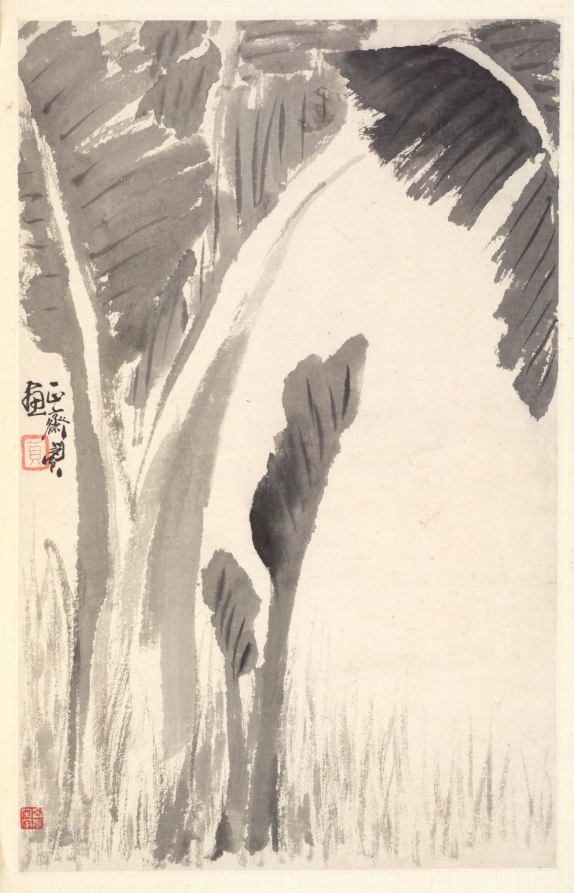
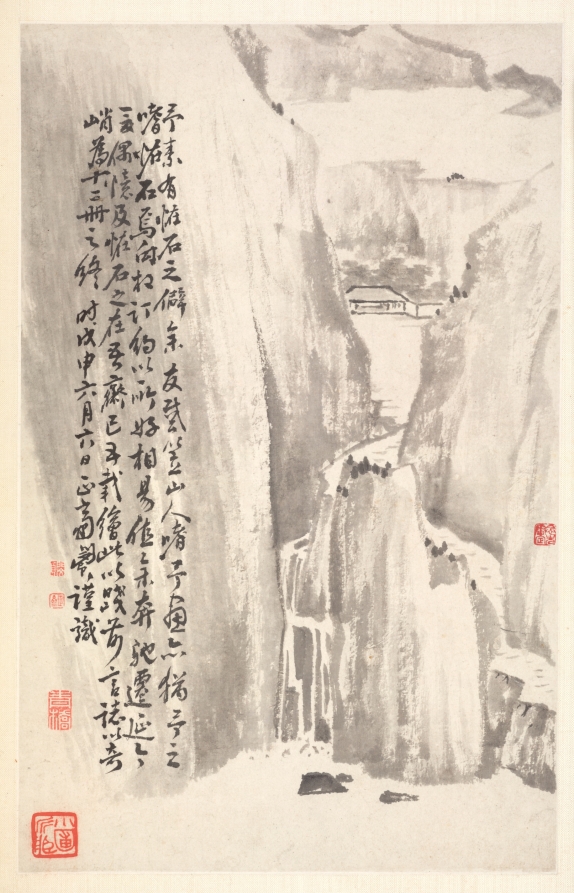
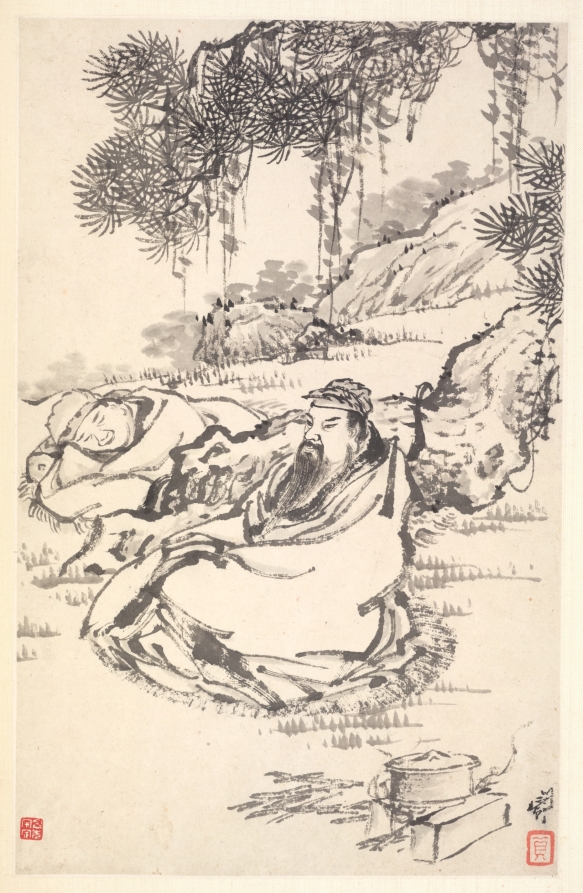
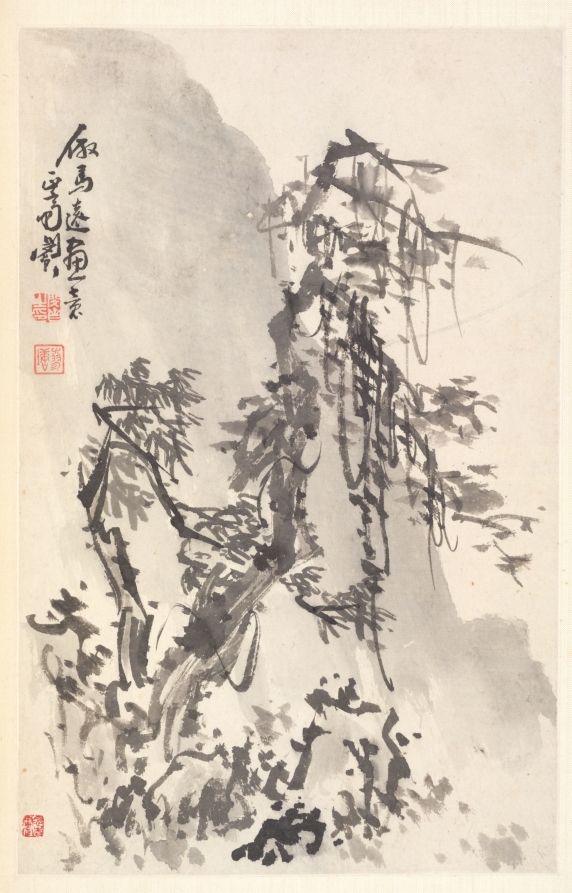
The album was painted for the artist's friend Dailili Shanren in exchange for a scholar’s stone. The paintings demonstrate Min Zhen’s versatility and mature style in the last years of his life. This leaf, Elephant, Horse, and Hare, seems to exhibit a contest, and may be associated with the recipient’s affinity to Buddhism (elephant), Confucianism (horse), and Daoism (hare).
The album was painted for the artist's friend Dailili Shanren in exchange for a scholar’s stone. The paintings demonstrate Min Zhen’s versatility and mature style in the last years of his life. This leaf, Elephant, Horse, and Hare, seems to exhibit a contest, and may be associated with the recipient’s affinity to Buddhism (elephant), Confucianism (horse), and Daoism (hare).
Provenance
Daili Shanren 戴笠山人 [active late 1700s] (1788–?); Ni Yun 倪耘 [d. 1864]; Yan Shiqing 顏世清 [1873–1929]; Xu Xiaopu 徐小圃 [1887–1961]; Ding Nianxian 丁念先 [1906–1969] (c. mid-1900s); (Eskenazi Ltd., London, England, sold to the Cleveland Museum of Art) (?–1985); The Cleveland Museum of Art, Cleveland, OH (1985–)
Accession Number
1985.71.1
Medium
album leaf, ink on paper
Dimensions
Overall single page: 36.8 x 22.1 cm (14 1/2 x 8 11/16 in.); Painting: 29 x 18.4 cm (11 7/16 x 7 1/4 in.)
Classification
Painting
Credit Line
John L. Severance Fund
Tags
Color: Gray
Background & Context
Background Story
This album leaf from Min Zhen's 1788 album depicts three animals—an elephant, a horse, and a hare—arranged in an unconventional composition that reveals the artist's wry humor and bold graphic sensibility. The elephant, rendered with commanding presence, dominates the left side of the composition through the sheer mass of its ink wash body. The horse, in contrast, is drawn with dynamic, calligraphic lines that convey nervous energy. The hare, smallest of the three, appears almost as an afterthought in the lower corner, yet its alert posture and oversized ears give it a surprising visual weight.
Min Zhen's treatment of animals has a folk-art freshness that distinguishes him from more polished court painters. The elephant's hide is rendered with patches of wash that suggest wrinkles and texture without naturalistic detail. The horse's mane and tail are slashed in with rapid, energetic strokes. This is not zoological illustration but the essence of animal character captured through the expressive possibilities of ink. The composition as a whole has an almost surreal quality—three animals of vastly different scales occupying the same pictorial space without narrative connection, united only by the artist's brush.
The grouping of elephant, horse, and hare might carry symbolic associations: the elephant representing strength and wisdom, the horse nobility and speed, the hare agility and fertility. But Min Zhen seems less interested in didactic symbolism than in the sheer pleasure of depicting living creatures at different scales and with different temperamental qualities. The leaf exemplifies the Chinese aesthetic ideal of "capturing the spirit" (chuan shen) through bold, abbreviated form rather than detailed naturalism.
Cultural Impact
Min Zhen's animal depictions connect Chinese ink painting to the broader tradition of "bird-and-flower" (huaniao) painting while injecting a fresh, almost cartoonish energy that anticipates modern Chinese graphic art. His unconventional groupings challenge the viewer's expectations of compositional decorum.
Why It Matters
This album leaf shows Min Zhen at his most playful and inventive. Three animals of vastly different sizes share a pictorial space with no regard for natural scale—a visual conceit that reveals the artist's freedom from convention and his delight in the pure expressivity of ink.