Description
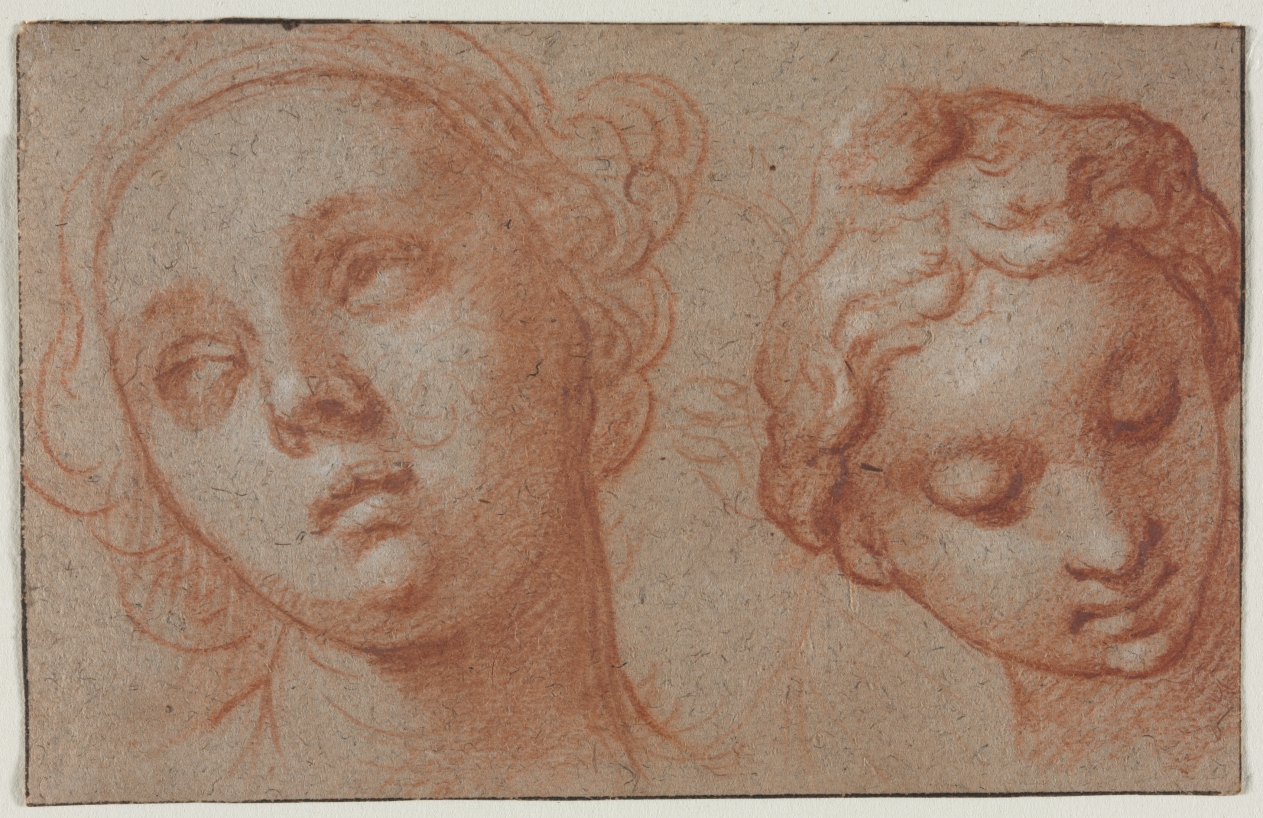
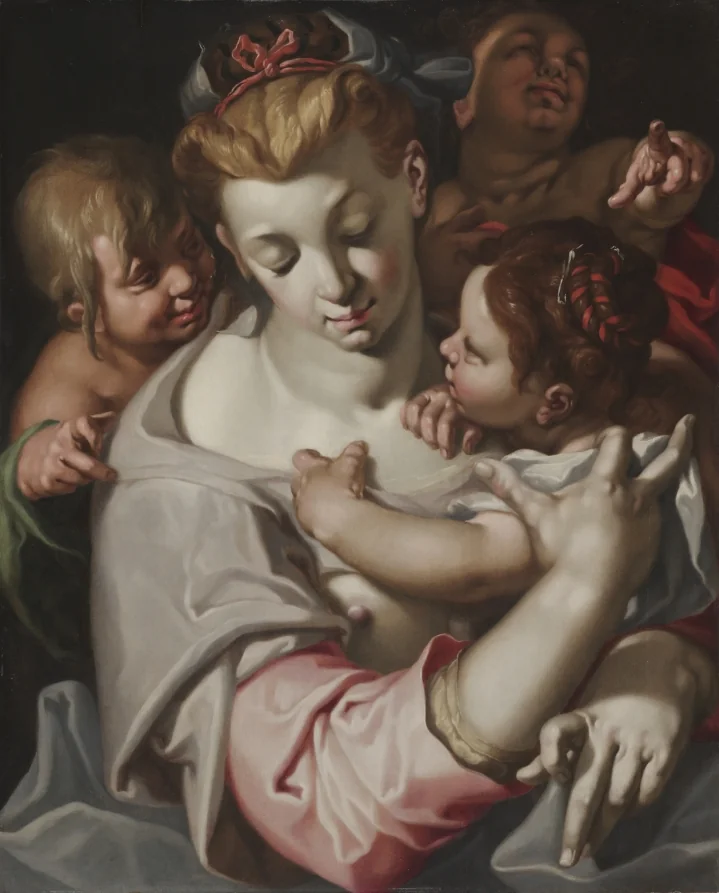
Abraham Bloemaert drew on traditional depictions of the Virgin and Child for this allegorical image of Charity: a woman surrounded by children, one an infant for whom she has bared her breast. Bloemaert was one of the leading proponents of the Mannerist style in the Northern Netherlands. Characteristics of that style include exaggerated figural proportions, contorted poses, heightened colors, densely packed compositions, and a deliberate eroticism—invoked here to emphasize the magnetic quality of Charity’s serene beauty.
Provenance
Private collection, Caracas, Venezuela (Probably until 1992); (Sotheby’s, New York, Jan. 17, 1992, no. 18 [as "attributed to Abraham Bloemaert"]; unsold) (1992); American private collection? (1992-1993?); (Sotheby’s, New York, private treaty sale, June 16, 1993, sold to Jack Kilgore) (1993); (Jack Kilgore & Co., Inc., New York, sold to the Cleveland Museum of Art) (1993-1994); The Cleveland Museum of Art, Cleveland, Ohio (1994-)
Accession Number
1994.10
Medium
oil on wood
Dimensions
Framed: 87 x 100 x 10.2 cm (34 1/4 x 39 3/8 x 4 in.); Unframed: 68.6 x 54.5 cm (27 x 21 7/16 in.)
Classification
Painting
Credit Line
Purchase from the J. H. Wade Fund
Tags
Painting Renaissance (1400–1599) Oil Painting Dutch Color: Brown
Background & Context
Background Story
Charity, painted around 1590 when Bloemaert was in his mid-twenties, is an early work that shows the influence of Mannerism on his artistic formation. The allegorical figure of Charity — one of the three theological virtues — is depicted in the elongated proportions and complex pose typical of late Mannerist figure painting. The wood panel support and the rich, jewel-like colors reflect Bloemaert's training in the workshop tradition, where painting on wood panel was still common and the Mannerist style was still dominant. The subject of Charity allowed Bloemaert to combine figure painting with allegorical meaning in a format that was both commercially viable and artistically ambitious.
Cultural Impact
The allegorical representation of Charity as a female figure with children was one of the most standard subjects in European painting, but Bloemaert's treatment reflects the particular conditions of Dutch art at the turn of the 17th century: a Catholic subject painted in a Protestant country, a Mannerist style at the moment when naturalism was beginning to emerge, and an allegorical tradition at the moment when genre painting was about to transform Dutch art.
Why It Matters
Charity is Bloemaert at the crossroads of Mannerism and naturalism: an allegorical figure painted with the elongated proportions and rich colors of the 16th century, but with a humanity and physical presence that points toward the 17th. The theological virtue is embodied in a real woman with real children — allegory becoming life.