Description
This album of landscape paintings depicts the famous scenic areas located in and around the city of Wuxing in southeastern China. These places were all known for their natural beauty, but in addition, a number were distinguished by their links to eminent historical figures and events. The artist, Song Xu, was not a native of Wuxing, but must have visited it when he accepted the commission, for he carefully depicted all eighteen views and wrote comments on each of them.
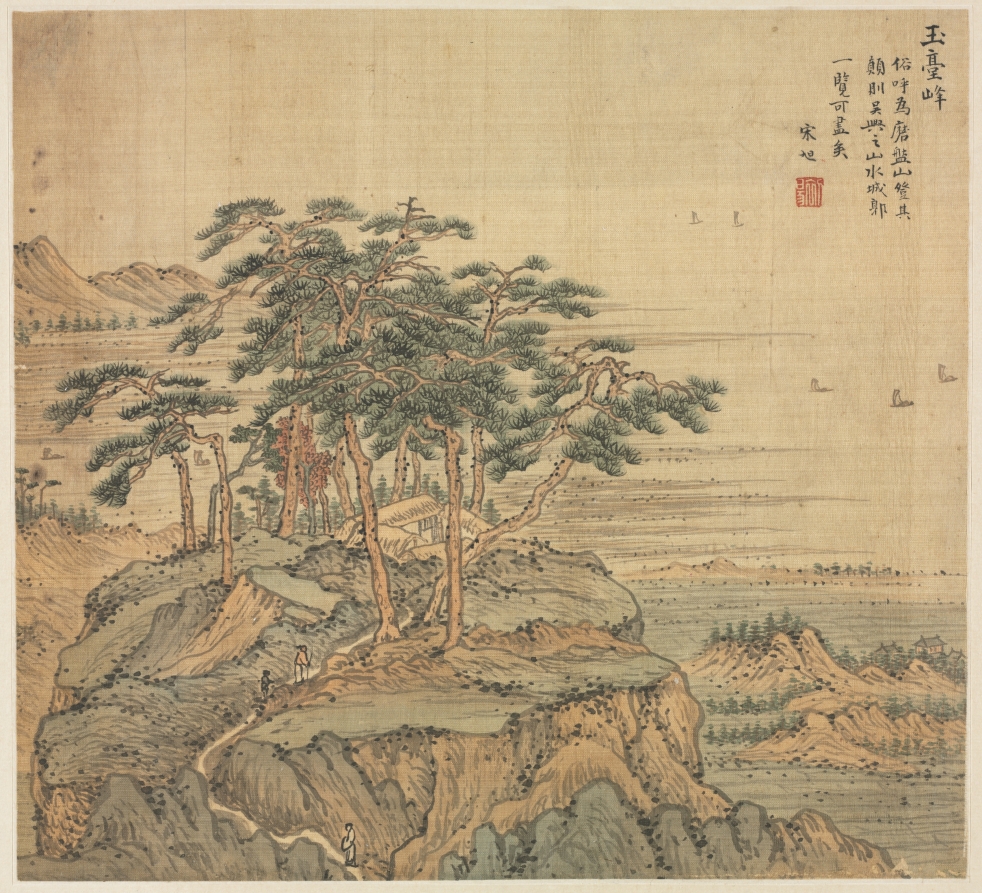
Song's gazetteerlike notation on this leaf reads:
Mount Daochang: From the prefectural city toward the south, about 5 to 6 li, there is the spiritual abode of Chan Master Fuhu [master who tamed tigers, or Zhifeng 志逢, 909–985]. On top [of the hill] are the Fuhu and Wanghu Pavilions. Looking farther south, one can see the mountains of Hangzhou. Looking toward the north, one can see all the way to Lake Tai and its hilly islands. Looking down, the city walls below with its towers and terraces are as splendid as in a painting.
Song's gazetteerlike notation on this leaf reads:
Mount Daochang: From the prefectural city toward the south, about 5 to 6 li, there is the spiritual abode of Chan Master Fuhu [master who tamed tigers, or Zhifeng 志逢, 909–985]. On top [of the hill] are the Fuhu and Wanghu Pavilions. Looking farther south, one can see the mountains of Hangzhou. Looking toward the north, one can see all the way to Lake Tai and its hilly islands. Looking down, the city walls below with its towers and terraces are as splendid as in a painting.
Provenance
(Kaikodo America Inc., New York, NY, sold to the Cleveland Museum of Art) (?–1998); The Cleveland Museum of Art, Cleveland, OH (1998–)
Accession Number
1998.78.13
Medium
Album leaf; ink and color on silk
Dimensions
Sheet: 26.4 x 28.4 cm (10 3/8 x 11 3/16 in.)
Classification
Painting
Credit Line
The Severance and Greta Millikin Purchase Fund
Tags
Painting Renaissance (1400–1599) Ink Silk Painting Chinese Color: White Color: Gray
Background & Context
Background Story
Mt. Daochang's name associates it with the Daoist tradition of spiritual practice (dao meaning 'way' or 'path'), and Song Xu's album leaf presents it as a mountain of distinctive character — its own profile, vegetation, and atmospheric effects. The artist's approach to specific mountains within the album format requires a balance between topographic accuracy (so that the peak is recognizable) and artistic interpretation (so that the composition functions as a painting, not merely a map). Song Xu achieves this balance through selective emphasis: key features are rendered in detail while secondary elements are suggested with loose brushwork.
Cultural Impact
Mt. Daochang belongs to a long tradition of Chinese mountain painting in which each peak has its own personality, history, and spiritual associations. By the late Ming, this tradition had become a sophisticated visual language in which knowledgeable viewers could identify mountains by their silhouettes, vegetation, and associated architecture — a kind of landscape literacy that Song Xu's album both assumes and reinforces.
Why It Matters
Mt. Daochang is a specific mountain made universal by the conventions of Chinese landscape painting. Song Xu's brushwork translates granite and vegetation into ink and color while preserving the peak's individual character — the essence of what makes each mountain itself.