Description
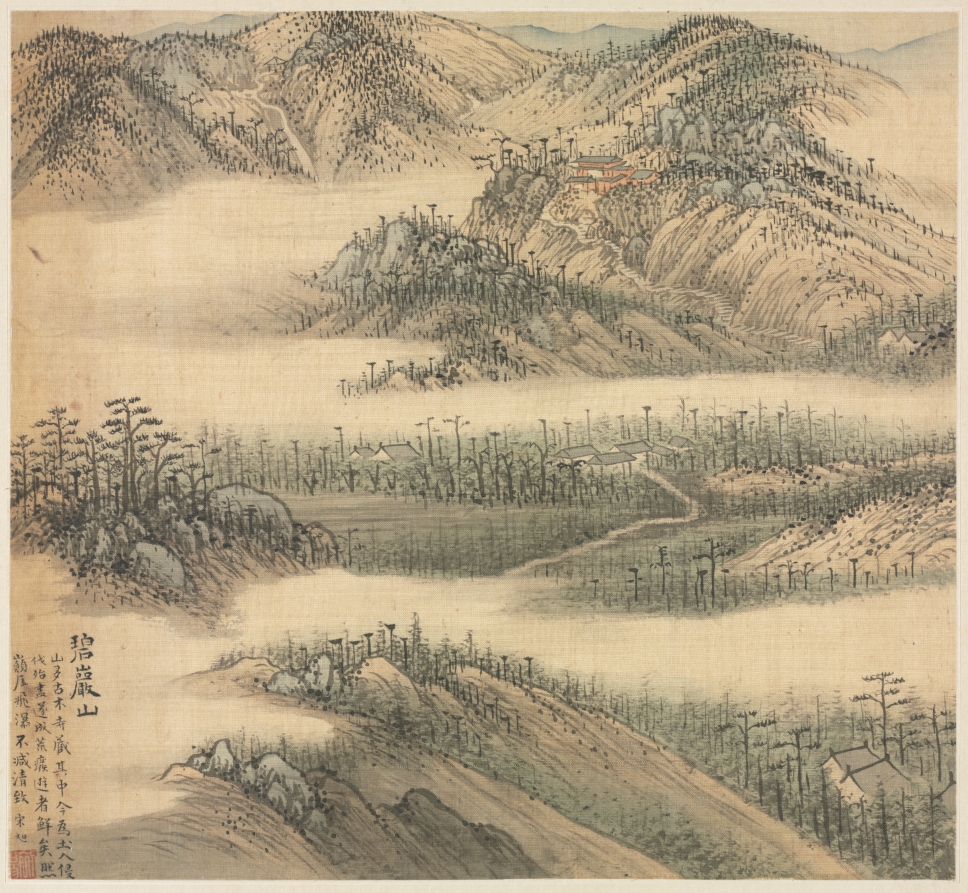
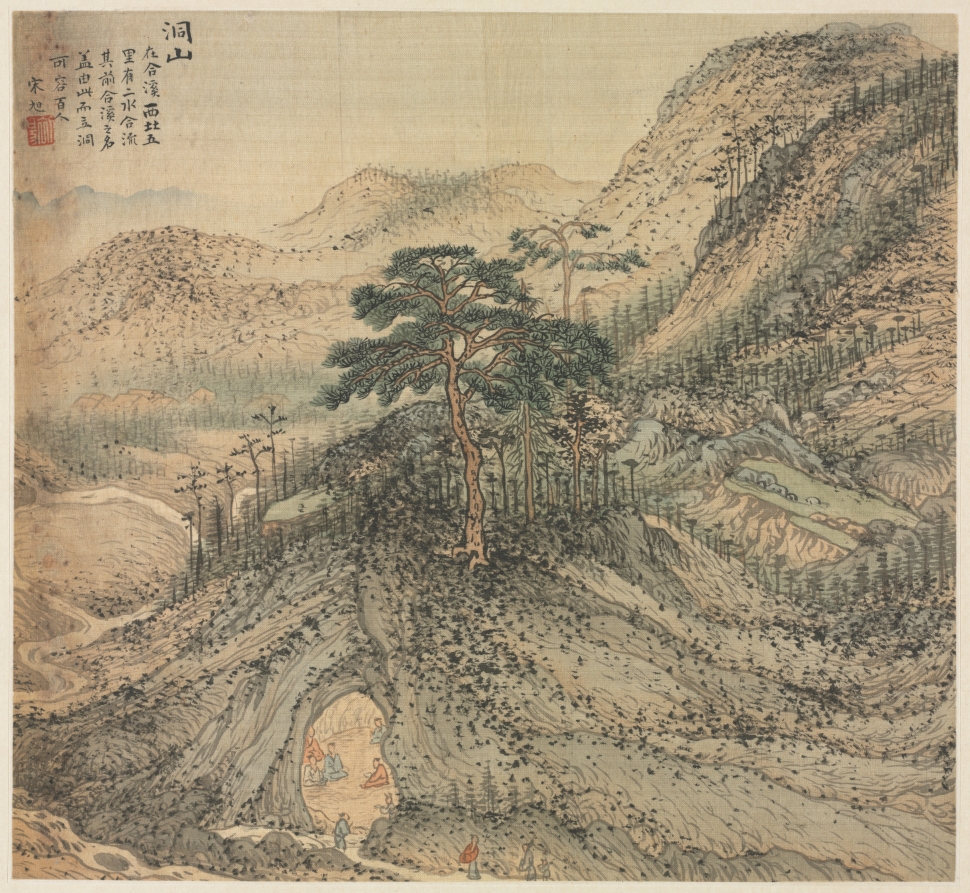
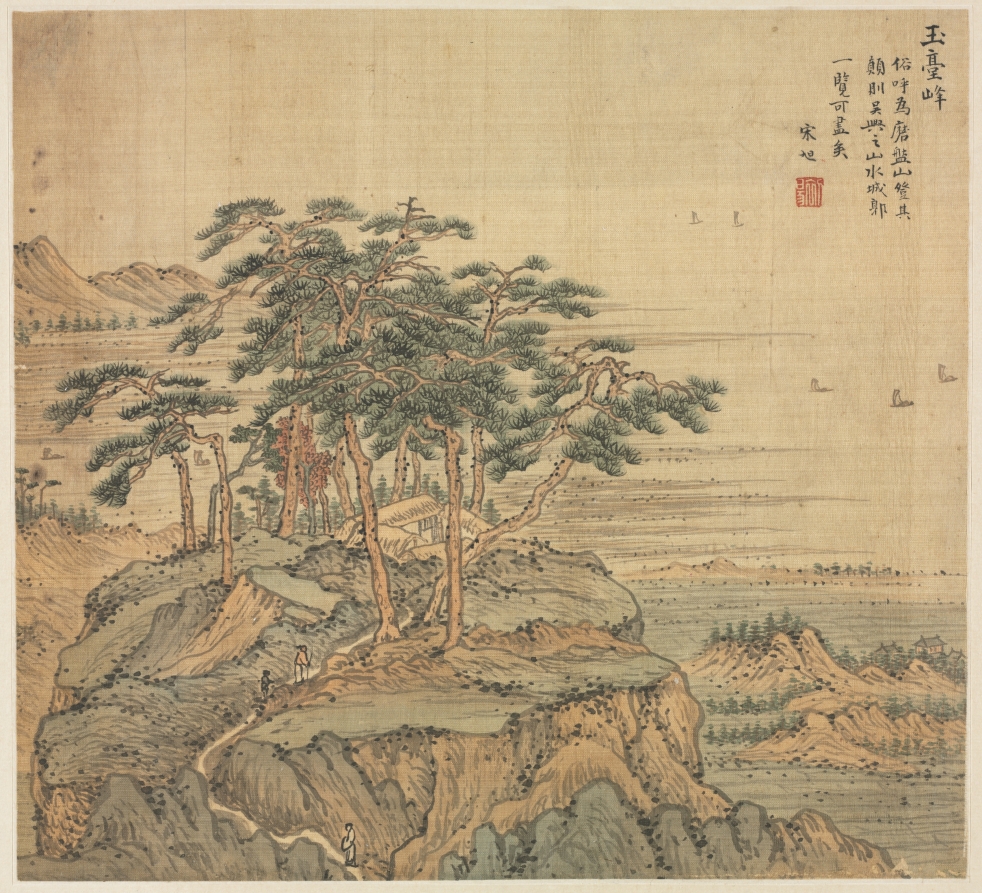
This album of landscape paintings depicts the famous scenic areas located in and around the city of Wuxing in southeastern China. These places were all known for their natural beauty, but in addition, a number were distinguished by their links to eminent historical figures and events. The artist, Song Xu, was not a native of Wuxing, but must have visited it when he accepted the commission, for he carefully depicted all eighteen views and wrote comments on each of them.
Song's gazetteer-like notation on this leaf reads:
Baoyang Lake: Several li (Chinese mile) from here to the east, one can exit through Lake Tai, which is quite near. Just a few li to the north is the township of Xiangshan. Having arrived there, one may want to cross over the border to the city of Yixing.
Song's gazetteer-like notation on this leaf reads:
Baoyang Lake: Several li (Chinese mile) from here to the east, one can exit through Lake Tai, which is quite near. Just a few li to the north is the township of Xiangshan. Having arrived there, one may want to cross over the border to the city of Yixing.
Provenance
(Kaikodo America Inc., New York, NY, sold to the Cleveland Museum of Art) (?–1998); The Cleveland Museum of Art, Cleveland, OH (1998–)
Accession Number
1998.78.14
Medium
Album leaf; ink and color on silk
Dimensions
Sheet: 26.4 x 28.4 cm (10 3/8 x 11 3/16 in.)
Classification
Painting
Credit Line
The Severance and Greta Millikin Purchase Fund
Tags
Painting Renaissance (1400–1599) Ink Silk Painting Chinese Color: Yellow Color: Gray
Background & Context
Background Story
Baoyang Lake provides a striking contrast to the mountain peaks in Song Xu's album, offering a horizontal composition of water and sky where the other leaves present vertical compositions of rock and cloud. The lake surface, reflecting the sky and surrounding landscape, allows Song Xu to demonstrate his mastery of a different set of painting techniques: horizontal brushstrokes for the water's surface, graduated washes for the sky's reflection, and precise detail for the boats and buildings along the shoreline. The composition is a masterclass in the Chinese principle of leaving space (liubai) — the large areas of unpainted silk function as both water and sky.
Cultural Impact
Water subjects in Chinese painting albums provide essential contrast to the mountain-dominated leaves. In the Chinese five-element system, water and mountain are complementary opposites (yin-shan yang-shui), and the inclusion of a lake in a mountain album creates a balance that mirrors the natural world's own harmony. Baoyang Lake is the still center of an album that is otherwise defined by vertical aspiration.
Why It Matters
Baoyang Lake is Song Xu's study in horizontality: water rather than rock, reflection rather than ascent. In an album of peaks, the lake provides the necessary stillness that makes the peaks feel high.