Description
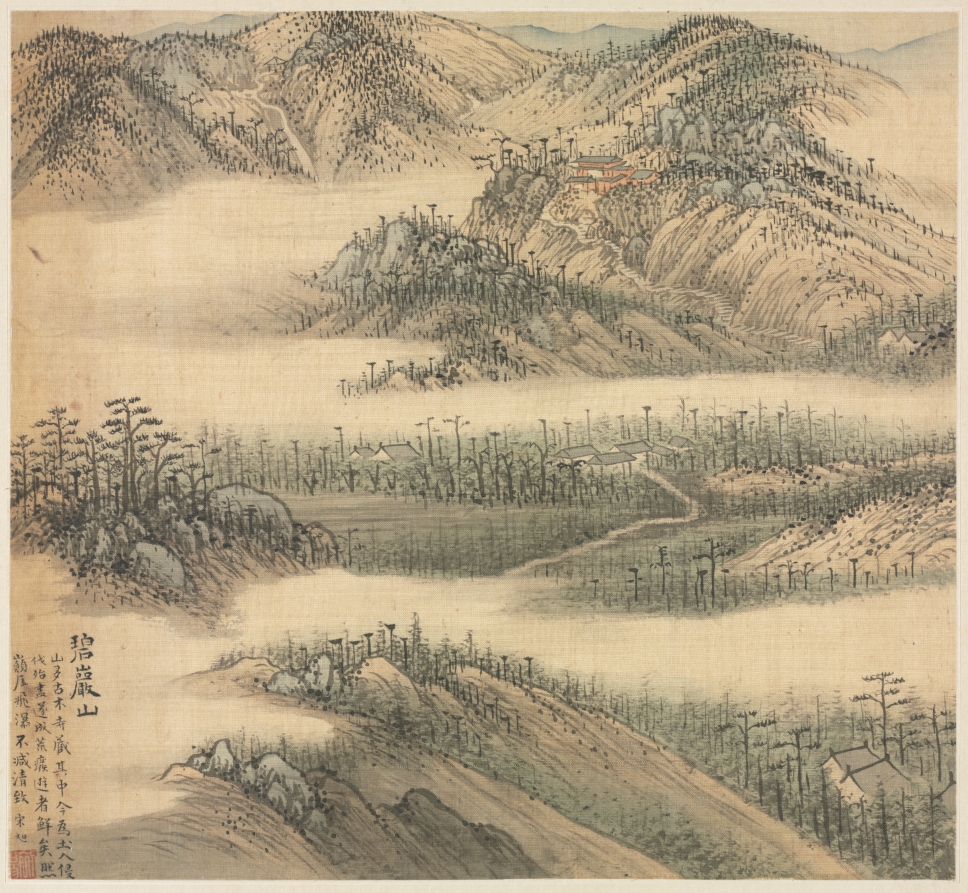
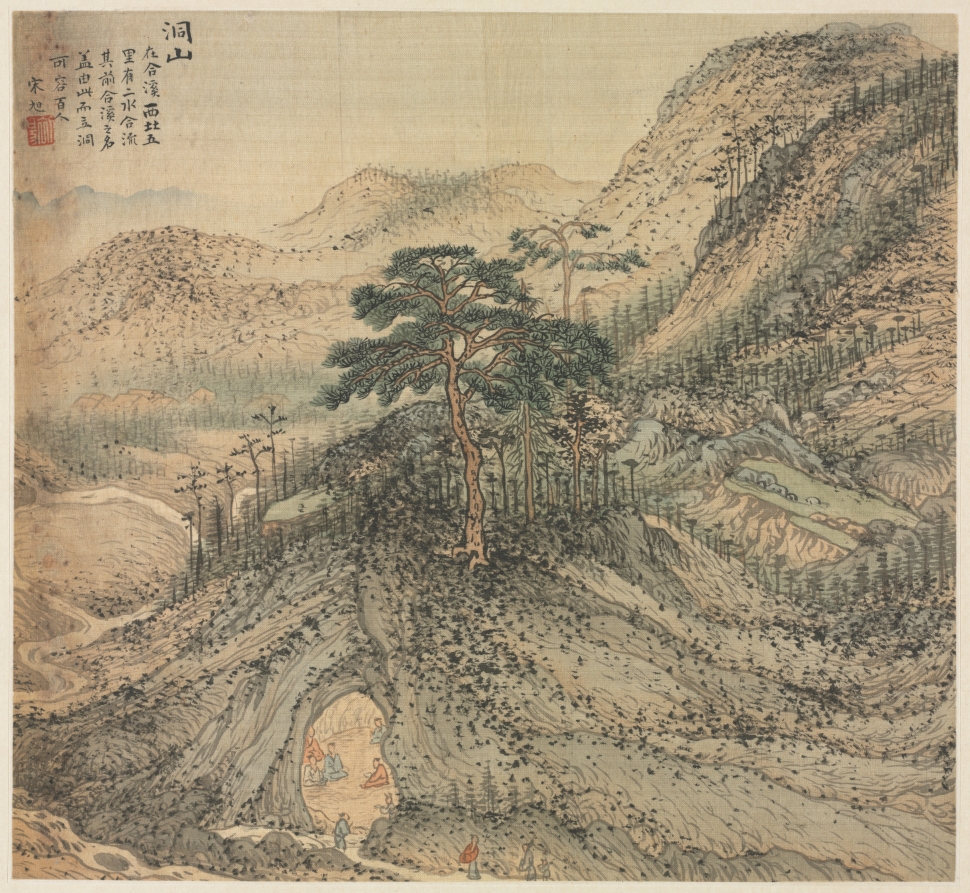
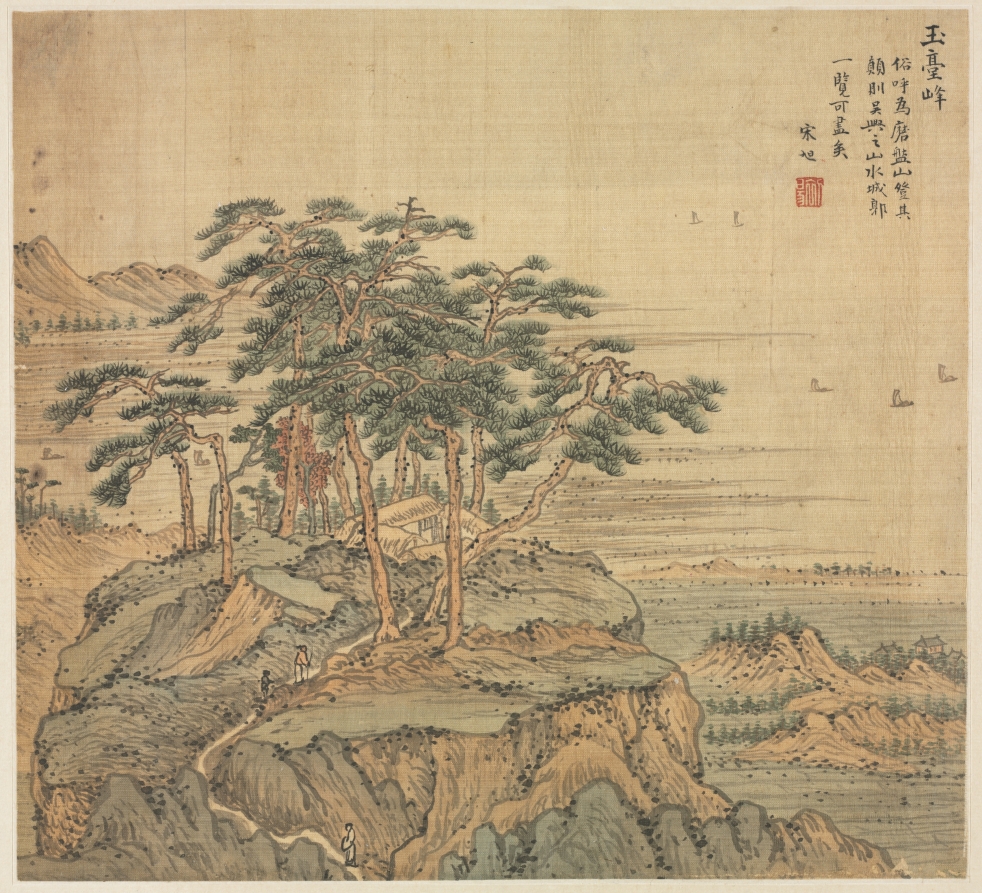
This album of landscape paintings depicts the famous scenic areas located in and around the city of Wuxing in southeastern China. These places were all known for their natural beauty, but in addition, a number were distinguished by their links to eminent historical figures and events. The artist, Song Xu, was not a native of Wuxing, but must have visited it when he accepted the commission, for he carefully depicted all eighteen views and wrote comments on each of them.
Song's gazetteer-like notation on this leaf reads:
Lüshan hui [Mount Lü corridor]: Its name stems from Lü Meng (178–219 CE), who camped here. It is a place in the Bian Mountain range. To get to the capital of (Wuxing) prefecture, one must follow through there.
Song's gazetteer-like notation on this leaf reads:
Lüshan hui [Mount Lü corridor]: Its name stems from Lü Meng (178–219 CE), who camped here. It is a place in the Bian Mountain range. To get to the capital of (Wuxing) prefecture, one must follow through there.
Provenance
(Kaikodo America Inc., New York, NY, sold to the Cleveland Museum of Art) (?–1998); The Cleveland Museum of Art, Cleveland, OH (1998–)
Accession Number
1998.78.15
Medium
Album leaf; ink and color on silk
Dimensions
Sheet: 26.4 x 28.4 cm (10 3/8 x 11 3/16 in.)
Classification
Painting
Credit Line
The Severance and Greta Millikin Purchase Fund
Tags
Painting Renaissance (1400–1599) Ink Silk Painting Chinese Color: Yellow Color: Gray
Background & Context
Background Story
Lushan (Mount Lu) is one of China's most famous sacred mountains, celebrated in poetry and painting since the Jin dynasty. Song Xu's depiction of a view from or near Lushan connects his geographic album to one of the central sites in Chinese cultural geography. Mount Lu's association with the poet Tao Yuanming (whose 'Peach Blossom Spring' was nearby), the Buddhist teacher Huiyuan (who founded the Pure Land school there), and the Song dynasty philosopher Zhu Xi (who made it a center of Neo-Confucian learning) makes it a convergence point of Daoist, Buddhist, and Confucian traditions.
Cultural Impact
Painting Lushan in an album of sacred and scenic sites was a declaration of cultural knowledge. Any educated viewer in late Ming China would recognize the mountain and its associations, and Song Xu's depiction would be evaluated not just as a landscape but as a contribution to the centuries-long tradition of Lushan painting. The mountain's layered peaks, waterfalls, and misty valleys had been painted by countless artists before Song Xu, and his version had to be both recognizable as Lushan and distinctive as his own.
Why It Matters
Lushan Hui is Song Xu paying homage to one of the most painted mountains in Chinese history. His version joins a conversation that includes Tao Yuanming, Li Bai, Su Shi, and countless others — proof that some mountains belong to the entire culture, not just to one artist.