Provenance
Eugène Deudon [1841-1916]; sold 8 March 1899 to Paul Durand-Ruel [1831-1922], Paris;[1] sold by 1921 to Stern, Asea Vestar, Sweden; Mme. Nordeen, Stockholm; (Hirschl and Adler Galleries, New York); sold 1966 to Mr. Paul Mellon, Upperville, VA; gift 1983 to NGA.
[1] Early provenance according to Anne Distel, "Charles Deudon (1832-1914): collectionneur." _La Revue de l'Art_ no. 86, 1989, p. 65.
Accession Number
1983.1.26
Medium
oil on canvas
Dimensions
overall: 50.2 x 65.4 cm (19 3/4 x 25 3/4 in.) | framed: 76.4 x 93.4 x 7.6 cm (30 1/16 x 36 3/4 x 3 in.)
Classification
Painting
Credit Line
Collection of Mr. and Mrs. Paul Mellon
Tags
Painting Impressionist & Modern (1851–1900) Oil Painting Canvas French Color: Orange Color: Brown
Background & Context
Background Story
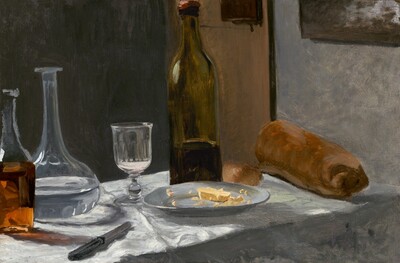
Interior, after Dinner (1868/1869) is an early work depicting a domestic interior—a subject rare in Monet's mature output but significant for understanding his artistic development. The painting shows the aftermath of a meal: empty chairs, used plates, the quality of lamplight in a room where social gathering has just ended. This subject connects Monet to the Dutch interior tradition and to the contemporary French tradition of domestic genre painting that included painters like Bonnat and Fantin-Latour. The 1868-69 date places this during Monet's formative period—before the first Impressionist exhibition of 1874—when he was exploring various subjects and styles while developing the personal approach that would define his mature work. The painting's interior setting—rare for the painter who would become famous for outdoor scenes—reveals Monet's understanding that light creates space and mood in interior as effectively as in exterior. The lamplight's warm glow, the shadows it casts, and the atmosphere of post-meal quiet all demonstrate Monet's sensitivity to light's emotional quality—a sensitivity he would later apply to outdoor effects. The painting also documents bourgeois domestic life in 1860s France—the material culture, the social rituals, and the intimate spaces of middle-class existence.
Cultural Impact
Monet's early interior paintings influenced how Impressionism's development was understood, revealing that the movement's signature outdoor subjects emerged from earlier engagement with interior light effects. The paintings influenced later French Intimist painters like Vuillard and Bonnard who similarly found beauty in domestic interior light. The after-dinner subject influenced how French bourgeois domesticity was represented in art.
Why It Matters
This painting matters because it reveals how Monet's signature outdoor Impressionism developed from earlier interior subjects—the attention to light, atmosphere, and mood that defines his mature work was already present in this early domestic scene. For art historians, the painting provides crucial evidence of continuity between Monet's early and late work.