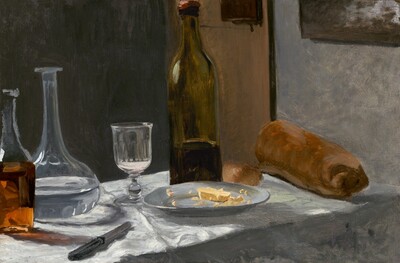
Provenance
Purchased from the artist December 1920 by (Durand-Ruel, Paris) and (Bernheim-Jeune, Paris); (Durand-Ruel, New York) by 1922 until at least 1926.[1] (Sam Salz, Inc., New York); sold 2 November 1960 to Mr. and Mrs. Paul Mellon, Upperville, Virginia; gift 1983 to NGA.
[1]See Wildenstein, Daniel, _Monet: Catalogue Raisonné_, 1996, vol. III: no. 1564 and also Paul Hayes Tucker, _Monet in the Twentieth Century_, exh. cat., Royal Academy of Arts, London, and Museum of Fine Arts, Boston, 1998, no. 15 and p. 130, regarding the early history of this painting. Lent by Durand-Ruel, New York, to a 1926 exhibition in Toronto.
Accession Number
1983.1.27
Medium
oil on canvas
Dimensions
overall: 65.7 × 101.6 cm (25 7/8 × 40 in.) | framed: 84.46 × 120.02 × 9.53 cm (33 1/4 × 47 1/4 × 3 3/4 in.)
Classification
Painting
Credit Line
Collection of Mr. and Mrs. Paul Mellon
Tags
Painting Early Modern (1901–1950) Oil Painting Canvas French
Background & Context
Background Story
Waterloo Bridge, London, at Dusk, painted in 1904, belongs to Monet London Series - the extraordinary group of nearly 100 canvases he produced during three visits to the British capital between 1899 and 1901. The painting captures the bridge and the distant Houses of Parliament dissolved in the fog and atmospheric haze that Monet called the most extraordinary sight in the world.
Monet painted the London Series from rooms at the Savoy Hotel, looking across the Thames toward Waterloo Bridge and the Houses of Parliament. Working on multiple canvases simultaneously, he captured the same views under different conditions of fog, light, and atmosphere, producing the most radical application of his serial method since the Haystacks and Cathedral.
The painting most advanced feature is its virtually complete dissolution of architectural form. Where earlier Impressionist paintings had dissolved edges while preserving recognizable shapes, Monet London canvases reduce bridges and buildings to ghostly presences, barely distinguishable from the fog that surrounds them. The result is a painting that hovers on the edge of abstraction - a composition of colored atmosphere in which the motif is present but barely visible.
The London Series represented Monet most sustained engagement with the urban environment and demonstrated that his serial method could address the most complex visual phenomena: the fog of London, which Monet painted as a luminous, colored substance rather than a mere absence of visibility. His fog is not grey but purple, pink, and orange - colored by the reflected light of the city and transformed by his brush into the most beautiful paintings of atmospheric obscurity in the history of art.
Cultural Impact
Monet London Series established the most radical phase of his serial method and influenced the development of abstract painting, particularly the atmospheric abstractions of Whistler and the color-field paintings of Rothko. His demonstration that the most obscured motif could produce the most beautiful painting expanded the range of Impressionism beyond the clear light of the French countryside.
Why It Matters
Waterloo Bridge at Dusk captures Monet most transcendent vision: a city dissolved in its own atmosphere, its architecture reduced to ghostly outlines in a haze of purple and gold. The painting is about seeing through fog - and about the discovery that the act of seeing through fog is more beautiful than the act of seeing clearly.