Description
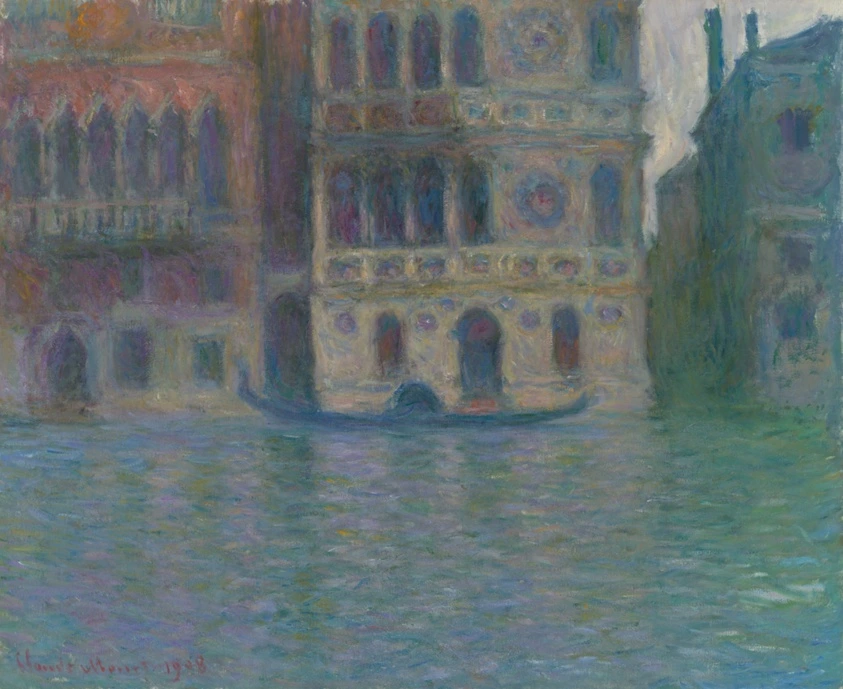
Claude Monet was reluctant to visit and paint Venice due to the proliferation of images of the city on the art market. When he was finally persuaded to travel there in 1908, however, he found himself inspired by the colors and atmosphere. Although he still worried about producing only trite “souvenir” images of the city, his handling of paint and color here shows his unique perspective on the well-known Palazzo Dario: he depicted the square’s sturdy marble buildings in the same way as the water, subtly dissolving the forms as if they are floating in the Venetian haze.
Provenance
The artist (d. 1926); sold in half-shares, to Bernheim-Jeune, Paris, and Durand-Ruel, Paris, Apr. 10, 1912, for 10,000 francs [per Durand-Ruel, Paris, stock book for 1901–13 (no. 10000, as Palais Dario), as confirmed by Paul-Louis Durand-Ruel and Flavie Durand-Ruel, Durand-Ruel Archives, to the Art Institute of Chicago, Feb. 21, 2013, curatorial object file]; sold to Durand-Ruel, New York, Oct. 11, 1912, or Oct. 17, 1912 [The Paris and New York Durand-Ruel stock books record different dates for the sale. The Paris stock book states: “Sold to DR New York on 11 October 1911.” The New York stock book for 1904–24 states: “Purchased by DR New York on 17 October 1912 as Venise, Palais Dario, 1908 / Stock DR New York no. 3542,” as confirmed by Paul-Louis Durand-Ruel and Flavie Durand-Ruel, Durand-Ruel Archives, to the Art Institute of Chicago, Feb. 21, 2013, curatorial object file]; sold to Arthur B. Emmons, Newport, Rhode Island, Dec. 26, 1912, for $7,500 [per Durand-Ruel, New York, stock book for 1904–24 (no. 3542, as Venise, Palais Dario, 1908), as confirmed by Paul-Louis Durand-Ruel and Flavie Durand-Ruel, Durand-Ruel Archives, to the Art Institute of Chicago, Feb. 21, 2013, curatorial object file]; sold back to Durand-Ruel, New York, May 27, 1913, for 37,600 francs [this and the following per Durand-Ruel, New York, stock book for 1904–24 (no. 3647, as Venise, Palais Dario, 1908), as confirmed by Paul-Louis Durand-Ruel and Flavie Durand-Ruel, Durand-Ruel Archives, to the Art Institute of Chicago, Feb. 21, 2013, curatorial object file]; sold back to Arthur B. Emmons, Newport, Rhode Island, May 27, 1913, for $6,500; sold at the Arthur B. Emmons, Newport, Rhode Island, sale, American Art Association, New York, Jan. 14, 1920, lot 42, to Durand-Ruel, New York, and Knoedler, New York, in half-shares, for $5,800 [per Durand-Ruel Archives and the Durand-Ruel, New York, stock book 1904–1924, as confirmed by Paul-Louis Durand-Ruel and Flavie Durand-Ruel, Durand-Ruel Archives, to the Art Institute of Chicago, Feb. 21, 2013, curatorial object file]; sold to Annie Swan Coburn (d. 1932), Chicago, Feb. 8, 1923, for $9,735 + tax [per Durand-Ruel, New York, stock book for 1904–24 (no. 4408, as Venise, Palais Dario, 1908), as confirmed by Paul-Louis Durand-Ruel and Flavie Durand-Ruel, Durand-Ruel Archives, to the Art Institute of Chicago, Feb. 21, 2013, curatorial object file]; bequeathed to the Art Institute of Chicago, 1933.
Accession Number
14630
Medium
Oil on canvas
Dimensions
66.2 × 81.8 cm (26 1/16 × 32 3/16 in.); Framed: 79.7 × 94 × 6.1 cm (31 3/8 × 37 × 2 3/8 in.)
Classification
Painting
Credit Line
Mr. and Mrs. Lewis Larned Coburn Memorial Collection
Tags
Painting Early Modern (1901–1950) Oil Painting Canvas
Background & Context
Background Story
Venice, Palazzo Dario (1908) belongs to Monet's Venetian series—paintings created during his only visit to Venice in 1908, when he was nearly seventy years old. The Palazzo Dario, a 15th-century palace on the Grand Canal known for its distinctive marble façade and its characteristic tilt, provided Monet with an architectural subject that combined Venice's unique light conditions with a building of particular visual character. Venice's light—reflected from water at every angle, filtered through the city's characteristic haze, and intensified by the surrounding lagoon's brightness—challenged Monet to adapt his method to conditions very different from those at Giverny. The 1908 visit was initially conceived as a vacation, but Monet's competitive drive transformed it into a major painting campaign. He worked on multiple canvases simultaneously, capturing the same subjects under different atmospheric conditions—his serial method applied to Venice's unique visual circumstances. The Palazzo Dario, with its patterned façade reflected in the Grand Canal, provided a subject where architecture and water merged into a unified visual field. Monet's treatment dissolves the building's sharp edges into reflections that double its visual presence, creating an image where the boundary between solid and liquid becomes uncertain.
Cultural Impact
Monet's Venice series influenced how the city was represented in modern art, offering an Impressionist alternative to the more topographical treatments that dominated Venetian painting. The paintings influenced later artists who visited Venice, from John Singer Sargent to J.M.W. Turner, by demonstrating that the city's unique light could be captured through atmospheric rather than architectural emphasis. The Palazzo Dario subject specifically influenced how Venetian Gothic architecture was understood, connecting its visual character to water reflection.
Why It Matters
This painting matters because it represents the late Monet—a masterful artist working at the peak of his powers in a legendary setting. The Venice paintings condense decades of atmospheric observation into images of extraordinary beauty, demonstrating that the Impressionist method could serve any subject, any city, and any light condition, while producing works specific to each place and moment.