Water Lilies

Description

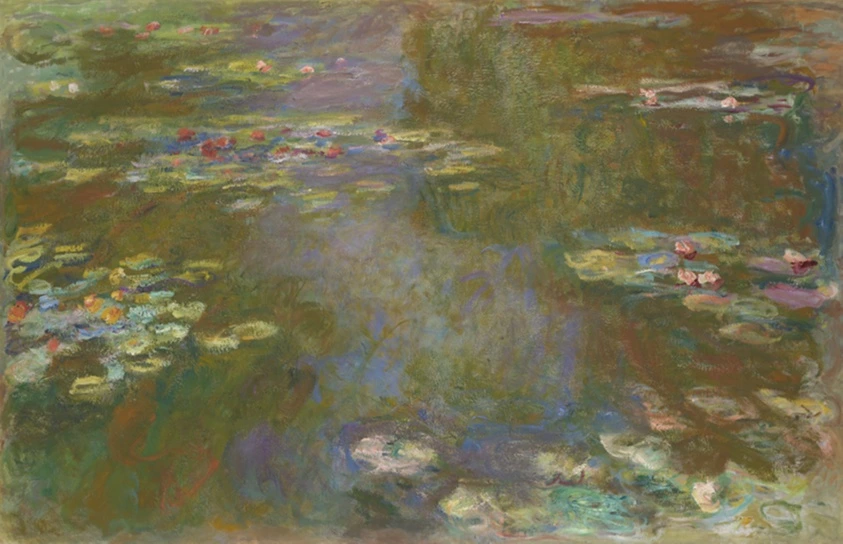
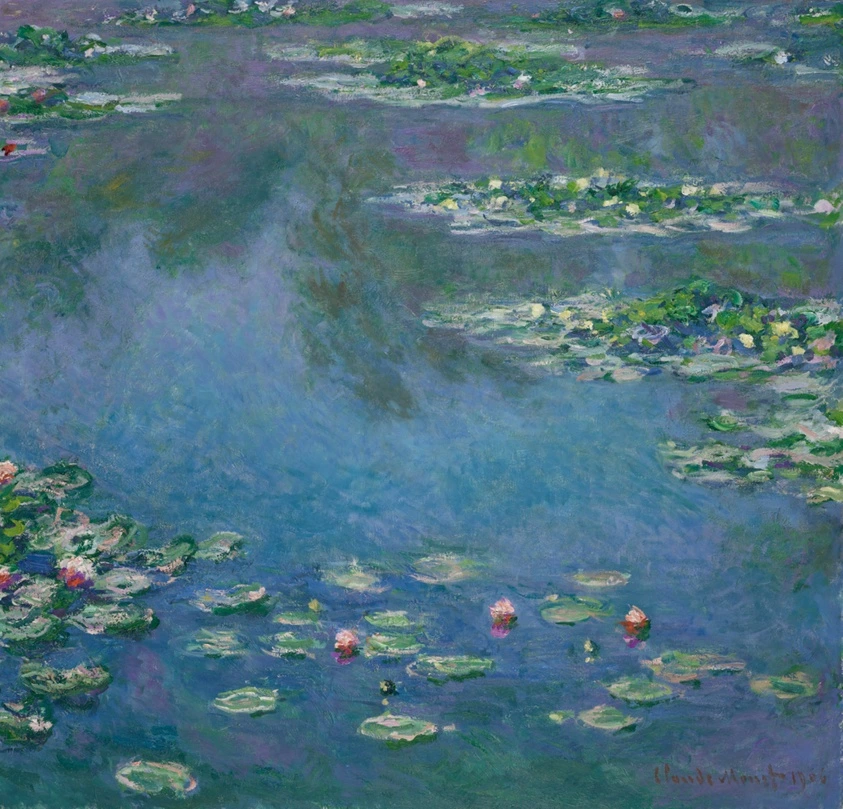
“One instant, one aspect of nature contains it all,” said Claude Monet, referring to his late masterpieces, the water landscapes that he produced at his home in Giverny between 1897 and his death in 1926. These works replaced the varied contemporary subjects he had painted from the 1870s through the 1890s with a single, timeless motif—water lilies. The focal point of these paintings was the artist’s beloved flower garden, which featured a water garden and a smaller pond spanned by a Japanese footbridge. In his first water-lily series (1897–99), Monet painted the pond environment, with its plants, bridge, and trees neatly divided by a fixed horizon. Over time, the artist became less and less concerned with conventional pictorial space. By the time he painted Water Lilies, which comes from his third group of these works, he had dispensed with the horizon line altogether. In this spatially ambiguous canvas, the artist looked down, focusing solely on the surface of the pond, with its cluster of vegetation floating amid the reflection of sky and trees. Monet thus created the image of a horizontal surface on a vertical one.

Provenance

The artist (d. 1926); sold to Durand-Ruel, Paris (3/4 interest), and Bernheim-Jeune, Paris (1/4 interest), June 3, 1909, for 14,000 francs [this and the following per Durand-Ruel, Paris, stock book for 1901–13 (no. 9082, as Les nymphéas, paysage d’eau, série de 1906), as confirmed by Paul-Louis Durand-Ruel and Flavie Durand-Ruel, Durand-Ruel Archives, to the Art Institute of Chicago, Feb. 21, 2013, curatorial object file]; sold to Henri Bernstein, Paris, May 29, 1909, for 20,000 francs [see previous: the Durand-Ruel Archives notes that “the apparent chronological anomaly between the dates of the purchase and of the sale is not unusual”]; sold to Durand-Ruel, Paris, Aug. 9, 1909, for 20,000 francs [per Durand-Ruel, Paris, stock book for 1901–13 (no. 9134, as Les nymphéas, paysage d’eau, série de 1906), as confirmed by Paul-Louis Durand-Ruel and Flavie Durand-Ruel, Durand-Ruel Archives, to the Art Institute of Chicago, Feb. 21, 2013, curatorial object file]; on deposit to Durand-Ruel, New York, Apr. 1911 [per Durand-Ruel, New York, deposit book for 1894–1925 (no. 7606, as Les nymphéas, paysage d’eau, série de 1906), as confirmed by Paul-Louis Durand-Ruel and Flavie Durand-Ruel, Durand-Ruel Archives, to the Art Institute of Chicago, Feb. 21, 2013, curatorial object file]; sold to Durand-Ruel, New York, Feb. 10, 1914 [this and the following per Durand-Ruel, New York, stock book for 1904–24 (no. 3768, as Les nymphéas, paysage d’eau, série de 1906), as confirmed by Paul-Louis Durand-Ruel and Flavie Durand-Ruel, Durand-Ruel Archives, to the Art Institute of Chicago, Feb. 21, 2013, curatorial object file]; sold to Martin A. Sold by Durand-Ruel, New York, to Martin A. Ryerson (d. 1932), Chicago, Feb. 10, 1914, for $5,000 [see previous; also a purchase receipt on Durand-Ruel letterhead, dated February 10, 1914, details that this painting (no. 3768, Monet, Les nymphéas, paysage d’eau, 1906) was acquired by M. A. Ryerson, in addition to two other paintings (no. 3668, Monet, La cabane de douaniers, 1897 (cat. 35); and no. 3646, Monet, Waterloo Bridge, London,1903) (cat. 39) for $20,000, photocopy in curatorial object file]; bequeathed to the Art Institute of Chicago, 1933.

Water Lilies

Claude Monet

1906

Accession Number

16568

Medium

Oil on canvas

Dimensions

89.9 × 94.1 cm (35 3/8 × 37 1/16 in.); Framed: 103.2 × 107 × 5.8 cm (40 5/8 × 42 1/8 × 2 1/4 in.)

Classification

oil on canvas

Museum

The Art Institute of Chicago

Chicago, United States

Credit Line

Mr. and Mrs. Martin A. Ryerson Collection
Background & Context

Background Story

'One instant, one aspect of nature contains it all,' said Claude Monet, the founder of Impressionism. For the last three decades of his life (1897–1926), Monet painted almost exclusively at his home in Giverny, focusing on the water garden he had designed and cultivated with obsessive care. The garden featured a pond spanned by a Japanese footbridge, surrounded by weeping willows, irises, and — most importantly — water lilies. Monet employed a team of gardeners to maintain the pond exactly as he wished, even diverting a local river to ensure proper water flow.

Cultural Impact

Jackson Pollock, Mark Rothko, and Joan Mitchell all acknowledged Monet's late Water Lilies as a precursor to their own work. The series anticipated Abstract Expressionism by 50 years. Monet produced approximately 250 oil paintings of water lilies — one of the most sustained artistic investigations of a single motif in art history, comparable to Bach's Well-Tempered Clavier or Beethoven's late string quartets.

Why It Matters

The Water Lilies series represents the ultimate expression of Impressionism — an attempt to capture not a single moment of light, but the infinite, ever-changing surface of nature itself. By looking down into the water, Monet created images that are simultaneously representational and abstract, realistic and dreamlike.