Water Lily Pond

Description

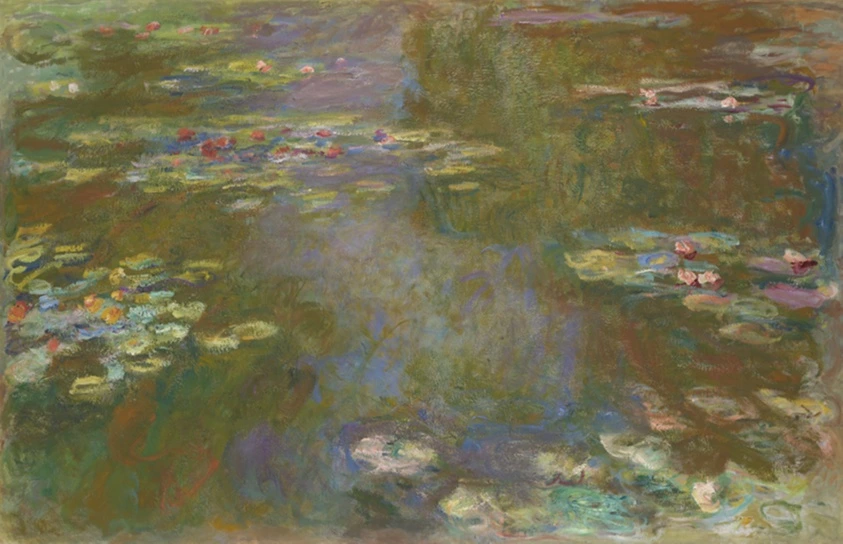
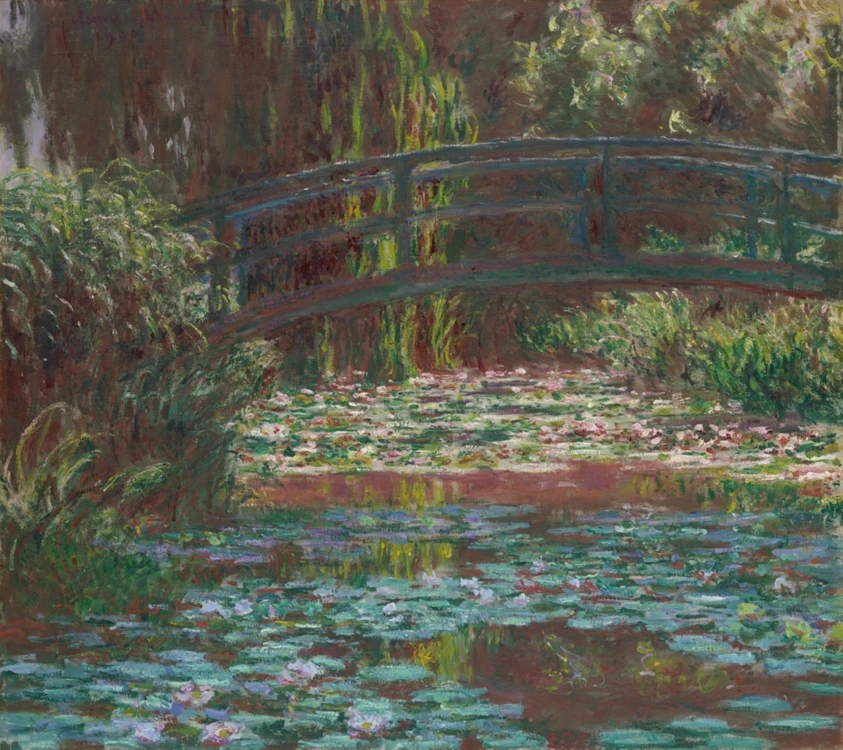
In 1893, three years after buying property at Giverny, Claude Monet began transforming the marshy ground behind his home into a pond, on the narrow end of which he built a Japanese-style wood bridge. Adding both exotic and domestic plantings, including his famous water lilies, the artist created the garden that would be one of his principal subjects for the rest of his life. Water Lily Pond was among the 18 similar versions of the motif that he made in 1899–1900; their common theme was the mingling of the lilies with reflections of other vegetation on the pool’s surface.

Provenance

The artist (d. 1026); sold to Léonce Rosenberg, Paris, Dec. 1900 [this and the following per Wildenstein 1996]. Prince de Wagram, 1904. Léonce Rosenberg, Paris, by July 22, 1914 [this and the two following per Durand-Ruel, Paris, stock book for 1913–21 (no. 10710, as Le bassin aux nymphéas, 1900), as confirmed by Paul-Louis Durand-Ruel and Flavie Durand-Ruel, Durand-Ruel Archives, to the Art Institute of Chicago, Feb. 21, 2013, curatorial object file]; sold to Durand-Ruel, Paris, July 22, 1914, for 21,000 francs; sold to Durand-Ruel, New York, Dec. 3 or 30, 1914; sold to Arthur Meeker, Chicago, Apr. 8, 1915, for $7,400 [per Durand-Ruel, New York, stock book for 1904–24 (no. 3807, as Le bassin aux nymphéas, 1900), as confirmed by the Durand-Ruel Archives in the correspondence cited above, curatorial object file. Wildenstein 1996 states that the painting was acquired again by Durand-Ruel around 1923, referencing a letter from Durand-Ruel to A. Meeker, dated Nov. 24, 1923; however, in the 2013 correspondence cited above, the Durand-Ruel Archives explained, “We have not found such information in our archives.”]. Annie Swan Coburn, Chicago (d. 1932), by 1933; bequeathed to the Art Institute of Chicago, 1933.

Water Lily Pond

Claude Monet

1900

Accession Number

87088

Medium

Oil on canvas

Dimensions

89.8 × 101 cm (35 3/8 × 39 3/4 in.); Framed: 112.4 × 122.6 × 10.2 cm (44 1/4 × 48 1/4 × 4 in.)

Classification

Painting

Museum

The Art Institute of Chicago

Chicago, United States

Credit Line

Mr. and Mrs. Lewis Larned Coburn Memorial Collection
Background & Context

Background Story

Claude Monet's "Water Lily Pond" (1900) depicts the Japanese-style bridge over the water lily pond at Monet's home in Giverny — a subject that would become the central motif of his artistic life for the next three decades. The painting shows the arched wooden bridge spanning the pond, its surface covered with water lilies, surrounded by the weeping willows, bamboo, and other exotic plants that Monet had carefully cultivated around the water garden he created. In 1893, Monet purchased a marshy tract of land across the road from his house in Giverny and diverted a small stream to create a pond. Over the fierce objections of local farmers, who feared his exotic plants would poison the water supply, Monet transformed this modest wetland into one of the most famous gardens in art history. The pond, its bridge, and the water lilies that floated on its surface became his inexhaustible subject, painted in every season, every light, and every mood. The 1900 "Water Lily Pond" belongs to the first series of pond paintings, which Monet exhibited at the Galerie Durand-Ruel in 1900 to enthusiastic reviews. These early pond paintings still include the bridge — a compositional anchor that would gradually disappear from his work as the water surface itself became the entire subject. In this painting, the bridge creates a strong diagonal thrust across the canvas, connecting the foreground bank with the distant willows and providing a human scale against which the lush vegetation can be measured. The Japanese bridge was not an arbitrary choice. Monet was a passionate collector of Japanese prints — his house at Giverny contained over 200 Japanese woodblock prints by Hokusai, Hiroshige, and others — and the garden itself was designed in the Japanese aesthetic tradition, with its emphasis on asymmetry, water, and the integration of architecture with nature. The bridge's arch shape, borrowed directly from Japanese garden design, creates a satisfying compositional curve that contrasts with the vertical willows and the horizontal expanse of water. The painting's composition balances the structural clarity of the bridge with the wild abundance of the surrounding vegetation. Monet's garden was not a formal French garden of clipped hedges and geometric paths, but a carefully arranged wilderness that appeared natural while being intensively managed. This paradox — a garden that looks wild but is cultivated — is reflected in the painting's balance between compositional structure and chromatic freedom, between the geometry of the bridge and the organic chaos of the lilies.

Cultural Impact

Monet's water garden at Giverny became one of the most productive artistic sites in history, generating over 250 paintings of water lilies, bridges, and reflections that transformed the course of modern art.

Why It Matters

This painting of the Japanese bridge over the water lily pond captures the garden that became Monet's paradise and his prison — a man-made wilderness of water, plants, and light that would obsess him for thirty years.