Description
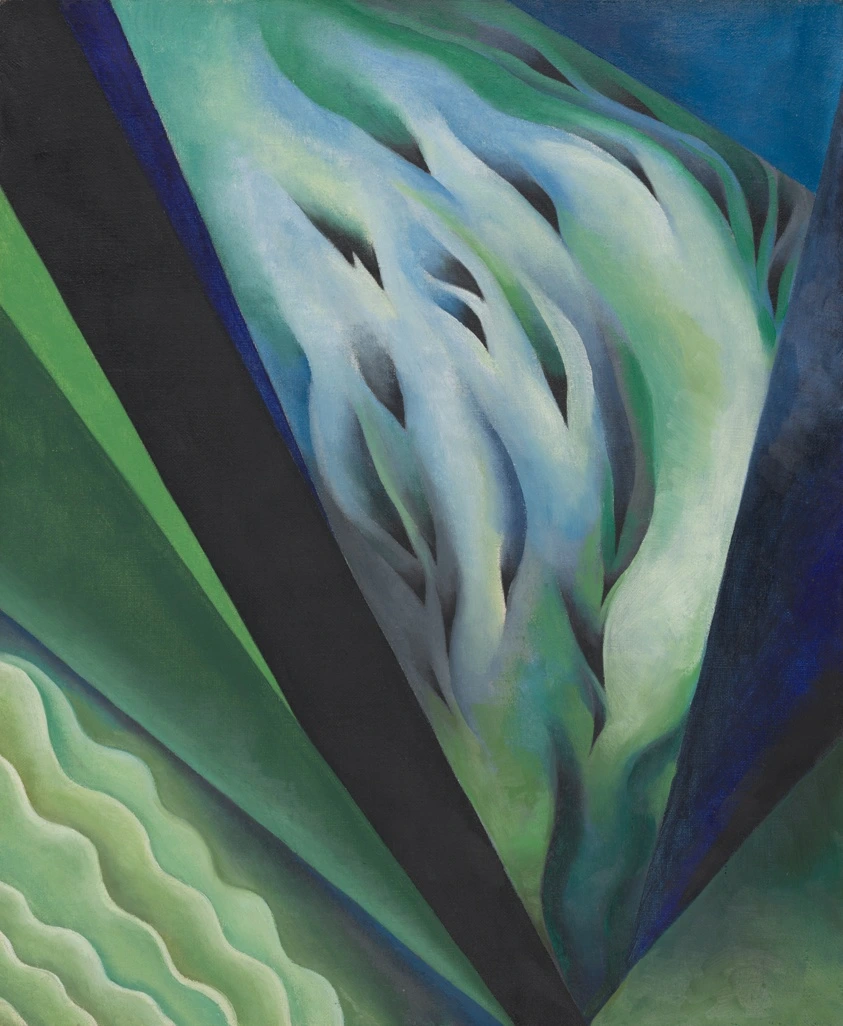
Around 1920 Georgia O’Keeffe painted a number of oils exploring, as she later recalled, “the idea that music could be translated into something for the eye.” In Blue and Green Music, O’Keeffe’s colors and forms simultaneously suggest the natural world and evoke the experience of sound. She was drawn to the theories of the Russian Expressionist painter Vasily Kandinsky, who, in his 1912 text Concerning the Spiritual in Art, argued that visual artists should emulate music in order to achieve pure expression free of literary references.
Provenance
Georgia O’Keeffe (1887–1986), New York and New Mexico, then Abiquiú, NM, from 1949 [on loan to the Art Institute of Chicago from 1949; letter from O’Keeffe to Charles C. Cunningham, Dec. 9, 1969; copy in curatorial object file]; given through the Alfred Stieglitz Collection to the Art Institute of Chicago, 1969.
Accession Number
24306
Medium
Oil on canvas
Dimensions
58.4 × 48.3 cm (23 × 19 in.)
Classification
oil on canvas
Credit Line
Alfred Stieglitz Collection, gift of Georgia O'Keeffe
Tags
Color: Green
Background & Context
Background Story
Blue and Green Music from 1919-21 is one of O'Keeffe's early abstract paintings, from the period when she was developing the visual language that would make her one of the most original painters in American art. The painting translates the experience of music into visual form, organizing flowing shapes in blue and green rhythms that suggest the movement and cadence of musical composition. The 1919-21 date places this in the period when O'Keeffe was living in New York and receiving the guidance of Alfred Stieglitz, whose gallery 291 had shown her first abstract drawings in 1916.
Cultural Impact
Blue and Green Music is one of O'Keeffe's most important early abstractions because it demonstrates her ability to translate non-visual experience—in this case, music—into visual form. The painting's flowing shapes and color rhythms suggest musical composition without illustrating it, creating a visual equivalent for the experience of listening to music. This synesthetic approach—translating one sensory experience into another—was central to O'Keeffe's early work and remains one of the most distinctive aspects of her contribution to American modernism.
Why It Matters
Blue and Green Music is O'Keeffe translating music into painting: flowing blue and green shapes organized in rhythms that suggest musical composition without illustrating it. The 1919-21 painting is one of her most important early abstractions and demonstrates the synesthetic approach that was central to her development as an artist.