The Shelton with Sunspots, N.Y.

Description

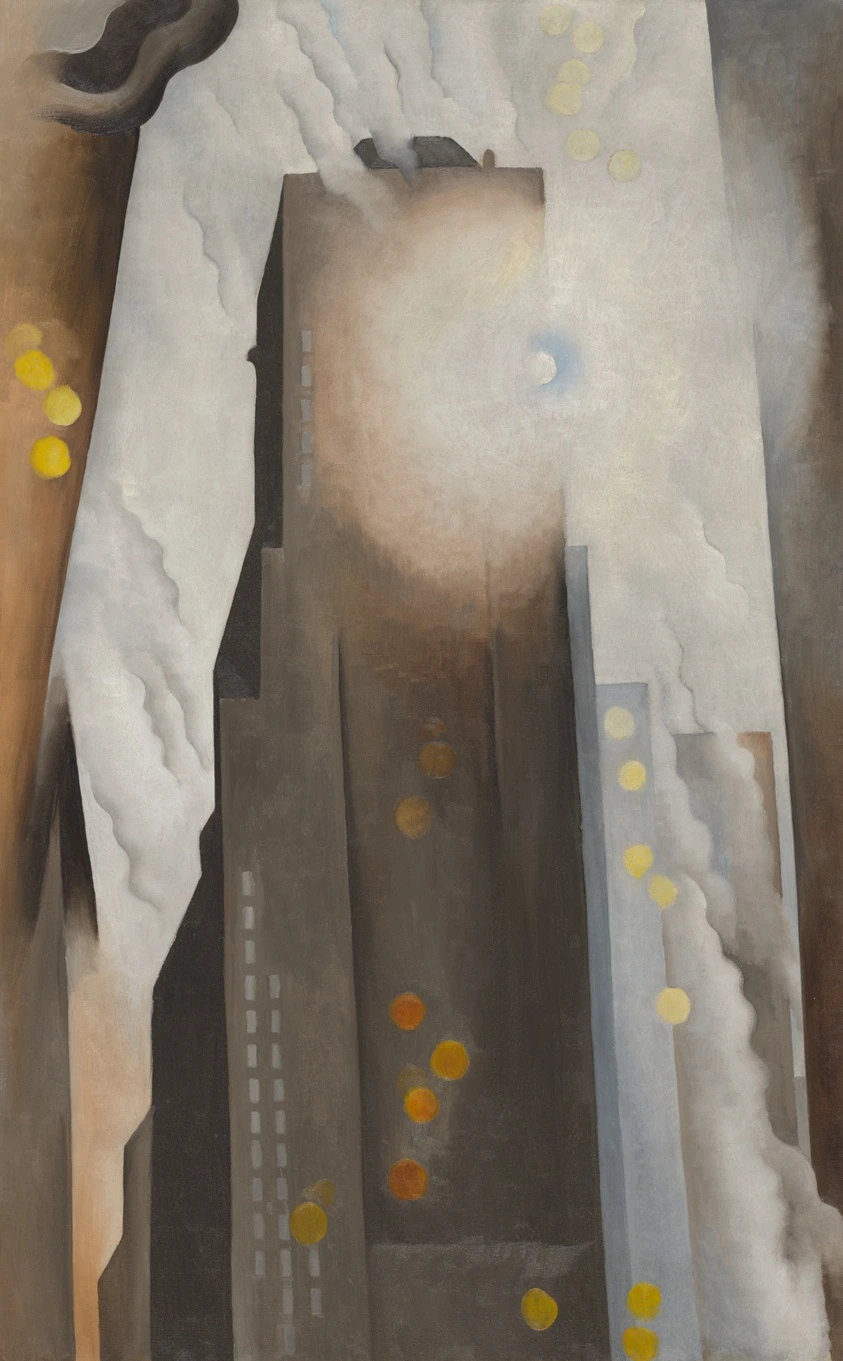
“I went out one morning to look at [the Shelton Hotel] and there was the optical illusion of a bite out of one side of the tower made by the sun, with sunspots against the building and against the sky,” said Georgia O’Keeffe, recalling the precise moment that inspired her to paint The Shelton with Sunspots. Although her depictions of flowers and the southwestern landscape are powerful and evocative, O’Keeffe painted a group of cityscapes in the 1920s that are no less intriguing. She married the photographer and dealer Alfred Stieglitz in 1924, and the following year they moved into the Shelton, a recently completed skyscraper. O’Keeffe was fascinated by the soaring height of the building and emphasized its majesty in this painting by rendering it from the street below. In the glaring light of the emerging sun, the building becomes an abstracted series of rectangles arranged in the center of the composition. Yet the hard edges of the Shelton are softened by the numerous circular sunspots and wavy, flowing lines of smoke and steam, suggesting that despite her urban subject matter, O’Keeffe nevertheless sought to unify man-made and organic forms, just as she would in her southwestern paintings such as Black Cross, New Mexico .

Provenance

Georgia O’Keeffe (1887–1986), New York; with the Intimate Gallery, New York, by 1927; sold to Alma Morgenthau Wertheim (1887–1953), New York, 1927; to her daughter, Anne Wertheim Langman (1914–1996), New York, after 1946. The Downtown Gallery, New York, by 1957; sold to Leigh B. Block (1905–1987), Chicago, June 18, 1957 [invoice, no. 7639, June 18, 1957; copy in curatorial object file]; given to the Art Institute of Chicago, 1985.

The Shelton with Sunspots, N.Y.

Georgia O'Keeffe

1926

Accession Number

104031

Medium

Oil on canvas

Dimensions

122.6 × 76.9 cm (48 1/4 × 30 1/4 in.)

Classification

oil on canvas

Museum

The Art Institute of Chicago

Chicago, United States

Credit Line

Gift of Leigh B. Block

Background & Context

Background Story

The Shelton with Sunspots, N.Y. from 1926 depicts the Shelton Hotel—one of New York's tallest skyscrapers when it was built—through the optical effect of sunspots, the bright spots that appear when the sun is viewed through a camera lens or through squinted eyes. The painting combines O'Keeffe's interest in New York architecture with her investigation of optical phenomena, creating an image that is simultaneously a cityscape and a study of how light affects vision. The 1926 date places this in O'Keeffe's New York period, when she was painting the city's skyscrapers with the same directness and intensity that she would later bring to desert flowers and bones.

Cultural Impact

O'Keeffe's New York skyscraper paintings are among the most important works in the history of American urban landscape painting because they treat the skyscraper not as a symbol of modernity to be celebrated or condemned but as a visual phenomenon to be investigated. The Shelton with Sunspots treats the skyscraper as an optical event—the building seen through the distortion of bright light—creating an image that is simultaneously a cityscape and a study of how light transforms vision.

Why It Matters

The Shelton with Sunspots is O'Keeffe treating the skyscraper as an optical event: the building seen through the distortion of bright light, simultaneously a cityscape and a study of how light transforms vision. The 1926 painting is a key work in O'Keeffe's New York period, when she was investigating optical phenomena as rigorously as she would later investigate desert flowers.