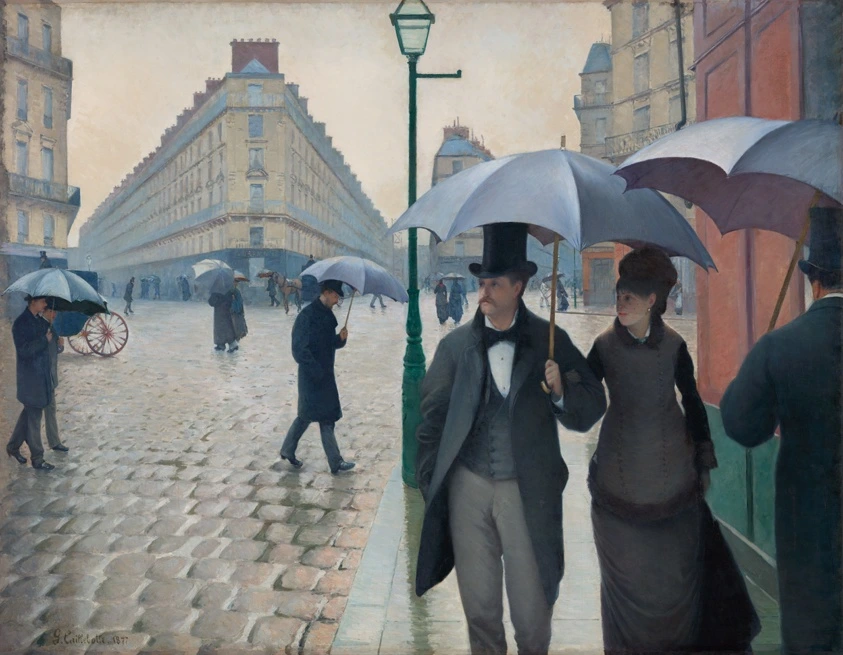
Paris Street; Rainy Day

Description

This complex intersection, just minutes away from the Saint-Lazare train station, represents in microcosm the changing urban milieu of late nineteenth-century Paris. Gustave Caillebotte grew up near this district when it was a relatively unsettled hill with narrow, crooked streets. As part of a new city plan designed by Baron Georges-Eugène Haussmann, these streets were relaid and their buildings razed during the artist’s lifetime. In this monumental urban view, which measures almost seven by ten feet and is considered the artist’s masterpiece, Caillebotte strikingly captured a vast, stark modernity, complete with life-size figures strolling in the foreground and wearing the latest fashions. The painting’s highly crafted surface, rigorous perspective, and grand scale pleased Parisian audiences accustomed to the academic aesthetic of the official Salon. On the other hand, its asymmetrical composition, unusually cropped forms, rain-washed mood, and candidly contemporary subject stimulated a more radical sensibility. For these reasons, the painting dominated the celebrated Impressionist exhibition of 1877, largely organized by the artist himself. In many ways, Caillebotte’s frozen poetry of the Parisian bourgeoisie prefigures Georges Seurat’s luminous Sunday on La Grande Jatte—1884, painted less than a decade later.

Provenance

The artist (died 1894); by descent to Martial Caillebotte (brother) and Marie Minoret (Martial’s wife), Paris, 1894 [this and the two following per Portland Art Museum, Paintings from the Collection of Walter P. Chrysler, Jr., exh. cat. (Portland Art Association, 1956), p. 47. See also fact sheet provided by Wildenstein and Company, copy in curatorial object file]; placed with Georges Minoret (brother-in-law of Martial Caillebotte), Château de Montglat, Provins, France, 1900; Returned to Albert and Geneviève Chardeau (daughter of Martial Caillebotte), Paris, 1950; sold to Walter P. Chrysler, Jr., New York, 1954 [per J. Kirk T. Varnedoe and Thomas P. Lee, Gustave Caillebotte: A Retrospective Exhibition, with contributions by J. Kirk T. Varnedoe, Marie Berhaut, Peter Galassi, and Hilarie Faberman, exh. cat. (Museum of Fine Arts, Houston, 1976), p. 110]; sold to Wildenstein and Company, 1964 [per email from Joseph Baillio, Wildenstein and Company, copy in curatorial object file]; sold to the Art Institute of Chicago, 1964 [per minutes from the meeting of the Committee on Earlier Painting and Sculpture, November 25, 1964 and minutes from the meeting of the Board of Trustees, December 21, 1964, both on file in Institutional Archives, Art Institute of Chicago].

Paris Street; Rainy Day

Gustave Caillebotte

1877

Accession Number

20684

Medium

Oil on canvas

Dimensions

212.2 × 276.2 cm (83 1/2 × 108 3/4 in.); Framed: 241.3 × 306.1 × 10.2 cm (95 × 120 1/2 × 4 in.)

Classification

oil on canvas

Museum

The Art Institute of Chicago

Chicago, United States

Credit Line

Charles H. and Mary F. S. Worcester Collection
Background & Context

Background Story

Gustave Caillebotte (1848-1894) painted Paris Street; Rainy Day in 1877, creating what has become one of the most iconic images of modern Parisian life. The painting depicts a broad Parisian boulevard on a rainy day, with elegantly dressed figures walking under umbrellas past the new Haussmannian architecture that had transformed Paris into the modern city of the Second Empire. The 1877 date places this at the height of the Impressionist period, when Paris was being transformed by Haussmann's boulevards into the modern city that the Impressionists would make their subject. The painting's monumental size (approximately 7 by 9 feet) and carefully composed perspective—with figures disposed across the broad boulevard in a precisely calculated geometric arrangement—make it one of the most ambitious paintings of the Impressionist era.

Cultural Impact

Paris Street; Rainy Day is important in the history of art because it is the iconic image of modern Parisian life in the Impressionist era. Caillebotte's painting combines the broad boulevards of Haussmann's Paris with the rainy atmosphere and the elegantly dressed figures that define the modern city experience. The painting's monumental size and carefully composed perspective make it one of the most ambitious paintings of the Impressionist era, and its image of modern Parisian life has become one of the most recognizable in Western art.

Why It Matters

Paris Street; Rainy Day is the iconic image of modern Paris: a broad Haussmannian boulevard on a rainy afternoon with elegantly dressed figures under umbrellas, painted in 1877 at the height of the Impressionist era. The monumental size and precisely composed geometric perspective make it one of the most ambitious and recognizable paintings of the Impressionist period.