Description
This preparatory drawing seems to have been freely sketched on the spot before being laid out in the studio with a straightedge and compass to regularize the perspective lines.
Provenance
By descent from the artist (died 1894) to his family; given to Kirk Varnedoe (1946–2003), New York, 1976; by descent to his wife, Elyn Zimmerman, New York, 2003 [New York 2006 auction cat.]; sold through James Goodman Gallery, New York, to the Art Institute of Chicago, 2011.
Accession Number
210484
Medium
Graphite, with touches of erasing and touches of charcoal, on tan, moderately thick, moderately textured handmade laid paper
Dimensions
30.2 × 46.5 cm (11 15/16 × 18 5/16 in.)
Classification
graphite
Credit Line
Purchased with funds provided by the Jentes Family Foundation
Background & Context
Background Story
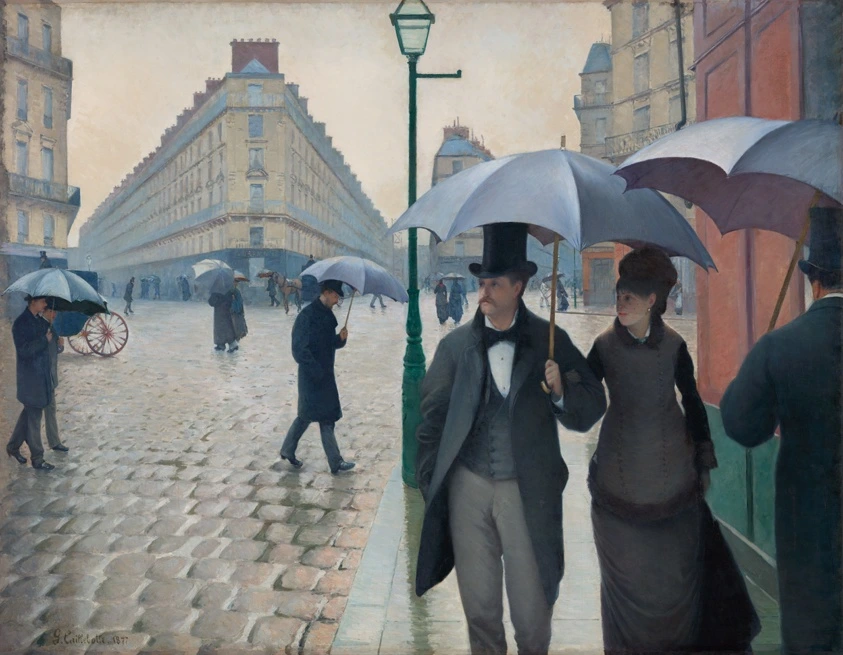
Gustave Caillebottes Study for Paris Street; Rainy Day from 1877 is a graphite drawing with charcoal touches that preserves the working process behind one of the most celebrated paintings of the Impressionist era. Caillebottes Paris Street; Rainy Day, now in the Art Institute of Chicago, depicts a broad Parisian boulevard populated by figures carrying umbrellas on a wet afternoon, and its complex composition of overlapping planes and precisely positioned figures has led scholars to compare it to the mathematical perspective constructions of the Renaissance. This study reveals the extent to which that composition was worked out in advance through drawing: the graphite lines and charcoal touches on tan laid paper establish the positions of the major figures and the perspectival framework of the boulevard, while the touches of erasing indicate the revisions that Caillebotte made as he refined the composition. The tan paper provides a middle tone that allows the charcoal to create shadows and the eraser to create highlights, producing a tonal range that approaches the finished painting in its modeling of figures and space. The moderately thick, moderately textured handmade laid paper is characteristic of French drawing paper of the period, and its quality indicates that Caillebotte chose his materials with the care appropriate to a study for a major painting. The drawing is a crucial document for understanding Caillebottes working method, which combined the Impressionist commitment to modern life with a compositional rigor that owed more to the academic tradition than his Impressionist colleagues acknowledged.
Cultural Impact
Caillebottes preparatory drawings for Paris Street; Rainy Day are essential documents for understanding one of the most important paintings of the Impressionist era and the degree to which its apparently spontaneous composition was in fact carefully constructed. They demonstrate that Impressionist painting could be the product of rigorous preparatory work, challenging the assumption that Impressionist composition was purely intuitive.
Why It Matters
A crucial preparatory study by Caillebotte for his Paris Street; Rainy Day, revealing through graphite and charcoal on tan paper the careful working out of the complex perspectival composition and figure placement that underlies one of Impressionisms most celebrated paintings.