Description
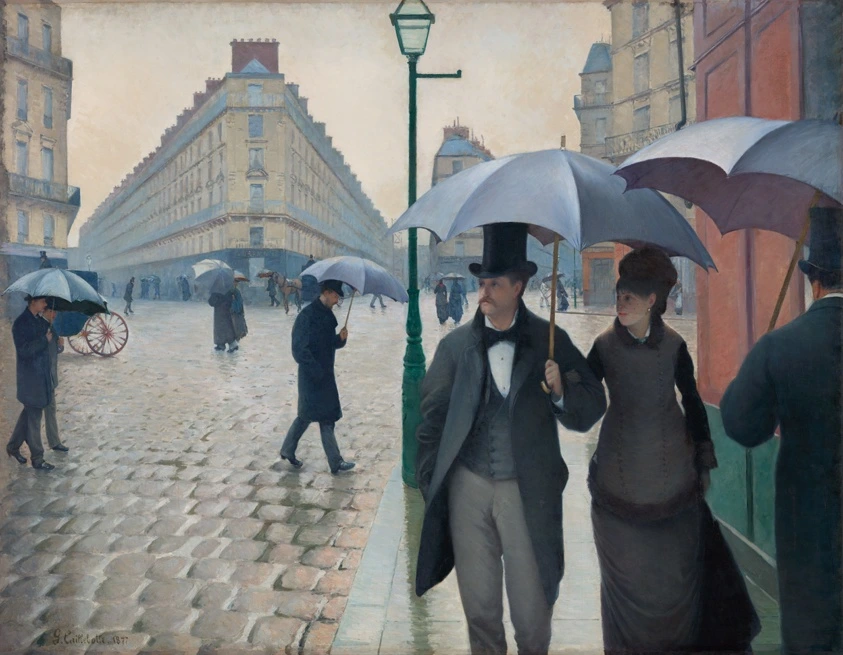
Born into a Parisian upper middle-class family, Gustave Caillebotte was attracted to the innovations of the young artists who became known as the Impressionists. He officially joined the group for their second exhibition, in April 1876, and then organized the exhibition of 1877, where he showed Paris Street; Rainy Day, his masterpiece.
Provenance
By descent from the artist to his brother Martial Caillebotte (1853–1910) and Marie Minoret (Martial’s wife), Paris, 1894 [estate stamp lower right]; private collector, France, c. 1985 [Sylvie Brame, Brame et Lorenceau, Oct. 1, 2014]; Galerie Brame et Lorenceau, Paris, by 1995 [Sylvie Brame, Brame et Lorenceau, Oct. 1, 2014]; sold to the Art Institute of Chicago, 1995.
Accession Number
140080
Medium
Graphite on off-white, medium-weight, moderately textured laid paper
Dimensions
49 × 31.5 cm (19 5/16 × 12 7/16 in.)
Classification
graphite
Credit Line
Purchased with funds provided by Janet and William Jentes
Background & Context
Background Story
Gustave Caillebottes Self-Portrait with a Hat from around 1879 is a graphite drawing on laid paper that depicts the artist wearing a top hat, the emblematic accessory of the Parisian bourgeois flaneur whose perspective Caillebotte so frequently adopted in his paintings. The drawing is relatively small and informal, suggesting that it was made as a personal study rather than a presentation piece, but it reveals Caillebottes skill as a draftsman and his capacity for self-observation. The top hat, which Caillebotte also wears in his full-length self-portrait of 1880 now in a private collection, is both a fashion accessory and a social marker, identifying the artist as a member of the Parisian upper class who could afford to stroll the boulevards at leisure rather than work in a studio. The choice of graphite on off-white laid paper produces a drawing of modest tonal range, all grays and whites, that suits the formal restraint of a man who expressed his personality through understatement rather than display. The year 1879 places this drawing in the period of Caillebottes most intense involvement with the Impressionist group, when he was organizing exhibitions, purchasing works by his colleagues, and painting the urban interiors and streetscapes for which he is best known. The self-portrait documents the appearance of an artist who was simultaneously a participant in and a patron of the Impressionist movement, a double role that gave him a unique position in the history of the group.
Cultural Impact
Caillebottes self-portraits are important documents of the social world of Impressionism, revealing the class position and self-presentation of an artist who was both a participant in and a financial supporter of the movement. His drawings preserve the working methods of an artist whose reputation as a painter has grown steadily since the 1970s.
Why It Matters
An informal self-portrait drawing by Caillebotte depicting himself wearing a top hat, the emblematic accessory of the Parisian flaneur, revealing the social position and self-presentation of an artist who was simultaneously a participant in and patron of the Impressionist movement.