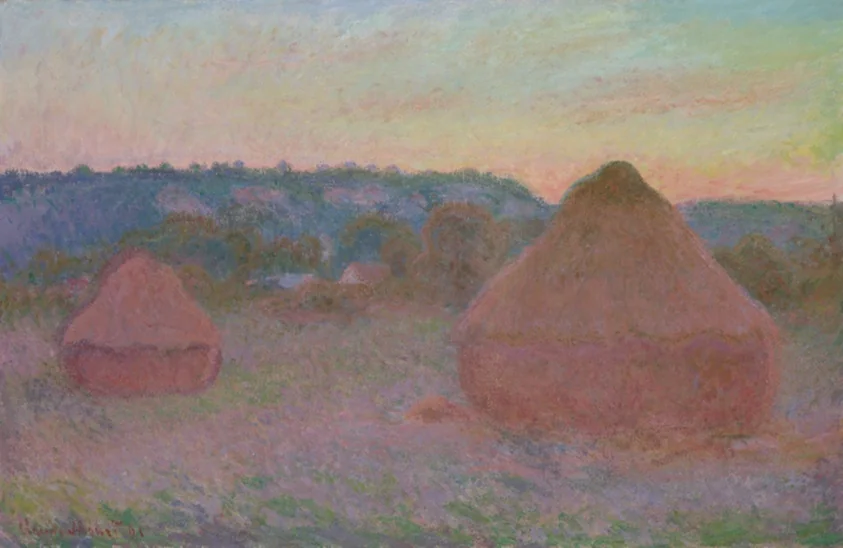
Stacks of Wheat (End of Day, Autumn)

Description

The monumental stacks that Claude Monet depicted in his series Stacks of Wheat rose fifteen to twenty feet and stood just outside the artist’s farmhouse at Giverny. Through 1890 and 1891, he worked on this series both in the field, painting simultaneously at several easels, and in the studio, refining pictorial harmonies. In May 1891, Monet hung fifteen of these canvases next to each other in one small room in the Galerie Durand-Ruel in Paris. An unprecedented critical and financial success, the exhibition marked a breakthrough in Monet’s career, as well as in the history of French art. In this view, and in nearly all of the autumn views in the series, the conical tops of the stacks break the horizon and push into the sky. But in most of the winter views, which constitute the core of the series, the stacks seem wrapped by bands of hill and field, as if bedded down for the season. For Monet, the stack was a resonant symbol of sustenance and survival. He followed this group with further series depicting poplars, the facade of Rouen Cathedral, and, later, his own garden at Giverny. The Art Institute has the largest group of Monet’s Stacks of Wheat in the world.

Provenance

The artist (d. 1926); sold to Durand-Ruel, Paris, July 2, 1891, for 3,200 francs [per Durand–Ruel, Paris, stock book for 1891–1901 (no. 1063, as Meules, fin de l’été), and from Brouillard 1888–1891, as confirmed by Paul-Louis Durand-Ruel and Flavie Durand-Ruel, Durand-Ruel Archives, to the Art Institute of Chicago, June 24, 2014, curatorial object file]. Durand-Ruel, New York; sold to Potter Palmer, Chicago, July 2, 1891, for $1,200 (or 6,000 francs) [Durand–Ruel, Paris, stock book for 1891–1901 (no. 1063, Meules, fin de l’été), and from Brouillard 1888–1891: “sold to Potter Palmer on the same day (2nd July 1891) for 1 200 dollars = 6 000 F,” as confirmed by Paul-Louis Durand-Ruel and Flavie Durand-Ruel, Durand-Ruel Archives, to the Art Institute of Chicago, June 24, 2014, curatorial object file. The Durand-Archives further states that “there is a discrepancy in our books about the sale of W 1270 to Potter Palmer: we cannot explain it.”] Durand-Ruel, New York, by Mar. 7, 1892 [this and the following per Durand-Ruel, New York, stock book 1888–1893 (no. 859, Meules, fin de l’été): “Sold to Potter Palmer on 7th March 1892 for 1 500 dollars / Stock DR New York no. 859 (previous stock DR Paris no. 1063),” as confirmed by Paul-Louis Durand-Ruel and Flavie Durand-Ruel, Durand-Ruel Archives, to the Art Institute of Chicago, June 24, 2014, curatorial object file]; sold to Potter Palmer, Chicago, Mar. 7, 1892, for $1,500; sold back to Durand-Ruel, New York, by Apr. 19, 1892 [this and the following per Durand-Ruel, New York, stock book for 1888–93 (no. 924, as Meules, fin de l’été), as confirmed by see Paul-Louis Durand-Ruel and Flavie Durand-Ruel, Durand-Ruel Archives, to the Art Institute of Chicago, June 24, 2014, curatorial object file]; sold to Sir William Van Horne, Montreal, Apr. 19, 1892, for $1,250. Durand-Ruel, New York, by Nov. 22, 1892 [per Durand-Ruel, New York, stock book for 1888–93 (no. 948, as Meules, fin de l’été), as confirmed by Paul-Louis Durand-Ruel and Flavie Durand-Ruel, Durand-Ruel Archives, to the Art Institute of Chicago, June 24, 2014, curatorial object file]; sold to Potter Palmer, Chicago, Nov. 22, 1892, for $1,200. Howard Young, New York, by 1932 [this and the following per Art Institute of Chicago, exh. cat., 1932]. Annie Swan Coburn (d. 1932), Chicago, by 1932; bequeathed to the Art Institute of Chicago, 1933.

Stacks of Wheat (End of Day, Autumn)

Claude Monet

1890–91

Accession Number

14624

Medium

Oil on canvas

Dimensions

65.8 × 101 cm (27 7/8 × 39 3/4 in.); Framed: 90.9 × 125.5 × 123.2 cm (35 3/4 × 49 3/8 × 48 1/2 in.)

Classification

oil on canvas

Museum

The Art Institute of Chicago

Chicago, United States

Credit Line

Mr. and Mrs. Lewis Larned Coburn Memorial Collection