The Philosopher's Conquest

Description

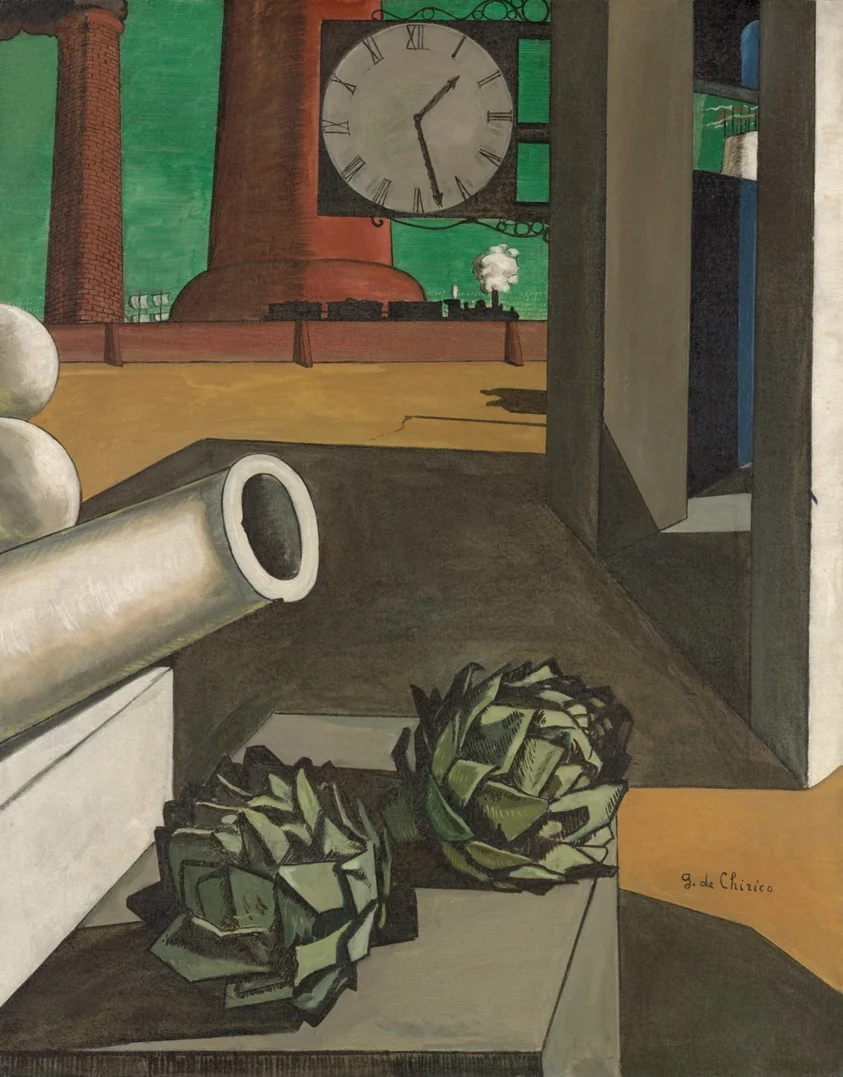
The work of Giorgio de Chirico represents an unexpected form of classicism in early avant-garde painting. This canvas, one of six in a series, combines a Mediterranean cityscape with still-life objects. Familiar elements appear in many of de Chirico’s paintings like pieces of a mysterious puzzle: a classical arcade, oddly oversize artichokes, a cannon and cannonballs, a clock, an industrial brick chimney, a monumental tower, a running train, and a square-rigged sailing ship. Here the stage set for this extraordinary juxtaposition of objects is an Italian piazza, virtually deserted except for the menacing shadowy figures outside the edge of the scene.

De Chirico represented objects with a matter-of-fact, though intentionally crude, precision. He painted his scenes flatly, in bright colors, and illuminated them with a cold white light. Rendered in this clear style, works like The Philosopher’s Conquest seem rife with meaning, though they remain resolutely enigmatic. Indeed, by juxtaposing incongruous objects, the artist sought to produce a metaphysical quality, what he called “art that in certain aspects resembles . . . the restlessness of myth.” De Chirico’s works would profoundly affect the Surrealists, who in the 1920s and 1930s attempted to portray dreams and images of the subconscious in their work.

This is one of thirty-five works that comprise the Winterbotham Collection. Click here to learn more about the collection.

Provenance

Galerie Paul Guillaume (died 1934), Paris, by 1926 [Paris 1926]. Exhibited at Valentine Gallery, New York, 1928 [dell’Arco and Baldacci 1982]. Pierre Matisse Gallery, New York; sold to the Art Institute of Chicago, 1939 [letter from Pierre Matisse, July 11, 1939, in curatorial file].

The Philosopher's Conquest

Giorgio de Chirico

1913–14

Accession Number

30839

Medium

Oil on canvas

Dimensions

125.1 × 99.1 cm (49 1/4 × 39 in.)

Classification

oil on canvas

Museum

The Art Institute of Chicago

Chicago, United States

Credit Line

Joseph Winterbotham Collection

Background & Context

Background Story

Giorgio de Chirico's "The Philosopher's Conquest" (1913–14) is an oil on canvas from the height of the Metaphysical Painting (Pittura Metafisica) period. De Chirico (1888–1978) was the founder of the Metaphysical school, a style that preceded and influenced Surrealism. This painting exemplifies the distinctive qualities of Metaphysical art: a sense of mystery and uncanny stillness, the use of empty urban spaces (piazzas), classical architecture, and unexpected juxtapositions of objects. "The Philosopher's Conquest" shows a sunlit square with classical arcades, a statue, and perhaps the enigmatic presence of a philosopher figure. The space is distorted by perspective, creating a dreamlike, disorienting effect. The long shadows cast by objects suggest either early morning or late afternoon, the times of day when reality seems most ambiguous. De Chirico's palette is warm and clear, the light is bright but unearthly. The painting creates a sense of suspended time and inexplicable significance, as if the scene were a fragment of a dream or a glimpse into a world governed by different laws than our own.

Cultural Impact

De Chirico's Metaphysical paintings were one of the most influential bodies of work in 20th-century art, directly inspiring the Surrealists and continuing to influence artists, filmmakers, and writers to the present day.

Why It Matters

This mysterious painting of a sunlit square captures the essence of de Chirico's Metaphysical vision: a world of uncanny stillness, inexplicable significance, and the unsettling beauty of empty spaces.