Accession Number
81970
Medium
Etching on tan wove paper
Dimensions
Image: 18 × 14 cm (7 1/8 × 5 9/16 in.); Sheet: 24.5 × 19 cm (9 11/16 × 7 1/2 in.)
Classification
etching
Credit Line
Gift of Joseph R. Shapiro
Background & Context
Background Story
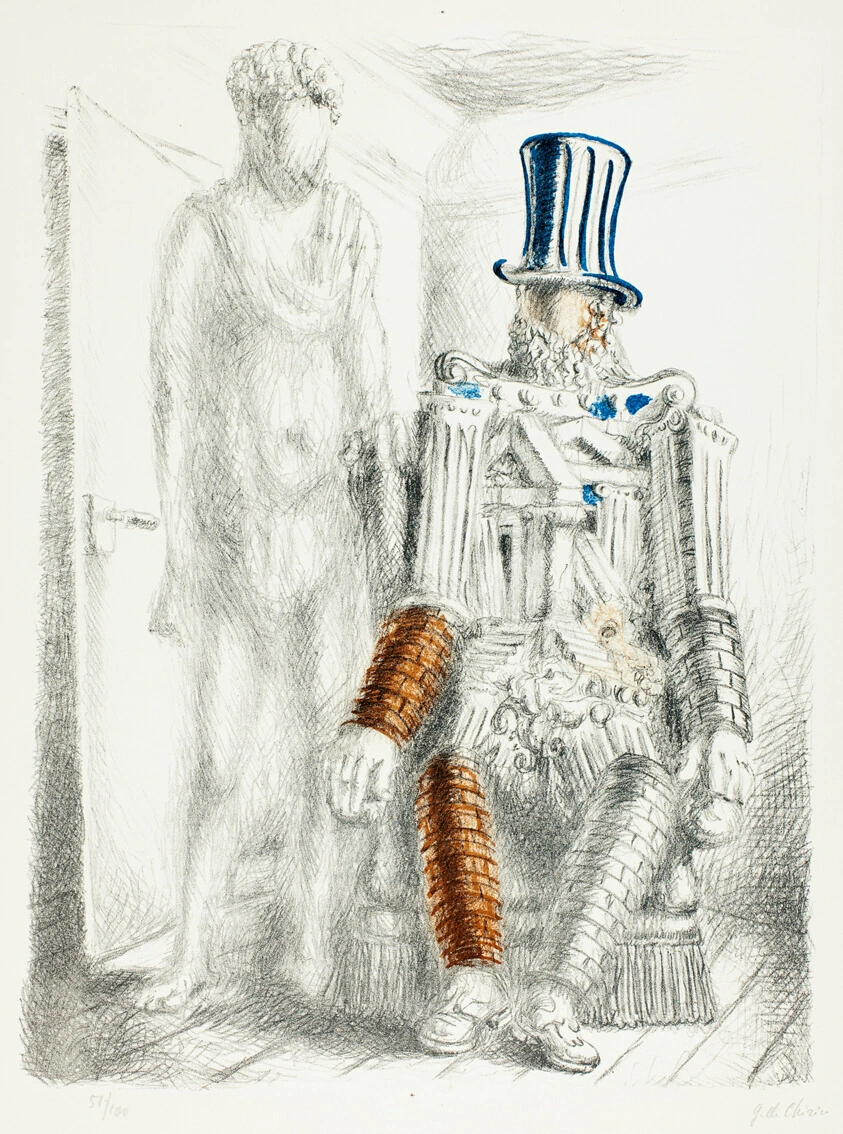
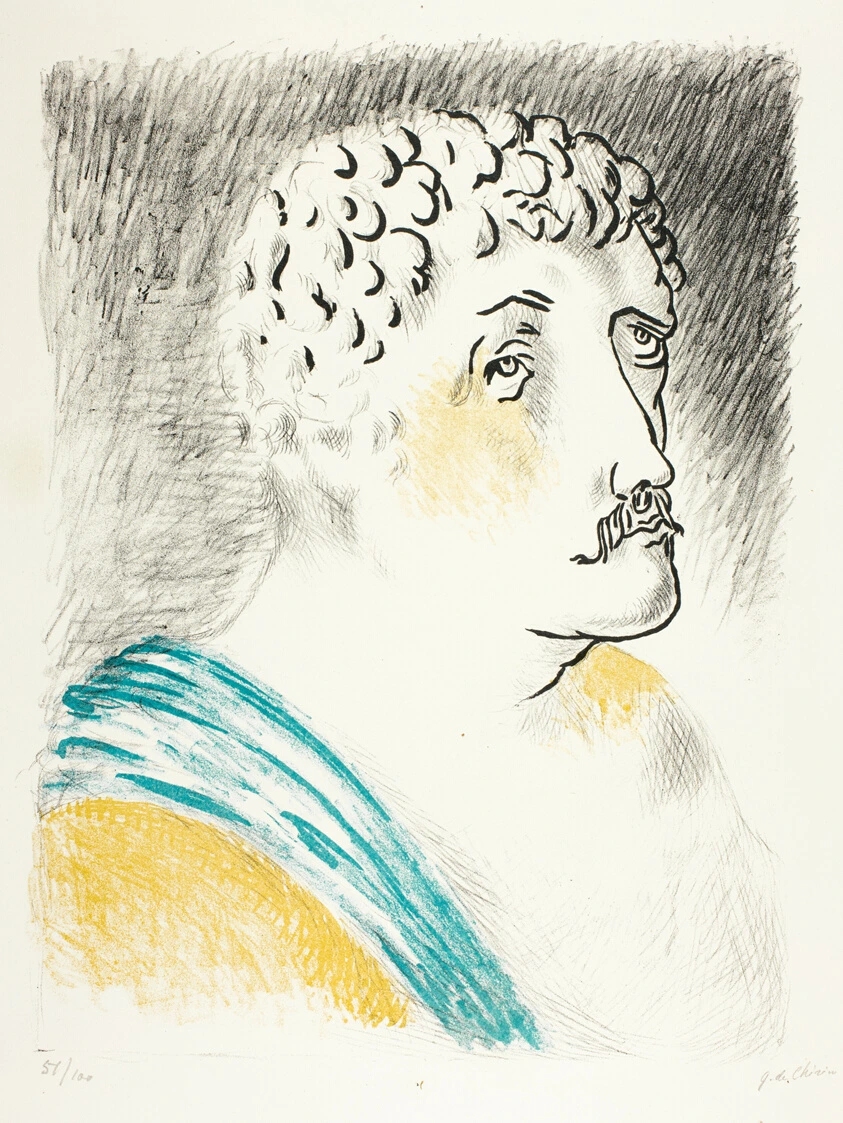
"Gladiators" is a 1928 etching by Giorgio de Chirico that captures the Italian metaphysical painter in his late period, when he had abandoned the empty piazzas and enigmatic mannequins of his most famous early work in favor of a more traditional, even academic approach to classical subject matter that scandalized his modernist admirers. The composition shows gladiators—ancient Roman combatants—rendered in etching with the precise, controlled line that de Chirico had developed through years of academic training and that he now deployed with a deliberate conservatism that was itself a provocation. The tan wove paper provides a warm, archaeological ground that makes the black etched lines appear like inscriptions on ancient stone, enhancing the sense of historical distance and classical reverence that the artist intended. The 1928 date places this work in the period when de Chirico was increasingly turning to etching as a medium for the classical and mythological subjects that occupied his later career, producing prints that documented his painted compositions with the fidelity of a reproductive engraver. This turn toward tradition was controversial: the Surrealists who had celebrated his early piazzas condemned his later classicism as a betrayal, and modernist critics have tended to dismiss the post-1920 work as a decline from the innovations of 1910–1918. Yet recent scholarship has reconsidered de Chirico's late period, finding in its apparent conservatism a sophisticated engagement with the history of art that challenges the modernist narrative of perpetual innovation. Art historians have connected this etching to the broader tradition of classical revival in twentieth-century art, from the "return to order" of Picasso's neoclassical period to the Mediterranean fantasies of the Nabis, noting that de Chirico's treatment is more archaeologically precise, more historically grounded than these contemporaries. The work also demonstrates the technical mastery that underpinned de Chirico's apparent conservatism: the etching is executed with a precision and control that few of his modernist contemporaries could match.
Cultural Impact
This 1928 etching documented controversial late-classical gladiatorial precision, using tan-paper archaeological warmth to challenge modernist innovation narratives through reproductive engraving fidelity.
Why It Matters
It matters because de Chirico drew Roman fighters and made them look like they were carved on old stone—proving that even tradition could be a provocation if the lines were careful enough.