Accession Number
76148
Medium
Lithograph in blue, orange, and black on white wove paper
Dimensions
Image: 41 × 31.2 cm (16 3/16 × 12 5/16 in.); Sheet: 56.5 × 45 cm (22 1/4 × 17 3/4 in.)
Classification
lithograph
Credit Line
Gift of Hedi and Carl Schniewind
Background & Context
Background Story
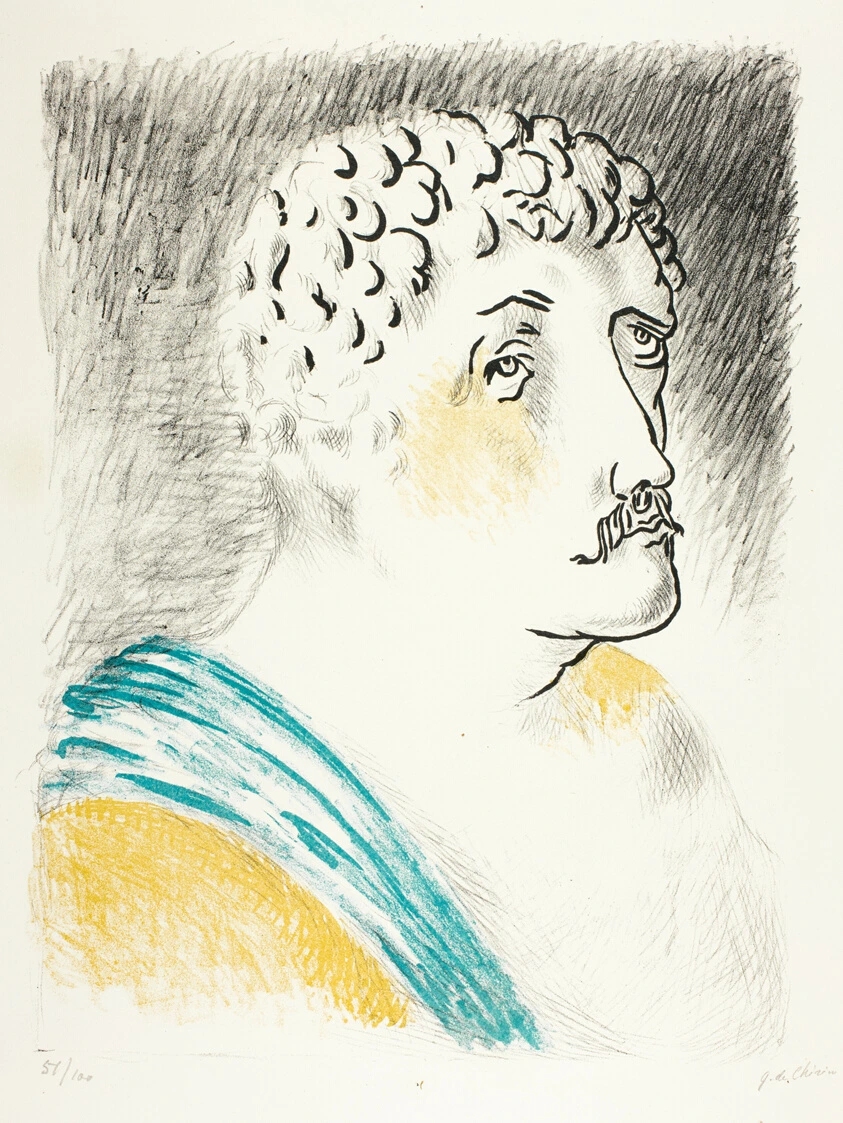
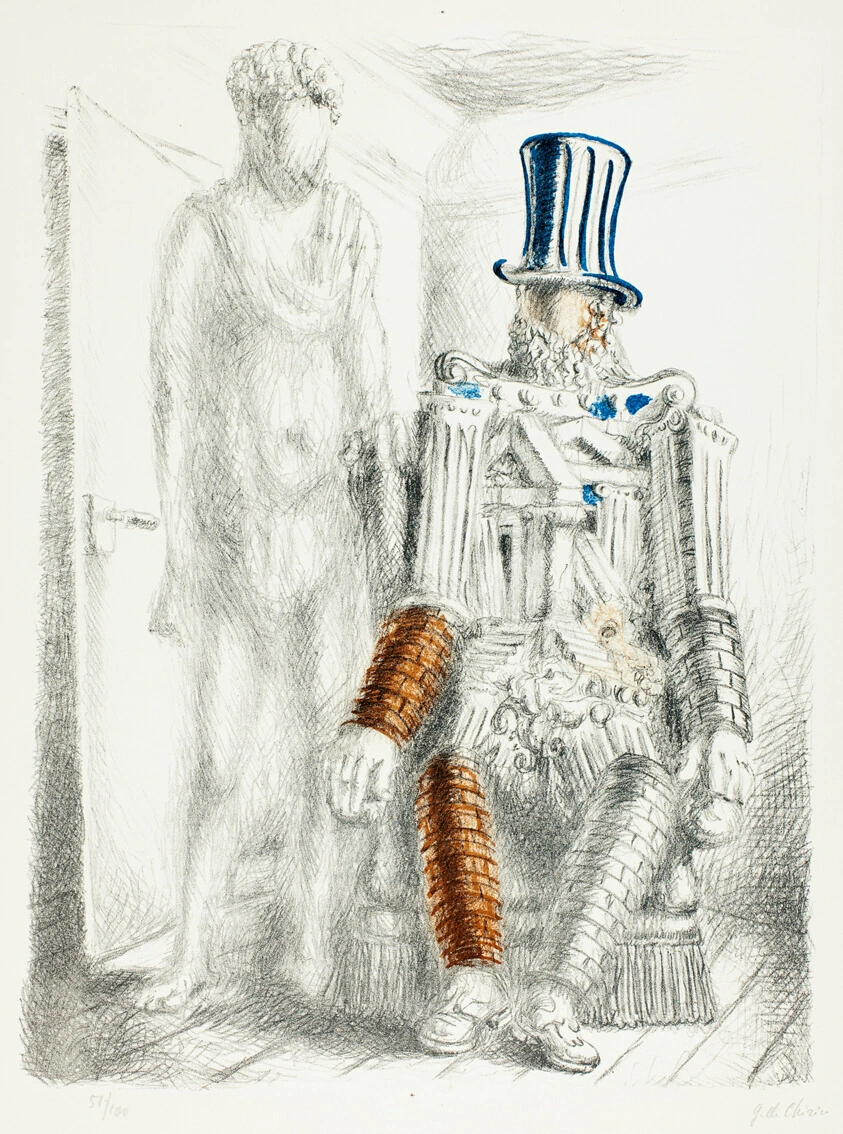
"The Return of the Prodigal Son, Plate one from Metamorposis" is a 1929 lithograph in blue, orange, and black that opens de Chirico's "Metamorposis" portfolio with one of the most familiar narratives of Western culture, the biblical parable of the son who leaves home, squanders his inheritance, and returns to his father's forgiveness. The composition shows the moment of return, the prodigal figure approaching or kneeling before the patriarch, rendered in the flat, poster-like colors of lithography that transform the familiar story into something strange and dreamlike. The blue, orange, and black palette is the same artificial combination that de Chirico employed throughout the series, creating a visual unity that suggests these biblical and classical subjects are all part of a single imaginative world, a museum of the mind where different historical periods coexist without chronological order. The 1929 date places this work in the period when de Chirico was increasingly interested in the relationship between ancient and modern, the classical tradition and contemporary life, and the "Metamorposis" series can be read as an attempt to make this relationship visible through the juxtaposition of subject and technique. Art historians have connected this image to the broader tradition of biblical illustration, from the engravings of Dürer to the lithographs of Odilon Redon, noting that de Chirico's treatment is more graphic, more commercially direct than these predecessors. The lithographic medium itself is significant: invented in the late eighteenth century and developed as a mass medium in the nineteenth, lithography carries associations with popular culture and commercial reproduction that de Chirico exploits to make his classical subjects feel contemporary and accessible. The work also demonstrates the narrative economy of de Chirico's late style: the story is told through a few essential gestures and poses, the composition reduced to its dramatic core without the descriptive detail that academic illustration would demand.
Cultural Impact
This 1929 lithograph opened the Metamorposis portfolio by transforming biblical narrative into dreamlike poster flatness, using commercial blue-orange-black unity to make ancient parable contemporarily accessible through graphic dramatic economy.
Why It Matters
It matters because de Chirico drew a son coming home and made the colors look like they were from a magazine—proving that even the Bible could be modern if the orange was loud enough.