Irises

Description

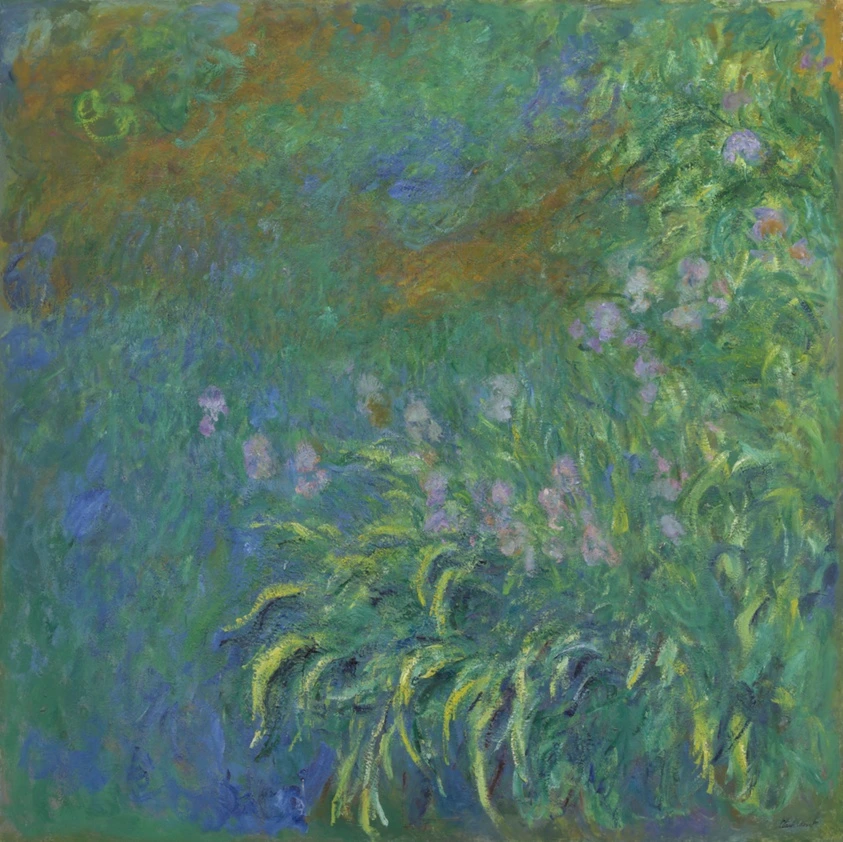
Approximately six and a half feet square, Irises is one of a series of large paintings Claude Monet undertook during World War I experimenting with familiar motifs on an ever-expanding scale. Lacking a discernible horizon or clear sense of depth, the viewer is both on top of and submerged in this encrusted and disorienting surface, suggestive of water, on which various vegetal and floral forms float.

Together with other related canvases, this work remained in the artist’s Giverny studio long after his death in 1926 and was only rediscovered in the 1950s, having suffered localized damage by shrapnel from shells during World War II. In 1956 the Art Institute’s pioneering curator of modern art, Katherine Kuh, bought this painting from Katia Granoff's gallery in Paris. Kuh recognized a formal affinity between Monet’s late experimental painting and the public’s growing interest in large-scale, abstract works like those by Jackson Pollock, whose Greyed Rainbow entered the Art Institute’s collection in 1955.

Provenance

The artist (died 1926); by descent to his son, Michel Monet, Giverny [this and the following per Wildenstein 1996]. Katia Granoff, Paris, by 1956; sold to the Art Institute of Chicago, 1956.

Irises

Claude Monet

1914–17

Accession Number

4887

Medium

Oil on canvas

Dimensions

200 × 200.7 cm (78 3/4 × 79 in.); Framed: 203.8 × 204.5 × 6.4 cm (80 1/4 × 80 1/2 × 1 1/2 in.)

Classification

oil on canvas

Museum

The Art Institute of Chicago

Chicago, United States

Credit Line

Art Institute Purchase Fund
Background & Context

Background Story

Claude Monet's "Irises" (1914–17) belongs to the artist's late period, when the gardens of Giverny had become his overwhelming artistic obsession and the failing of his eyesight was driving him toward ever more radical departures from representational convention. The painting presents a swath of irises — likely from the garden at Giverny, where Monet cultivated over 200,000 plants — in a composition that eliminates the horizon line and fills the canvas edge-to-edge with flowers and foliage, creating an immersive field of color and form that anticipates Abstract Expressionism by decades. Irises were among Monet's most beloved flowers. He planted them along the paths and borders of his water garden at Giverny, where their sword-shaped leaves and rich purple-blue blooms provided striking contrasts with the greens of the surrounding vegetation. The garden itself — which Monet designed, planted, and maintained with the help of a team of gardeners — was not merely a hobby but his primary artistic subject during the last decades of his life. The years 1914–17 were among the most productive and most difficult of Monet's career. The outbreak of World War I brought the conflict devastatingly close to Giverny — Monet could hear the artillery at the front — and his second wife Alice had died in 1911, leaving him alone in the house he had shared with her. In 1912, Monet was diagnosed with cataracts in both eyes, which would progressively cloud his vision until he agreed to surgery in 1923. Despite these challenges — or perhaps because of them — Monet worked with an intensity that astonished even his oldest friends, producing vast canvases of the water lilies and irises that filled his garden. The irises series from this period is characterized by a chromatic intensity and a compositional freedom that distinguish it from Monet's earlier work. Where the paintings of the 1890s are structured by clear horizons, recognizable viewpoints, and identifiable times of day, the late irises dissolve these markers. The viewer is immersed in the flowers as if standing among them, with no clear boundary between the garden and the canvas. The brushwork is more vigorous than in Monet's earlier paintings — individual strokes are longer, more insistent, and more emotionally charged — creating a surface that vibrates with the energy of a man who knew his time was limited and his vision was failing. Monet's late irises paintings would not be exhibited until after his death in 1926. When they were finally shown, their radical departure from Impressionist convention shocked audiences and critics alike. But within a decade, the Surrealists and Abstract Expressionists had claimed Monet as a precursor, recognizing in his late work the same impulse toward total immersion in pure color that would drive their own revolutions.

Cultural Impact

Monet's late garden paintings — including the irises — became foundational texts for Abstract Expressionism, inspiring a generation of American painters to abandon representation in favor of color fields and gestural brushwork.

Why It Matters

These irises, painted during World War I as Monet's eyesight deteriorated, push toward the threshold of abstraction — an immersive field of purple, blue, and green that dissolves the boundary between garden and canvas, observation and inner vision.