Description
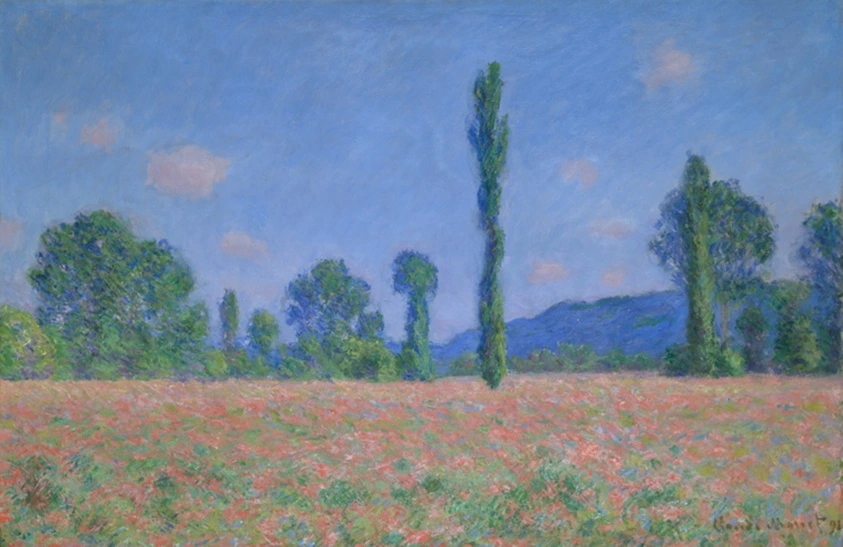
In July 1890, Claude Monet began four almost identically scaled canvases showing poppy fields near his home in Giverny. Although he did not consider these to be a series, like the 25 paintings of stacks of wheat that he began shortly after the harvest that same summer, the works certainly show his growing interest in developing several canvases at once. They also demonstrate a far more homogeneous touch than the freely brushed landscapes of his earlier career, with surfaces that have a tapestry-like materiality.
Provenance
The artist (d. 1926); possibly sold to Hamman, Paris, as agent for Knoedler and Company, New York, Sept. 1891 [per Wildenstein 1996)]. Potter Palmer (d. 1902), Chicago, by January 24, 1893 [per Durand-Ruel, New York, stock book for 1894–1905 (no. 1015, as Coquelicots), as confirmed by Paul-Louis Durand-Ruel and Flavie Durand-Ruel, Durand-Ruel Archives, to the Art Institute of Chicago, Feb. 5, 2013, curatorial object file]; on deposit with Durand-Ruel, New York, by Jan. 24, 1893 [per Durand-Ruel, New York, deposit book for 1888–93 (no. 5041, as Champ de coquelicots), as confirmed by Paul-Louis Durand-Ruel and Flavie Durand-Ruel, Durand-Ruel Archives, to the Art Institute of Chicago, Feb. 5, 2013, curatorial object file]; sold to Durand-Ruel, New York, Jan. 24, 1893, for 5,000 francs [this and the following per Durand-Ruel, New York, stock book for 1894–1905 (no. 1015 as Coquelicots), as confirmed by Paul-Louis Durand-Ruel and Flavie Durand-Ruel, Durand-Ruel Archives, to the Art Institute of Chicago, Feb. 5, 2013, curatorial object file]; sold to William W. Kimball (d. 1904), Chicago, Apr. 16, 1901, for $3,200; by descent to Mrs. Evaline M. Kimball (née Cone, d. 1921); bequeathed to the Art Institute of Chicago, 1922.
Accession Number
4783
Medium
Oil on canvas
Dimensions
61.2 × 93.4 cm (24 1/16 × 36 3/4 in.); Framed: 77.5 × 109.3 × 7 cm (30 1/2 × 43 × 2 3/4 in.)
Classification
oil on canvas
Credit Line
Mr. and Mrs. W. W. Kimball Collection
Background & Context
Background Story
Claude Monet's "Poppy Field (Giverny)" (1890–91) depicts a field of brilliant red poppies stretching across the landscape near Monet's home in Giverny, with figures — likely members of the artist's family — walking along a path that cuts through the flowers toward a line of trees and a cluster of buildings. The painting is one of several poppy-field compositions that Monet produced in the late 1880s and early 1890s, a period when serial painting was becoming his primary method.
The poppy field was a subject of particular significance for Monet. His first major success at the Salon had come in 1874 with "Impression, Sunrise" — the painting that gave Impressionism its name — and the poppy fields around Argenteuil had been among his most popular subjects since the early 1870s. Poppies were abundant in the fields of the Île-de-France, where Monet lived and worked, and their brilliant red blooms against the green of the wheat and grass created a chromatic contrast that perfectly suited his developing technique of painting in complementary color pairs.
By 1890, when this version was painted, Monet had settled permanently in Giverny and was refining the practice of painting the same subject in different conditions of light, weather, and time of day. The poppy field series demonstrates this approach: Monet painted the same field repeatedly, sometimes with figures, sometimes without, sometimes from an elevated viewpoint that emphasized the flat pattern of red flowers against green, sometimes from a lower angle that integrated the field into the surrounding landscape.
The composition of "Poppy Field (Giverny)" is characteristic of Monet's work from this period. The landscape is divided into horizontal bands — the green-blue of the foreground vegetation, the blaze of red poppies, the green of the trees, and the blue-white sky — creating a flattened, nearly abstract pattern of color that anticipates the decorative approach of his later serial paintings. The figures on the path provide a narrative element and a sense of scale, but they are subordinate to the chromatic drama of the poppies, which dominate the canvas with their insistent red.
Monet's poppy field paintings were enormously popular with collectors during his lifetime, and they remain among his most beloved works. The appeal is immediate and visceral: the combination of red and green, which Monet understood as complementary colors that intensify each other when placed side by side, creates a visual vibration that is almost impossible to resist. This chromatic understanding — rooted in the color theories of Chevreul and Delacroix that Monet had studied since the 1860s — was the foundation of Impressionist painting and the source of its revolutionary power.
Cultural Impact
Monet's serial paintings of poppy fields established the practice of painting the same subject under different conditions — a method that would become his defining contribution to art, leading ultimately to the Water Lilies, the Haystacks, and the Rouen Cathedral series.
Why It Matters
This poppy field demonstrates the complementary color contrast — red against green — that was fundamental to Impressionism, while the flattened, pattern-like composition anticipates the serial approach that would define Monet's career.