Cliff Walk at Pourville

Description

In February 1882, Claude Monet went to Normandy to paint, one of many such expeditions that he made in the 1880s. This was also a retreat from personal and professional pressures. His wife, Camille, had died three years earlier, and Monet had entered into a domestic arrangement with Alice Hoschedé (whom he would marry in 1892, after her husband's death). France was in the midst of a lengthy economic recession that affected Monet's sales. In addition, the artist was unenthusiastic about the upcoming seventh Impressionist exhibition—divisions within the group had become pronounced by this time—and he delegated the responsibility for his contribution to his dealer, Paul Durand-Ruel.

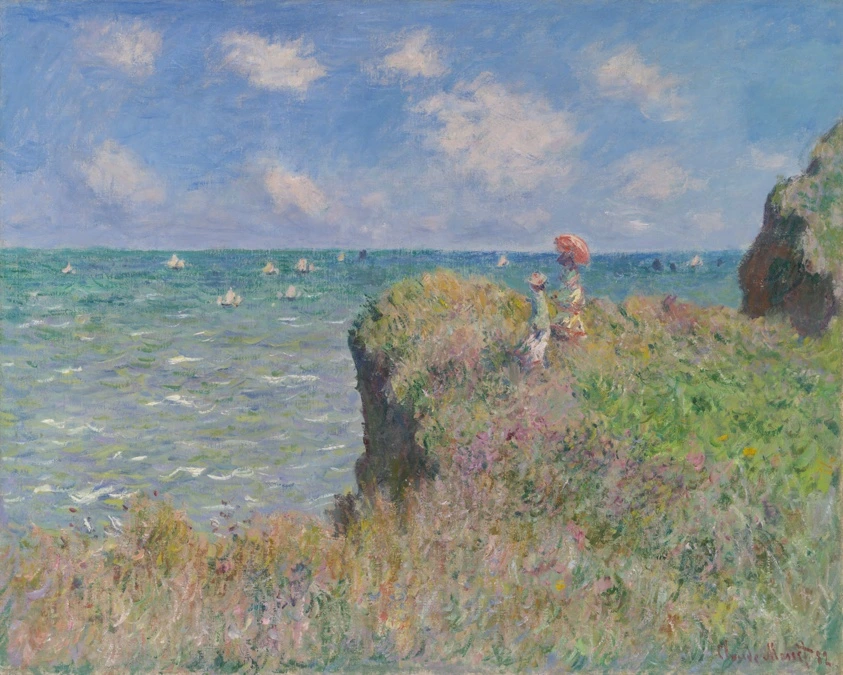
Disappointed in the area around the harbor city of Dieppe, which he found too urban, Monet settled in Pourville and remained in this fishing village until mid-April. He became increasingly enamored of his surroundings, writing to Hoschedé and her children: "How beautiful the countryside is becoming, and what joy it would be for me to show you all its delightful nooks and crannies!" He was able to do so in June, when they joined him in Pourville.The two young women strolling in Cliff Walk at Pourville are probably Marthe and Blanche, the eldest Hoschedé daughters.

In this work, Monet addressed the problem of inserting figures into a landscape without disrupting the unity of its painterly surface. He integrated these elements with one another through texture and color. The grass—composed of short, brisk, curved brushstrokes—appears to quiver in the breeze, and subtly modified versions of the same strokes and hues suggest the women's wind-whipped dresses and shawls and the undulation of the sea. X-radiographs show that Monet reduced the rocky outcropping at the far right to balance the proportions of sea and sky.

Provenance

Hayes, by Mar. 1, 1883 [per Galeries Durand-Ruel 1883]. Hermann Kapferer, Paris, by July 17, 1888 [per Durand-Ruel, Paris, stock book for 1888 (no. 1687), as confirmed by Paul-Louis Durand-Ruel and Flavie Durand-Ruel, Durand-Ruel Archives, to the Art Institute of Chicago, Oct. 5, 2010, curatorial object file. Wildenstein 1996 does not include Hermann Kapferer in the painting’s provenance and claims that Durand-Ruel purchased the painting from Monet in October 1882; the Durand-Ruel Archives are unable to support this claim]; sold to Durand-Ruel, Paris, July 17, 1888, for 1,200 francs [per Durand-Ruel, Paris, stock book for 1888 (no. 1687), as confirmed by Paul-Louis Durand-Ruel and Flavie Durand-Ruel, Durand-Ruel Archives, to the Art Institute of Chicago, Oct. 5, 2010, curatorial object file. Wildenstein 1996 does not include this in the provenance]; possibly sold to Annie Swan Coburn (d. 1932), Chicago, by Apr. 26, 1928 [per Art Institute of Chicago 1932. There is a notation on the Art Institute’s Museum Registration Department Artists Sheets that reads, “Durand-Ruel 995 4/26/28,” and one on receipt 5300 that states “P995 D-R Ap ’26.” This sale cannot be confirmed with the Durand-Ruel Archives, Paul-Louis Durand-Ruel and Flavie Durand-Ruel, Durand-Ruel Archives, to the Art Institute of Chicago, Oct. 5, 2010, curatorial object file]; bequeathed to the Art Institute of Chicago, 1933.

Cliff Walk at Pourville

Claude Monet

1882

Accession Number

14620

Medium

Oil on canvas

Dimensions

66.5 × 82.3 cm (26 1/8 × 32 7/16 in.); Framed: 88.9 × 104.8 × 10.8 cm (35 × 41 1/4 × 4 1/4 in.)

Classification

Painting

Museum

The Art Institute of Chicago

Chicago, United States

Credit Line

Mr. and Mrs. Lewis Larned Coburn Memorial Collection
Background & Context

Background Story

Claude Monet's "Cliff Walk at Pourville" (1882) depicts the dramatic chalk cliffs of the Normandy coast near the fishing village of Pourville (now Hautot-sur-Mer), where Monet spent the winter and early spring of 1882. Two women — likely Monet's companion Alice Hoschedé and one of her daughters — stand on the cliff top, their white dresses blending with the chalk-white rock face as they look out over the sea. The painting captures the exhilarating openness of the coastal landscape with a compositional daring that pushes the figures to the canvas's edge and devotes most of the space to sea, sky, and cliff. Pourville was one of several Normandy coastal villages where Monet worked during the early 1880s, producing series of paintings at Étretat, Dieppe, and other sites along the Channel coast. These coastal campaigns marked an important development in Monet's practice: increasingly, he was working on multiple canvases simultaneously, moving from one to another as the light changed, developing the serial approach that would become his defining method in the 1890s. The composition of "Cliff Walk" is one of Monet's most adventurous. The cliff dominates the lower two-thirds of the canvas, its pale surface filling the picture plane with a near-abstract field of white, cream, and pale blue. The sea and sky occupy the upper third, divided by a horizon line that sits high in the composition, creating a sense of vast openness overhead. The two women are perched at the cliff's edge — tiny figures in a landscape that threatens to swallow them — yet their presence gives the scene a human scale and a sense of leisurely contemplation that contrasts with the wildness of the coastal environment. The painting demonstrates Monet's growing mastery of the broken-color technique that would become the hallmark of Impressionism. Rather than mixing colors on the palette, he applies them in separate brushstrokes of pure pigment, allowing the viewer's eye to blend them optically. The cliff face is not a single tone of white but a shimmering mosaic of pale blue, cream, yellow, pink, and gray strokes, each one recording a moment of visual perception. The sea is a similar symphony of blues, greens, and purples, with white highlights suggesting the movement of waves. The painting also reflects the social changes that were transforming the Normandy coast in the 1880s. The arrival of the railway had brought Parisian tourists to previously remote fishing villages, creating a new leisure culture of seaside promenades, cliff walks, and fashionable bathing. Monet's women on the cliff are participants in this culture — their white dresses and relaxed poses suggest vacationers rather than locals, their presence on the cliff top a sign of the modernization that was reshaping the French coastline.

Cultural Impact

Monet's Normandy coastal paintings of the 1880s documented the transformation of the French seaside from remote fishing villages to fashionable tourist destinations, creating a visual record of the social changes brought by the railway.

Why It Matters

This painting balances the drama of the Normandy cliffs with the leisure of modern seaside tourism — two tiny figures on a vast white cliff face, demonstrating Monet's growing mastery of broken color and compositional daring.