Provenance
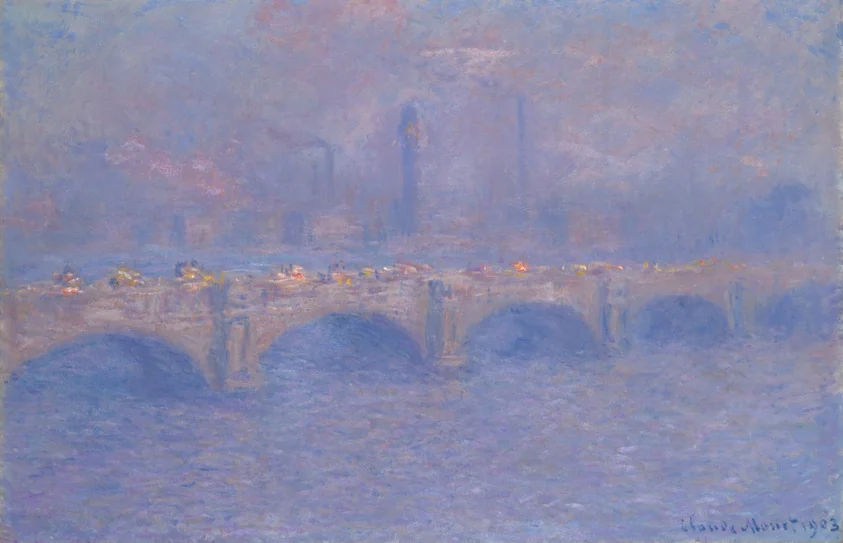
The artist (d. 1926); sold to Durand-Ruel, Paris, May 11, 1904, for 9,000 francs [this and the following per Durand-Ruel, Paris, stock book for 1901–13 (no. 7641, as La Tamise à Londres, Waterloo Bridge, effet de soleil, 1903), as confirmed by Paul-Louis Durand-Ruel and Flavie Durand-Ruel, Durand-Ruel Archives, to the Art Institute of Chicago, Feb. 21, 2013, curatorial object file]; sold to Durand-Ruel, New York, Dec. 14, 1904 or Jan. 6, 1905 [see previous; also per Durand-Ruel, New York stock book for 1904–1924 (no. 2965, as La Tamise à Londres, Waterloo Bridge, effet de soleil, 1903), as confirmed by Paul-Louis Durand-Ruel and Flavie Durand-Ruel, Durand-Ruel Archives, to the Art Institute of Chicago, Feb. 21, 2013, curatorial object file]; sold to W. A. Putnam, Jan. 10, 1905, for $4,000 [per Durand-Ruel, New York, stock book for 1904–24 (no. 2965, as La Tamise à Londres, Waterloo Bridge, effet de soleil, 1903), as confirmed by Paul-Louis Durand-Ruel and Flavie Durand-Ruel, Durand-Ruel Archives, to the Art Institute of Chicago, Feb. 21, 2013, curatorial object file; according to Wildenstein 1996, this sale was to A. M. Putnam]; sold back to Durand-Ruel, New York, May 22, 1913, for 25,000 francs [this and the following per Durand-Ruel, New York, stock book for 1904–24 (no. 3646, as La Tamise à Londres, Waterloo Bridge, effet de soleil, 1903), as confirmed by Paul-Louis Durand-Ruel and Flavie Durand-Ruel, Durand-Ruel Archives, to the Art Institute of Chicago, Feb. 21, 2013, curatorial object file; according to Wildenstein 1996, the painting was owned by Lawrence J. Abbott and William Lowell Putnam, c. 1913]; sold to Martin A. Ryerson (d. 1932), Chicago, Feb. 10, 1914, for $7,500 [see previous; also a purchase receipt on Durand-Ruel letterhead, dated February 10, 1914, which details that this painting (no. 3646, Monet, Waterloo Bridge, London, 1903) was acquired by M. A. Ryerson, in addition to two other paintings (no. 3668, Monet, La cabane de douaniers, 1897; and no. 3768, Monet, Les nymphéas, paysage d’eau, 1906 [cat. 44]) for $20,000, photocopy in curatorial object file]; bequeathed to the Art Institute of Chicago, 1933.