Description
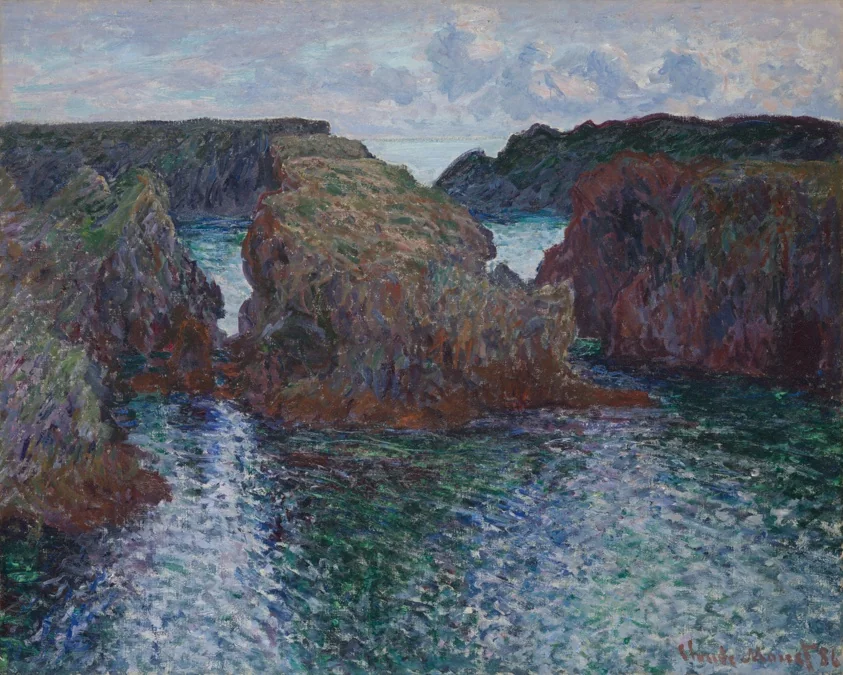
Belle-Île, a small island off the southern shore of Brittany, was known for its dramatic cliffs, rock formations, and grottoes. As he often did, Claude Monet misjudged the time he would need to explore and capture the beauty of the place, which he variously called “lugubrious,” “terrifying,” and “very beautiful.” He came for two weeks and stayed for more than two months. This canvas is one of a group depicting the frieze of rock formations known as Port-Goulphar.
Provenance
The artist (d. 1926); sold to Durand-Ruel, Paris, Dec. 21, 1892, for 4,500 francs [this and the following per Durand-Ruel, Paris, stock book for 1891–1901 (no. 2542), as confirmed by Paul-Louis Durand-Ruel and Flavie Durand-Ruel, Durand-Ruel Archives, to the Art Institute of Chicago, Feb. 5, 2013, curatorial object file]; sold to Durand-Ruel, New York, Dec. 19, 1895 or Jan. 4, 1896 [see previous and New York stock book for 1894–1905 (no. 1515, as Belle Isle), both confirmed by Paul-Louis Durand-Ruel and Flavie Durand-Ruel, Durand-Ruel Archives, to the Art Institute of Chicago, Feb. 5, 2013, curatorial object file; The Paris and New York Durand-Ruel stock books record different dates for the sale]; sold to Mrs. Harriet Borland (née Blair, d. 1933), Chicago, Mar. 6, 1897, for $2,000 [per Durand-Ruel, New York, stock book for 1894–1905 (no. 1515), as confirmed by Paul-Louis Durand-Ruel and Flavie Durand-Ruel, Durand-Ruel Archives, to the Art Institute of Chicago, Feb. 5, 2013, curatorial object file]; by to her son Chauncey Blair Borland, Chicago, 1933; given by Mr. and Mrs. Chauncey B. Borland, Chicago, to the Art Institute of Chicago, beginning in 1964 [The painting was given to the Art Institute of Chicago in undivided fractional interests beginning in 1964. The Art Institute received the final fractional interest for one hundred percent ownership in 1973.]
Accession Number
20545
Medium
Oil on canvas
Dimensions
66 × 81.8 cm (26 × 32 3/16 in.); Framed: 83.9 × 100.4 × 9.9 cm (33 × 39 1/2 × 3 7/8 in.)
Classification
Painting
Credit Line
Gift of Mr. and Mrs. Chauncey B. Borland
Tags
Color: Blue Color: Gray
Background & Context
Background Story
In September 1886, Monet traveled to Belle-Île-en-Mer, a rugged island off the southern coast of Brittany, seeking what he described as "wild and terrible" coastal scenery to challenge his brush. "Rocks at Port-Goulphar, Belle-Île" shows the island's granite coast pounded by Atlantic waves, the dark stone formations rising from foam with geological violence. The painting is among the most dramatic of Monet's marine works, abandoning the gentle Normandy cliffs for something closer to Romantic sublime—yet rendered with the analytical color separation of mature Impressionism. The palette is notably darker and more saturated than his usual coastal scenes, with deep violets, emerald greens, and slate grays dominating the composition. Monet stayed on Belle-Île for approximately seven weeks, producing around thirty canvases that he considered among his most important. He wrote to Gustave Geffroy that the sea here was "mad," and the painting conveys that frenzy through broken brushwork that makes the wave surfaces vibrate against the static mass of rock. The work also demonstrates his growing willingness to let paint assert its own materiality: thick impasto in the surf, scraped passages in the wet sand, and visible canvas texture in the sky all call attention to the painting as an object rather than a transparent window.
Cultural Impact
This dramatic marine canvas expands Monet's range into Romantic terrain while maintaining Impressionist color analysis, influencing later Symbolist and Expressionist seascapes.
Why It Matters
It matters as Monet's confrontation with nature's violence—proof that Impressionism could handle the sublime, not just the pleasant.