Description
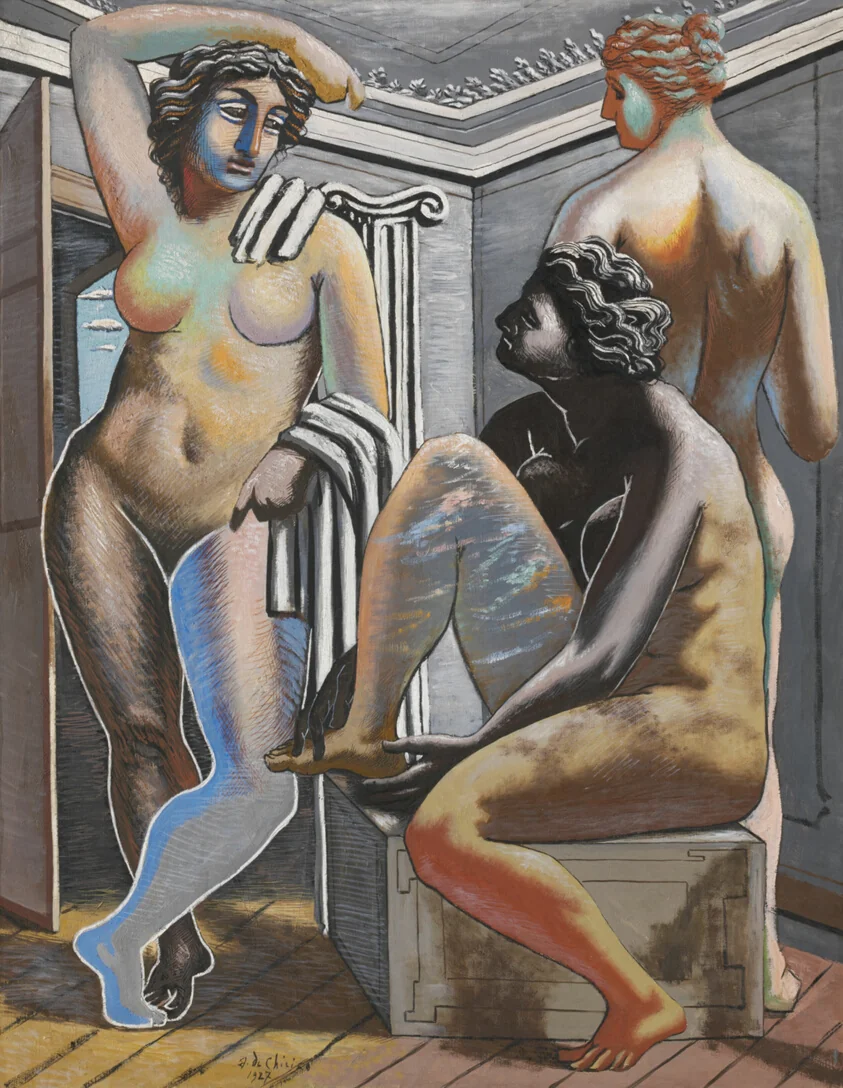
In the years following World War I, artists across Europe sought to put the disruptions of war behind them. Searching for a new artistic vocabulary, they moved away from the fragmented forms of prewar Cubism and looked to the classical tradition, forging what was known as the “return to order.” This new style had many sources of inspiration, including the art of ancient Greece and Rome, the Renaissance, and even later Neoclassical revivals. Giorgio de Chirico was likewise attracted to the idea of classicism; his The Eventuality of Destiny is in part the result of his study of the works and techniques of the Old Masters.
Provenance
Galerie de L’Effort Moderne (Léonce Rosenberg), Paris, by 1928 [Léonce Rosenberg Archive, negative no. 14-N-902]; sold to Valentine Gallery, New York, 1928 [this and the following according to letter from Julia May Boddewyn, Apr. 9, 1997, in curatorial file]; sold to Mr. Frederic Clay Bartlett, Jr., Chicago, by Nov. 1928 [letter mentioned above]; by descent to his wife, Evelyn Bartlett, Beverly, MA and Ft. Lauderdale, FL, 1956; given to the Art Institute of Chicago, 1964.
Accession Number
20554
Medium
Oil on canvas
Dimensions
146 × 114.3 cm (57 1/2 × 45 in.)
Classification
oil on canvas
Credit Line
Gift of Mrs. Frederic C. Bartlett
Background & Context
Background Story
Giorgio de Chirico's "The Eventuality of Destiny" (1927) is an oil on canvas from the later phase of the artist's Metaphysical period. By 1927, de Chirico's style had evolved from the spare, enigmatic piazzas of his early Metaphysical works toward a more complex and sometimes more conventional mode, but the distinctive qualities of his vision remained. The title "The Eventuality of Destiny" suggests a philosophical meditation on fate, chance, and the course of human life. The painting likely features the characteristic elements of de Chirico's art: classical architecture, long shadows, enigmatic objects, and a sense of suspended time. The composition may include the mannequin-like figures that appeared in some of his works, or the strange juxtapositions of objects that create a sense of inexplicable significance. The palette is warm and clear, the light bright but unearthly. This painting belongs to the period when de Chirico was becoming increasingly suspicious of the Surrealists who had claimed him as their precursor, and his work from this time shows him both continuing and questioning the Metaphysical tradition he had founded.
Cultural Impact
De Chirico's later Metaphysical works demonstrate the persistence of his unique vision, even as he distanced himself from the Surrealist movement that had been inspired by his earlier paintings.
Why It Matters
This enigmatic painting, with its philosophical title and mysterious imagery, explores the themes of fate and destiny that pervade de Chirico's work, the dreamlike space and unexplained objects creating a world of perpetual uncertainty.