The Black Place

Description

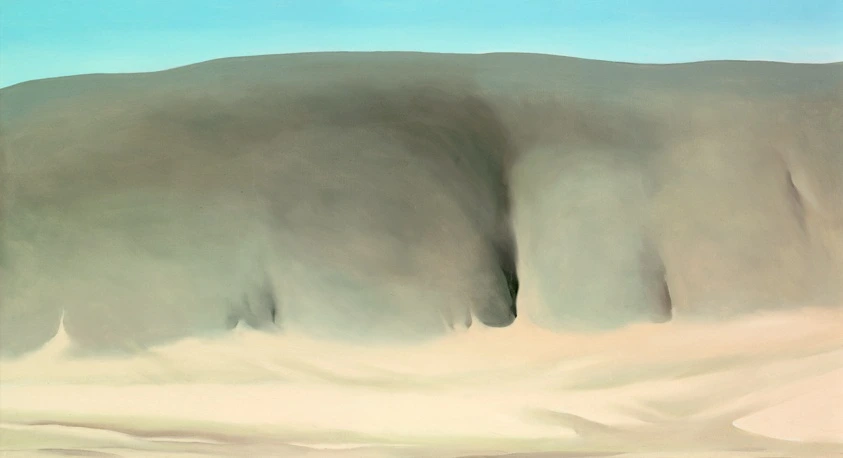
The Black Place features an unusually muted palette for Georgia O’Keeffe’s Southwestern paintings: the composition is dominated by shades of white and gray, relieved only by a thin strip of blue sky at the top. “The Black Place” was the name she gave her favorite location to paint, an area of the Bisti/De-Na- Zin Wilderness (also known as the Bisti Badlands) located approximately 150 miles west of Abiquiu, New Mexico. While she painted numerous images of the region’s rounded, gray hills, here she depicted a low, sandy crest that reminded her of her husband, Alfred Stieglitz, as she wrote to him: “When I see the country in its silvery beauty and forbidding blackness in my memory—it is so often almost as if I see you too—your silvery hair and grey clothes and black cape.”

Provenance

Georgia O’Keeffe (1887–1986), New York and New Mexico, then Abiquiú, NM, from 1949 [on loan to the Art Institute of Chicago from 1949; letter from O’Keeffe to Charles C. Cunningham, Dec. 9, 1969; copy in curatorial object file]; given through the Alfred Stieglitz Collection to the Art Institute of Chicago, 1969.

The Black Place

Georgia O'Keeffe

1943

Accession Number

32630

Medium

Oil on canvas

Dimensions

50.7 × 91.5 cm (19 15/16 × 36 in.)

Classification

Painting

Museum

The Art Institute of Chicago

Chicago, United States

Credit Line

Alfred Stieglitz Collection, gift of Georgia O'Keeffe
Background & Context

Background Story

The Black Place from 1943 depicts the black and gray hills of the Bisti Badlands in northwestern New Mexico—a landscape so desolate and dramatic that O'Keeffe called it 'the Black Place' and returned to paint it repeatedly throughout the 1940s. The painting transforms the eroded sandstone formations into an abstract composition of dark hills and light sky, reducing the landscape to its essential forms with the directness and intensity that characterize O'Keeffe's best landscape paintings. The 1943 date places this in the period when O'Keeffe was producing her most radical landscape paintings, reducing the New Mexico terrain to its geometric essentials.

Cultural Impact

O'Keeffe's Black Place paintings are among the most radical landscape paintings in American art because they reduce the landscape to its geometric essentials without losing its specific character. The Black Place from 1943 is not an abstract painting but a landscape reduced to its essential forms—the eroded hills rendered as dark shapes against a light sky, recognizable as a specific place but transformed into a composition of pure form and color.

Why It Matters

The Black Place is O'Keeffe's landscape reduced to geometric essentials: the eroded sandstone hills of the Bisti Badlands transformed into dark shapes against light sky, recognizable as a specific place but composed as pure form. The 1943 painting is among O'Keeffe's most radical landscape works, reducing the New Mexico terrain to its irreducible shapes.