The Home of the Heron

Description

The landscape painter George Inness once explained, “The true purpose of the painter is simply to reproduce in other minds the impression which a scene has made upon him . . . to awaken an emotion.” Inness sought, particularly in his later years, to record not so much the appearance of nature as its poetry. To achieve this, he limited his subject matter to, in his words, “rivers, streams, the rippling brook, the hillside, the sky, the clouds.” For half a century, the artist captured these moisture-laden subjects in all seasons, during all hours of the day and night. First he made small, quick sketches in the field or wood, and then, in the seclusion of his studio, he used them to create the more than one thousand oils credited to him.

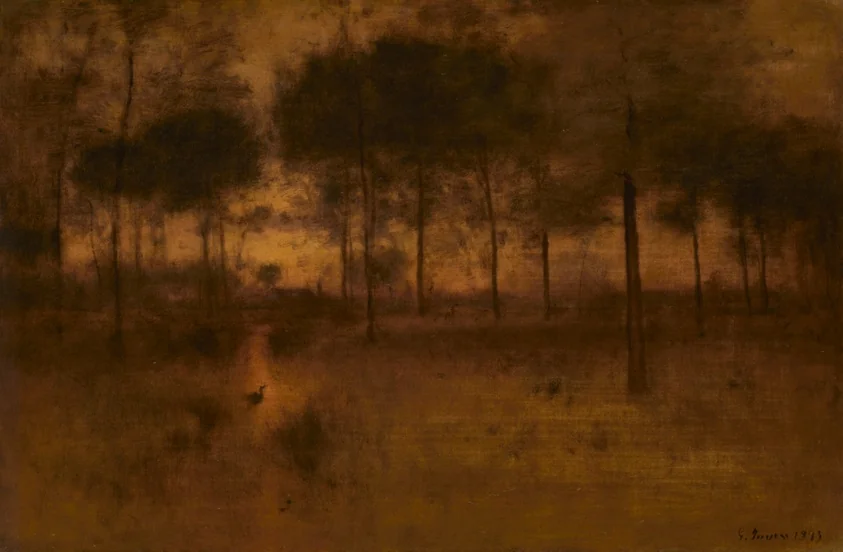
Inness completed The Home of the Heron near the end of his career, after he had finally achieved a degree of comfort and success. The painting is characteristic of his late work, with loosely rendered detail and dim objects that seem bathed in an almost incandescent glow. The picture’s blurred outlines, broad handling, and delicate, subtle tonalities, as well as the solitary presence of the heron, masterfully evoke nature’s stillness and mystery. With more than two dozen canvases by Inness, the Art Institute has one of the most comprehensive collections of the painter’s work.

Provenance

Estate of the artist (sale, Fifth Avenue Galleries, New York, February 12-14, 1895, no. 69, as "The Sun's Last Reflection"); E.W. Bass, 1895; Emerson McMillin, New York, to 1911; Knoedler & Co., New York, 1911; Reinhardt Galleries, Chicago, 1911; sold to Edward B. Butler, Chicago, 1911; given to the Art Institute of Chicago, 1911.

The Home of the Heron

George Inness

1893

Accession Number

64724

Medium

Oil on canvas

Dimensions

76.2 × 115.2 cm (30 × 45 in.)

Classification

Painting

Museum

The Art Institute of Chicago

Chicago, United States

Credit Line

Edward B. Butler Collection

Background & Context

Background Story

"The Home of the Heron" is an 1893 oil on canvas by George Inness that captures the American Tonalist painter in his most spiritually suggestive and atmospherically unified mode, the image showing a marsh or wetland scene rendered with the same muted palette and thick, atmospheric brushwork that made Inness the defining master of American Tonalism. The composition is a medium-sized canvas—76.2 × 115.2 centimeters—showing a heron's home in a marsh with the oil on canvas creating a surface of extraordinary atmospheric density and spiritual suggestion. The 1893 date places this work in the period of Inness's most mature and spiritually ambitious production, when he was producing the paintings that expressed his Swedenborgian beliefs and his vision of nature as a manifestation of the divine. Art historians have connected this painting to the broader tradition of the spiritual landscape in American art, from the paintings of the Hudson River School to the works of the American Impressionists, noting that Inness's treatment is more focused on the atmospheric unity and the spiritual suggestion, the transformation of observed nature into visual theology, than the topographical accuracy or the naturalistic observation of these other traditions.

Cultural Impact

This 1893 oil canvas made heron home spiritually atmospheric through medium 76cm muted palette thick brushwork and marsh atmospheric density, using mature Swedenborgian period to transform wetland observation into visual theology beyond Hudson River School topographical naturalism.

Why It Matters

It matters because Inness painted a heron's home and made the canvas feel like it was whispering about God in grey and green—proving that even a swamp could be a church if the atmosphere was deep enough.