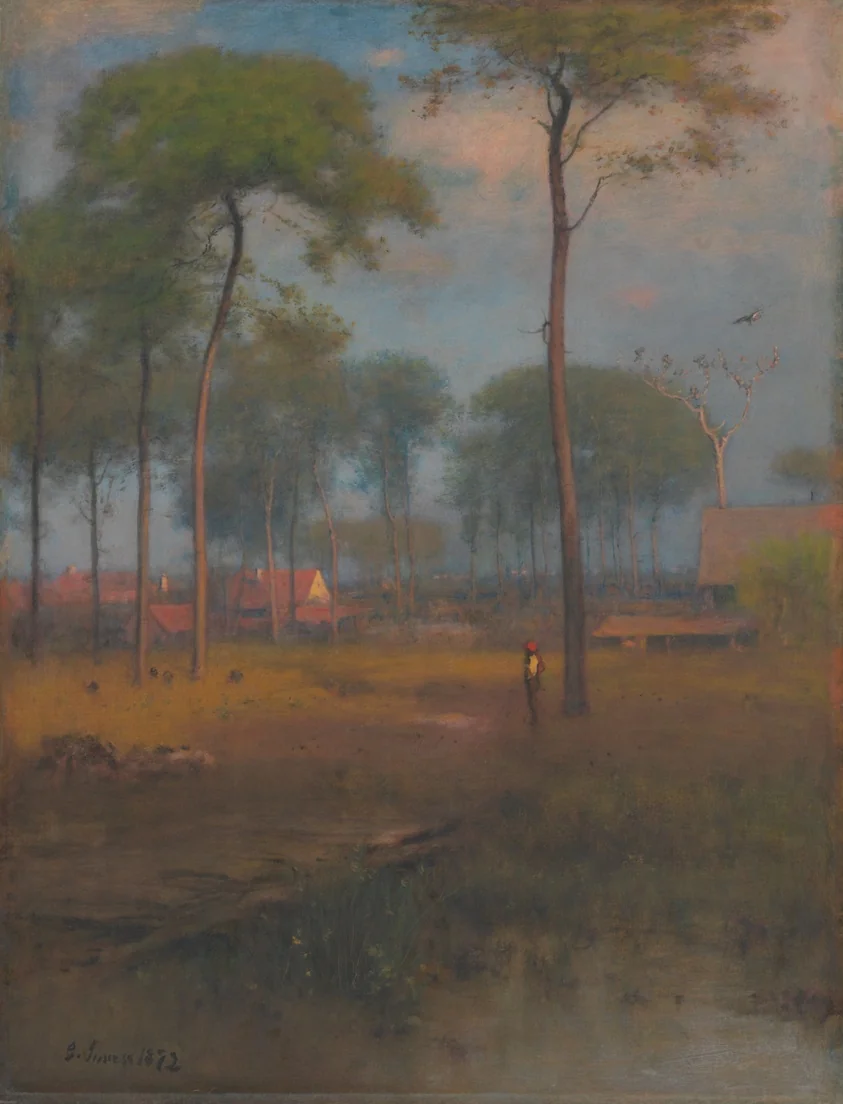
Early Morning, Tarpon Springs

Description

In 1878 the painter George Inness wrote in Harper’s magazine:

"Details in the pictures must be elaborated only enough fully to reproduce the impression that the artist wishes to reproduce. When [there are more details], the impression is weakened or lost, and we see simply an array of external things which may be cleverly painted and may look very real, but which do not make an artistic painting. . . . The one is poetic truth, the other is scientific truth; the former is aesthetic, the latter is analytic."

In the course of his lengthy career, Inness increasingly eschewed precision of detail in his paintings, conveying mood and emotion through richness of tone and broadness of handling. He first visited Florida about 1890, and he subsequently established a house and studio in Tarpon Springs, where he executed this painting. In a pink-and-blue morning light, a lone man studies a cluster of buildings in the middle distance. Through blurred outlines and delicate, subtle tonalities, as well as the solitary presence of the figure, Inness masterfully evoked the brightening day and peaceful mood of this moment.

Provenance

Reinhardt Galleries, Chicago, 1911; sold to Edward B. Butler, Chicago, 1911; given to the Art Institute of Chicago, 1911.

Early Morning, Tarpon Springs

George Inness

1892

Accession Number

64729

Medium

Oil on canvas

Dimensions

107.2 × 82.2 cm (42 3/16 × 32 3/8 in.)

Classification

Painting

Museum

The Art Institute of Chicago

Chicago, United States

Credit Line

Edward B. Butler Collection

Background & Context

Background Story

"Early Morning, Tarpon Springs" is an 1892 oil on canvas by George Inness that captures the American Tonalist painter in his most luminously atmospheric and coloristically refined mode, the image showing the Florida morning rendered with the same golden light and atmospheric depth that characterized his most powerful late works. The composition is a large canvas—107.2 × 82.2 centimeters—showing the early morning light in Tarpon Springs with the oil on canvas creating a surface of extraordinary luminosity and atmospheric warmth. The 1892 date places this work in the final years of Inness's life, when he was producing the Florida paintings that demonstrated his mastery of southern light and his continued evolution as a painter of spiritual atmosphere. Art historians have connected this painting to the broader tradition of the Florida landscape in American art, from the paintings of the period to the works of the American Impressionists, noting that Inness's treatment is more focused on the atmospheric unity and the spiritual suggestion, the transformation of observed morning into golden vision, than the topographical accuracy or the naturalistic observation of these other traditions.

Cultural Impact

This 1892 oil canvas made Florida morning luminously golden through large 107cm southern-light atmospheric warmth and final-year spiritual evolution, using late Florida production to transform observed dawn into golden meditative vision beyond American Impressionist topographical naturalism.

Why It Matters

It matters because Inness painted a Florida morning and made the canvas feel like it was greeting the day with quiet awe—proving that even a sunrise could be a revelation if the atmosphere was warm enough.