Description
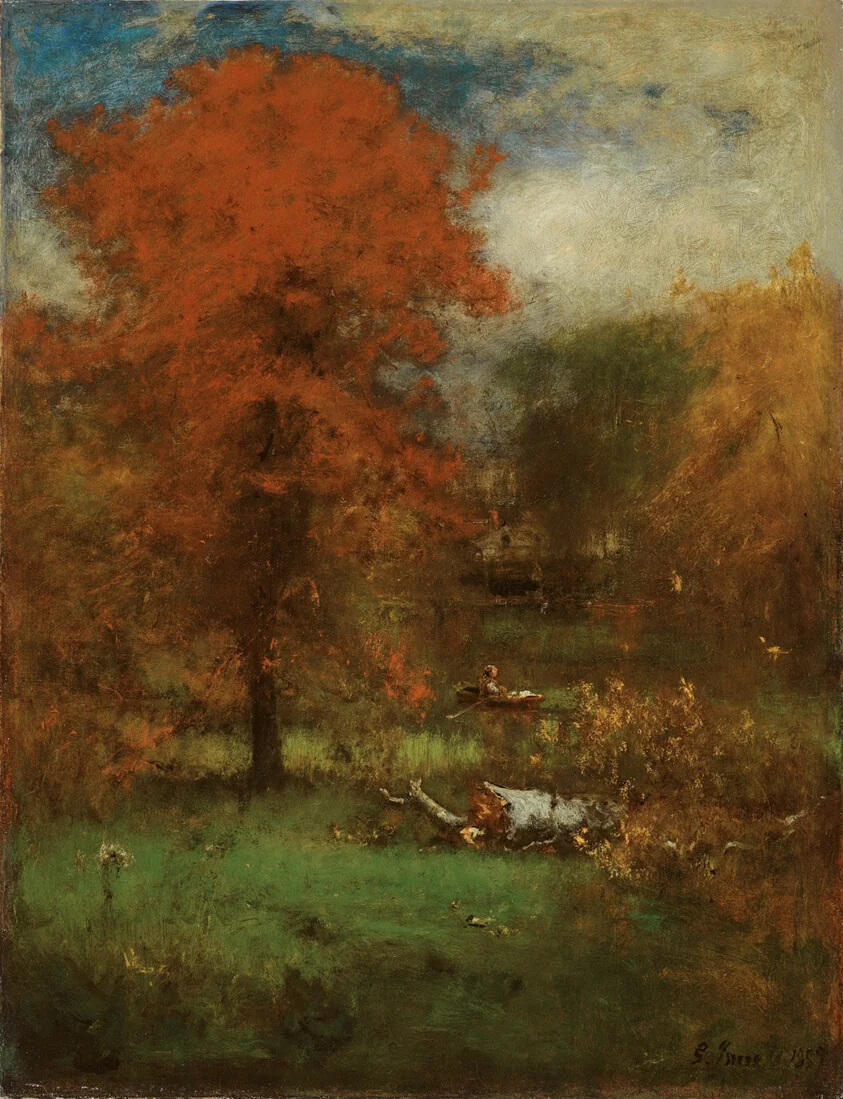
A distinctive landscape painter of the 19th century, George Inness excelled at capturing the poetics and mood of his environs, finding spiritual resonances in nature, from its grand vistas to its quiet nooks. The Mill Pond depicts a sylvan setting, in which a small figure rows a boat in the pond at middle distance. Brilliant pigments of orange, green, and blue electrify an otherwise tranquil scene. Through color and atmosphere rather than line or detail, Inness communicated an intensity of vision, fueled by an individual encounter with nature.
Provenance
Thomas B. Clarke (sale, American Art Association, New York, February 14-18, 1899); Emerson McMillin, New York, from 1899 to 1911; Knoedler & Co., New York, 1911; Reinhardt Galleries, Chicago, 1911; sold to Edward B. Butler, Chicago, 1911; given to the Art Institute of Chicago, 1911.
Accession Number
151108
Medium
Oil on canvas
Dimensions
95.9 × 75.6 cm (37 3/4 × 29 3/4 in.)
Classification
Painting
Credit Line
Edward B. Butler Collection
Background & Context
Background Story
George Inness's "The Mill Pond" (1889) is an oil on canvas from the late period of the artist's career, when his style had become increasingly soft, atmospheric, and spiritualized. The mill pond—an artificial pond created by damming a stream to power a mill—was a common feature of the American landscape, and Inness's treatment transforms this ordinary subject into a vision of transcendent beauty. The painting shows the pond with its surrounding trees, the mill building perhaps visible in the distance, the whole scene enveloped in a soft, hazy light. Inness's late technique is characterized by loose, soft brushwork, a subdued but rich palette, and a focus on the overall atmosphere rather than specific details. The forms dissolve into the light, creating a sense of nature as a veil through which a higher spiritual reality might be perceived. Inness was deeply influenced by the theology of Emanuel Swedenborg, who believed that the natural world was a symbol of the spiritual world, and his late landscapes are meditations on this idea.
Cultural Impact
Inness's late Tonalist landscapes were among the most spiritually ambitious works of 19th-century American art, seeking to represent nature as a revelation of divine presence.
Why It Matters
This late painting of a mill pond captures the spiritual dimension of Inness's art, the soft light and dissolving forms creating a vision of nature as a threshold to a higher reality.