Provenance
(Sale, Fifth Avenue Art Galleries, New York, February 7-8, 1901, no. 110). Emerson McMillin, New York. M. Knoedler & Co., New York, 1911; sold to Edward B. Butler, Chicago, 1911; given to the Art Institute of Chicago, 1911.
Accession Number
64736
Medium
Oil on canvas
Dimensions
73.8 × 114.3 cm (29 1/16 × 45 in.)
Classification
Painting
Credit Line
Edward B. Butler Collection
Background & Context
Background Story
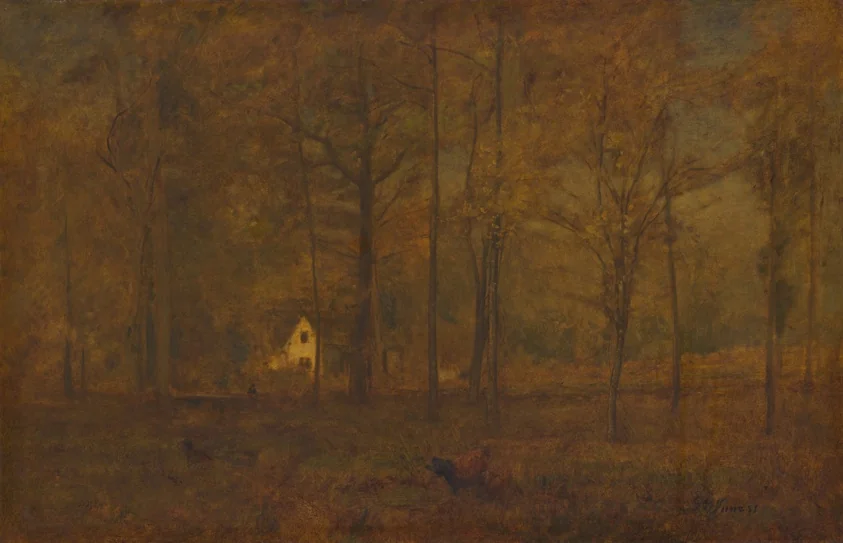
George Inness's "Autumn Woods" (1891–94) is an oil on canvas depicting the forest in autumn, the season of color and transformation. Autumn was a subject that appealed deeply to Inness, offering a palette of extraordinary richness and variety as the leaves turned from green through gold and red to brown. This painting shows a woodland scene, the trees in their autumn colors, the forest floor carpeted with fallen leaves. Inness's treatment is characteristically atmospheric, the forms softened and blurred, the colors modulated into a harmonious whole. The palette is dominated by the warm colors of autumn—golds, oranges, russets, and touches of remaining green. The brushwork is loose and expressive, the trees and leaves suggested rather than described in detail. The date range 1891–94 encompasses the final years of Inness's life, when his Tonalist style had achieved its fullest development. The autumn woods become a meditation on the cycle of the seasons, the beauty of decay, and the promise of renewal that follows the fall.
Cultural Impact
Inness's autumn landscapes are among the most beautiful works of American Tonalism, capturing the rich colors and reflective mood of the fall season with extraordinary sensitivity.
Why It Matters
This painting of autumn woods captures the rich colors and quiet beauty of the fall forest, Inness's soft handling and warm palette transforming the seasonal cycle into a meditation on time, change, and the enduring beauty of nature.