Provenance
Possibly with Thomas B. Clarke, New York; Emerson McMillin, New York, to 1911; with M. Knoedler & Co., New York, 1911; with Reinhardt Galleries, Chicago, 1911; sold to Edward B. Butler, Chicago, 1911; given to the Art Institute of Chicago, 1911.
Accession Number
64768
Medium
Oil on artist's board
Dimensions
61 × 82.9 cm (15 5/8 × 24 in.)
Classification
Painting
Credit Line
Edward B. Butler Collection
Background & Context
Background Story
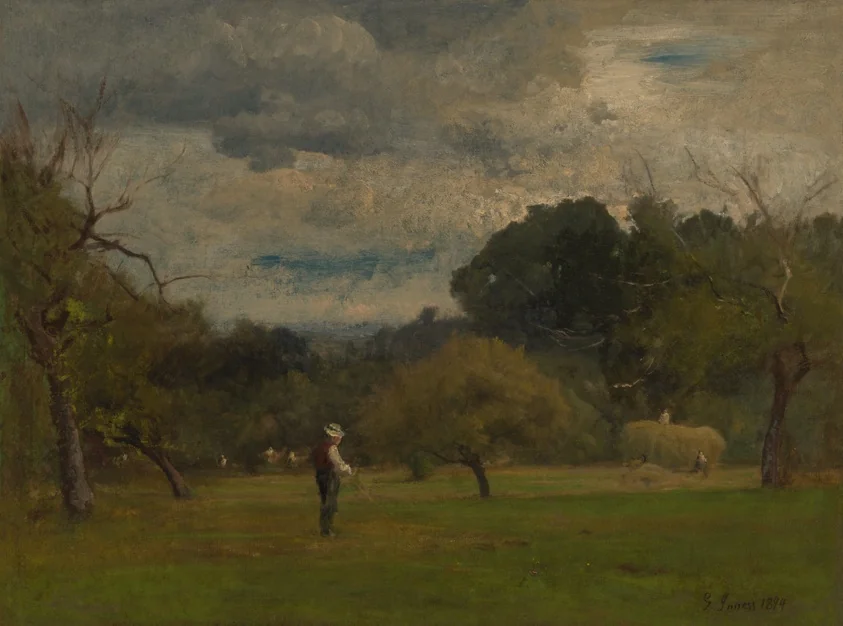
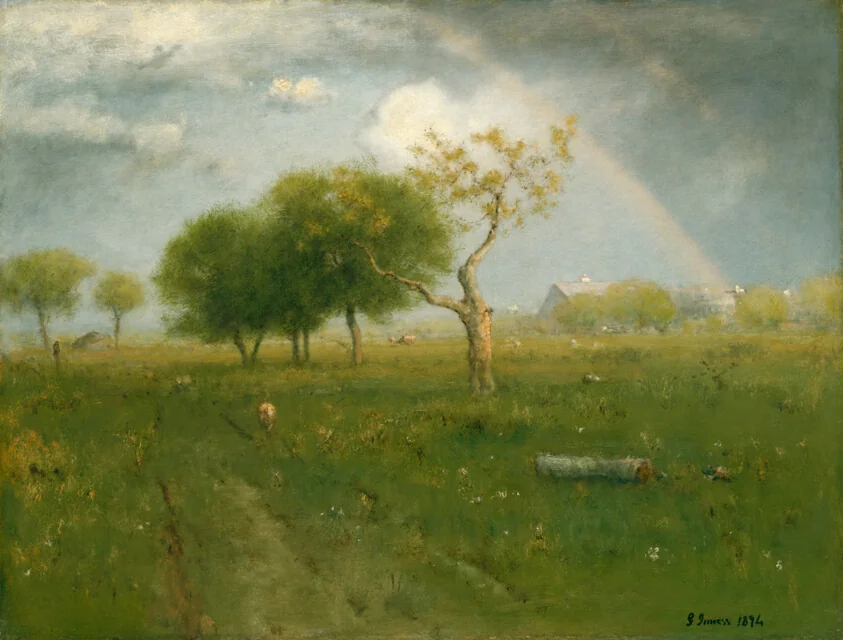
George Inness's "Delaware Valley" (c. 1865–75) is an oil on artist's board depicting the valley of the Delaware River, a region that was a popular subject for Hudson River School painters. This work dates from the middle period of Inness's career, when he was moving from the detailed style of his early Hudson River School work toward the more atmospheric Tonalist style of his later years. The Delaware Valley is shown with its characteristic rolling hills, farmland, and the river winding through the landscape. The handling is more detailed than Inness's later works, with individual trees and buildings clearly delineated, but there is already a sensitivity to atmosphere and the effects of light that anticipates his mature style. The palette is naturalistic, with the greens of the vegetation, the browns of the earth, and the blues of the sky rendered in a harmonious range. The artist's board support gives the painting a more intimate, sketch-like quality than Inness's larger canvases.
Cultural Impact
Inness's middle-period landscapes document the transition from the detailed naturalism of the Hudson River School to the more personal, atmospheric style of his Tonalist maturity.
Why It Matters
This view of the Delaware Valley shows Inness at a transitional moment, the careful observation of the Hudson River School beginning to give way to the more atmospheric and personal vision of his later work.