Provenance
Possibly American Art-Union, New York; possibly Henry E. Russell, Macon, GA, 1848 by distribution from the American Art-Union. Dr. John Kepke, Brooklyn, by c.1916; by descent to Edith K. MacDonald, Elk Grove, CA; given to the Art Institute of Chicago, 1977.
Accession Number
94127
Medium
Oil on canvas
Dimensions
57.2 × 62.2 cm (22 1/2 × 24 1/2 in.)
Classification
Painting
Credit Line
Gift of Mrs. Edith Kepke MacDonald
Background & Context
Background Story
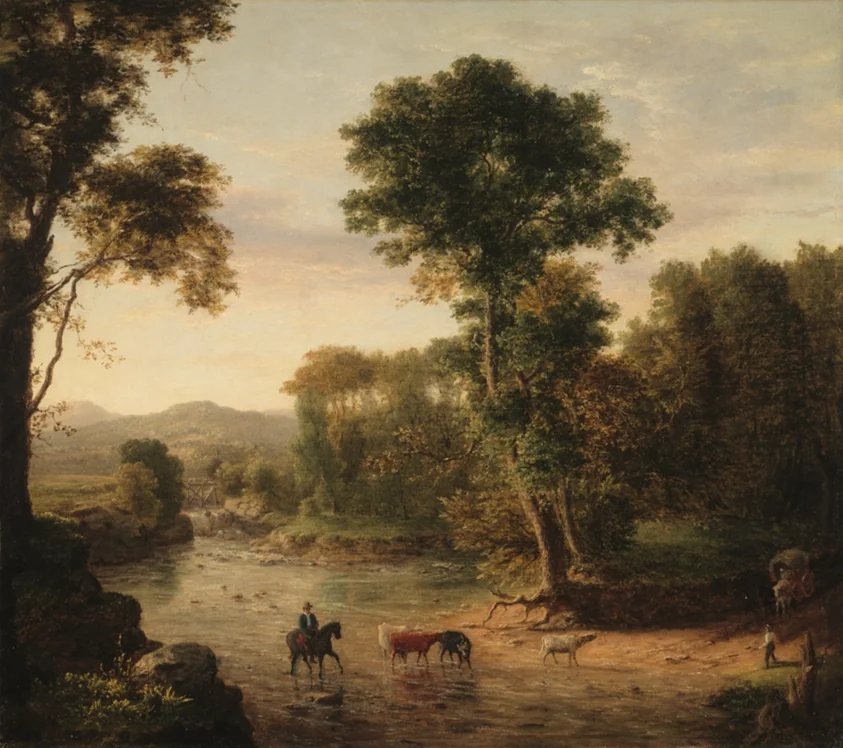
George Inness's "Crossing the Ford" (1848) is an oil on canvas from the very beginning of Inness's career, painted when he was just 23 years old. This early work shows the influence of the Hudson River School and the detailed landscape style that dominated American painting of the period. The subject—figures crossing a shallow river crossing, or ford—was a classic motif of 19th-century landscape painting, offering opportunities to depict both human activity and natural scenery. The painting shows the ford with its figures, the surrounding landscape rendered with careful attention to detail. The technique is more precise and less atmospheric than Inness's later works, with individual trees, rocks, and figures clearly delineated. The palette is naturalistic and fairly conservative. This painting is important for understanding Inness's development: it shows the young artist working within the conventions of the Hudson River School before he developed the more personal, poetic, and atmospheric style of his maturity. Even in this early work, however, there is a sensitivity to light and composition that anticipates his later achievements.
Cultural Impact
Inness's early Hudson River School works document the foundation of his art, providing a baseline against which the evolution of his personal style can be measured.
Why It Matters
This early landscape of a river crossing shows the young Inness mastering the conventions of the Hudson River School, the careful observation and detailed handling laying the groundwork for the more visionary style of his maturity.