Provenance
Sold by Valori Plastici, Rome, to G. Bonetti, May 1927 [letter from Georgette Passedoit to Carl Schniewind of May 16, 1946 in curatorial file]; sold to Passedoit Gallery, New York, c. July 1943 [letter mentioned above]; sold to Theodor Schemmp, New York [letter mentioned above]; sold to the Art Institute, 1944.
Accession Number
51398
Medium
Graphite on cream wove paper
Dimensions
30.2 × 22.1 cm (11 15/16 × 8 3/4 in.)
Classification
graphite
Credit Line
William McCallin McKee Memorial Endowment
Background & Context
Background Story
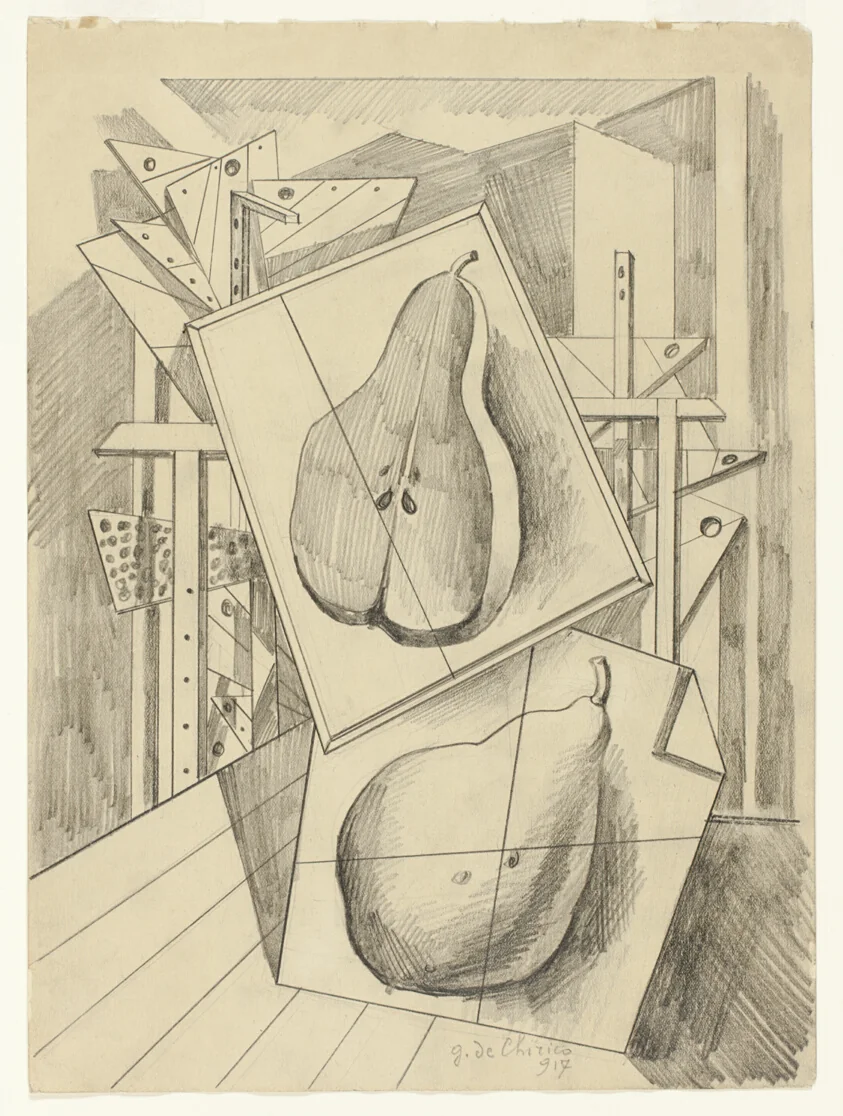
Giorgio de Chirico's "Autumnal Still Life" (1917) is a graphite drawing on cream wove paper that applies the Metaphysical sensibility to the traditional genre of still life. The title "Autumnal Still Life" suggests the season of fall, with its associations of decay, melancholy, and the passage of time. The drawing likely shows a tabletop arrangement of objects—perhaps fruits, a bottle, or other still-life elements—but rendered with the mysterious, uncanny quality that characterizes all of de Chirico's work. The objects may be displaced from their expected contexts, or combined in ways that create a sense of inexplicable significance. The graphite technique is precise and controlled, the forms delineated with clarity. The year 1917 was a crucial one for de Chirico: he was serving in the Italian army, but he continued to paint and draw, producing some of the most important works of his Metaphysical period. This still life may reflect the wartime context in its subdued mood and its meditation on transience and mortality.
Cultural Impact
De Chirico's Metaphysical still lifes transform the most traditional genre of painting into a vehicle for his unique vision, finding mystery and significance in the most ordinary objects.
Why It Matters
This autumnal still life captures de Chirico's ability to invest everyday objects with a sense of mystery and significance, the precise drawing and enigmatic arrangement creating a meditation on time and transience.