Provenance
Mary and Leigh Block, Chicago, by 1970 [du Plessix 1970]; given to the Art Institute, 1988.
Accession Number
110995
Medium
Graphite, with erasing and touches of smudging, on cream laid paper
Dimensions
27.2 × 20 cm (10 3/4 × 7 7/8 in.)
Classification
graphite
Credit Line
Gift of Mary and Leigh Block
Background & Context
Background Story
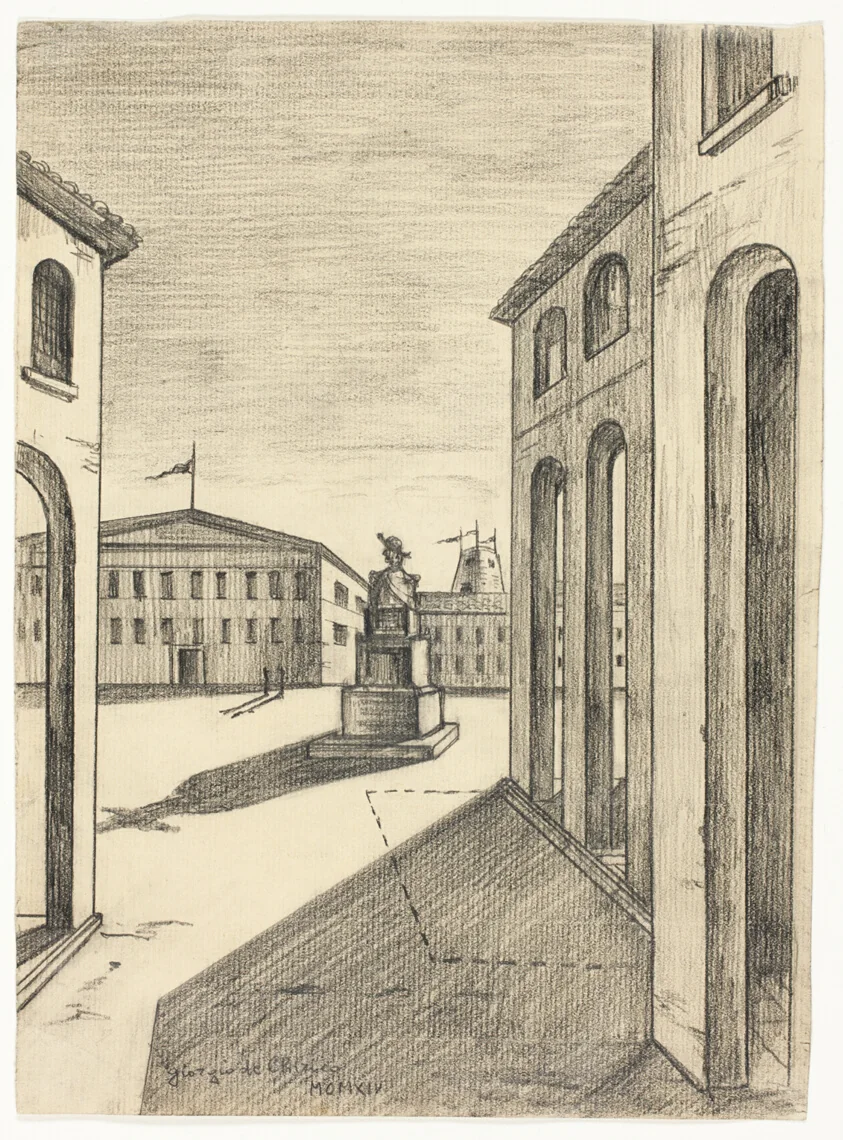
Giorgio de Chirico's "Piazza" (1914) is a graphite drawing with erasing and touches of smudging on cream laid paper, from the most intense period of de Chirico's Metaphysical phase. The piazza—the Italian city square—was de Chirico's signature subject, and this drawing shows his ability to create the mysterious, disorienting spaces that define his art. The piazza is shown with its characteristic elements: classical arcades, a statue or monument, long shadows stretching across the empty space. The perspective is exaggerated, the space distorted to create a sense of unease. The erasing technique creates highlights and areas of lighter tone that suggest the bright, unearthly light of de Chirico's metaphysical world. The smudging adds soft areas of shadow. The year 1914 was the peak of de Chirico's Metaphysical period, when he was producing the works that would make him famous. This drawing, created in that annus mirabilis, captures the essence of his vision: the empty piazza, the long shadows, the sense of a world suspended in a moment of inexplicable significance.
Cultural Impact
De Chirico's piazza drawings of 1914 represent the purest expression of his Metaphysical vision, capturing the uncanny stillness and mysterious beauty of empty urban spaces.
Why It Matters
This drawing of a piazza from 1914 captures the essence of de Chirico's art: the empty square, the long shadows, the classical arcades, all rendered with a precision that makes the familiar strange and the ordinary mysterious.