Mythologie

Description

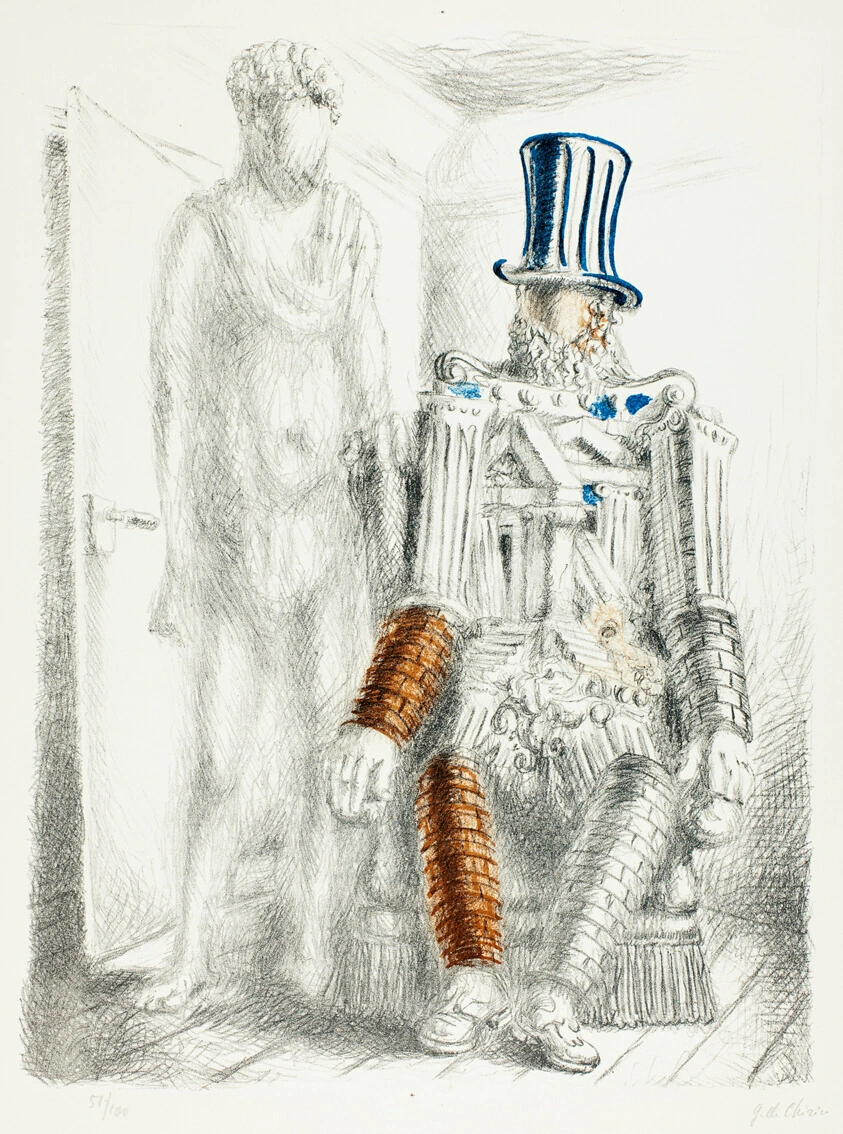
This portfolio contains a set of lithographic prints of handwritten poems by Jean Cocteau and illustrations by artist Giorgio de Chirico. It is not conventionally bound, there is a tactile element to untying the book’s three ribbon-like restraints in order to view its loose-leaf content. Chirico’s illustrations have a distinct throughline of jagged, zig-zagging lines representing water in various forms: lakes, rivers, swimming pools and streams. Figures of nude bathers wade and soak, observed by men in suits and classical sculptures in tightly cropped spaces. Cocteau’s choice to print the text in his handwriting instead of letterpress is unusual, in that it calls attention to the physical act of writing in ways that wouldn’t have been possible with conventional forms of printed text. The florid script, personal like a handwritten letter, takes on a unique visual character, eroding the barriers between drawing and poetry.

Mythologie

Giorgio de Chirico

Paris: Editions des Quatre Chemins, 1934

Accession Number

244539

Medium

Portfolio of loose leaves containing twelve pages of printed text lithographed from author's handwritten manuscript and ten lithographic illustrations, signed and numbered

Dimensions

28.5 × 23 cm (11 1/4 × 9 1/16 in.)

Classification

book

Museum

The Art Institute of Chicago

Chicago, United States

Credit Line

Mary Reynolds Collection, Ryerson & Burnham Libraries

Background & Context

Background Story

Giorgio de Chiricos Mythologie from 1934 is a livre dartist, an artists book published by Editions des Quatre Chemins in Paris, containing ten lithographic illustrations and twelve pages of text lithographed from the authors handwritten manuscript. The book represents de Chiricos most ambitious engagement with the artists book format, a medium that had been developed by Vollard and Kahnweiler in the early 20th century as a vehicle for combining original prints with literary text in a deluxe format. Mythologie takes its title from de Chiricos lifelong preoccupation with classical mythology and its transformation through the lens of modern irrationality, a theme that had defined his Metaphysical paintings of the 1910s and would continue to occupy him throughout his career. The lithographic illustrations depict the fragmented architectural forms, mannequins, and classical ruins that constitute de Chiricos personal mythology, rendered with the sharp edges and atmospheric shadows that make his images immediately recognizable. The handwritten text, lithographed directly from de Chiricos manuscript, preserves the intimacy and idiosyncrasy of his writing, in which dreamlike narratives and philosophical meditations are interspersed with the same enigmatic imagery that appears in the illustrations. The portfolio format, with loose leaves rather than a bound book, allows the individual pages to be displayed separately, reflecting the modernist insistence on the autonomy of the image and the readers freedom to experience the work in any order.

Cultural Impact

De Chiricos Mythologie is a significant contribution to the tradition of the artists book and a key document of the intersection of Metaphysical painting and literary Surrealism. The livre dartist format influenced the development of book arts in the 20th century and established a precedent for the collaboration between visual artists and publishers that would produce many of the most important artists books of the modern period.

Why It Matters

An artists book by de Chirico combining ten lithographic illustrations of his personal mythology with twelve pages of handwritten text, published in a deluxe portfolio format that exemplifies the livre dartist tradition and the intersection of Metaphysical painting with literary Surrealism.