Accession Number
180667
Medium
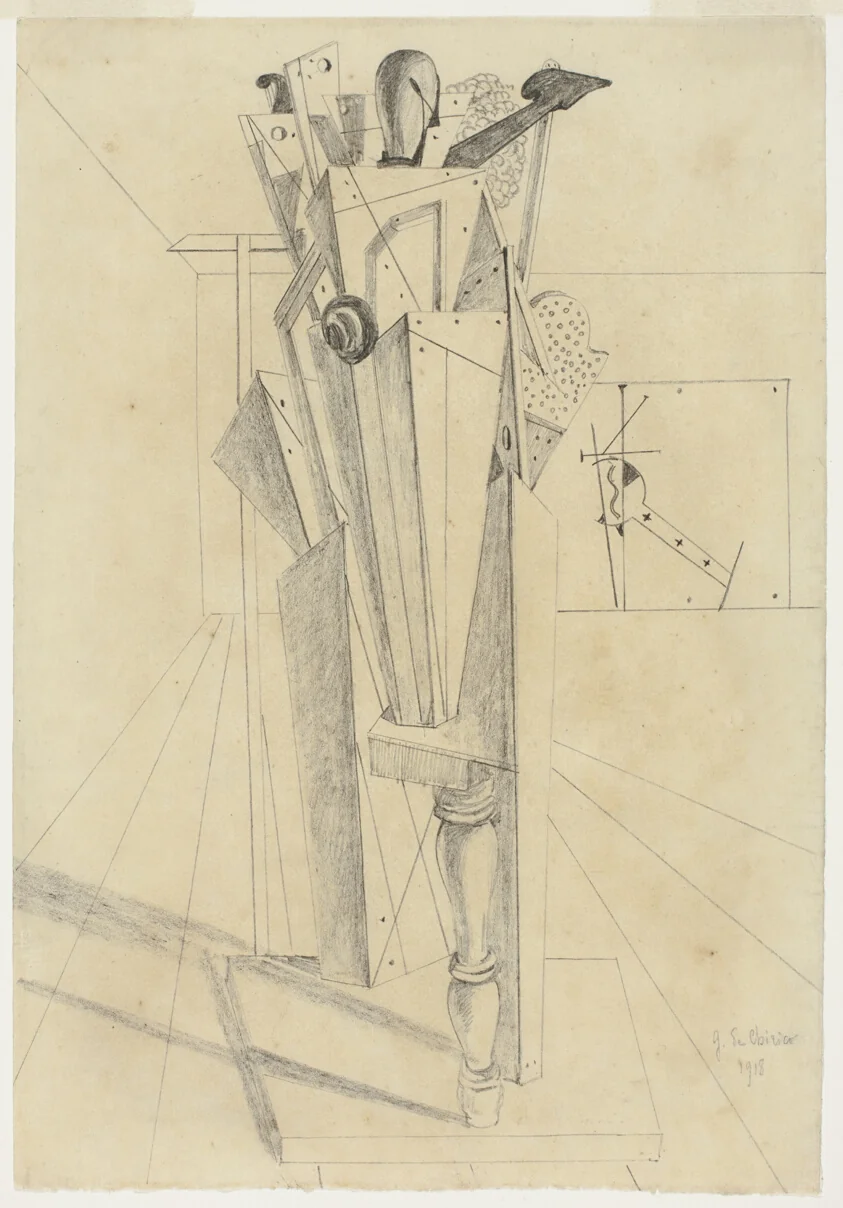
Graphite on cream wove tracing paper
Dimensions
31 × 21.4 cm (12 1/4 × 8 7/16 in.)
Classification
drawings (visual works)
Credit Line
Gift of the Gecht Family
Background & Context
Background Story
Giorgio de Chirico's "The Pharaoh" (1918) is a graphite drawing on cream wove tracing paper that belongs to the Metaphysical period. The subject of the pharaoh—an ancient Egyptian ruler—was unusual for de Chirico, whose work typically featured classical Greco-Roman architecture rather than Egyptian motifs. The pharaoh may appear as a statue, a mannequin, or a costumed figure in one of de Chirico's enigmatic piazzas. The graphite technique on tracing paper gives the drawing a distinctive quality: the translucent paper softens the lines and gives the work an ethereal, provisional character. The year 1918 was the final year of World War I and the end of the most intense phase of de Chirico's Metaphysical period. This drawing, with its mysterious title and enigmatic imagery, captures the essence of his art: the sense of a world where time is suspended, meanings are uncertain, and the ordinary rules of reality no longer apply. The pharaoh, a figure from a distant past, appears in a timeless space that could be any time or no time at all.
Cultural Impact
De Chirico's Metaphysical drawings continue to influence artists, writers, and filmmakers with their enigmatic imagery and their ability to make the familiar world seem strange and uncertain.
Why It Matters
This drawing of a pharaoh in de Chirico's enigmatic style brings together ancient Egypt and modern Italy in a timeless space that challenges our sense of historical and geographical reality.