Accession Number
1959.304
Medium
graphite
Dimensions
Sheet: 48.2 x 31.9 cm (19 x 12 9/16 in.)
Classification
Drawing
Credit Line
Gift of Mr. and Mrs. Severance A. Millikin
Tags
Color: Orange
Background & Context
Background Story
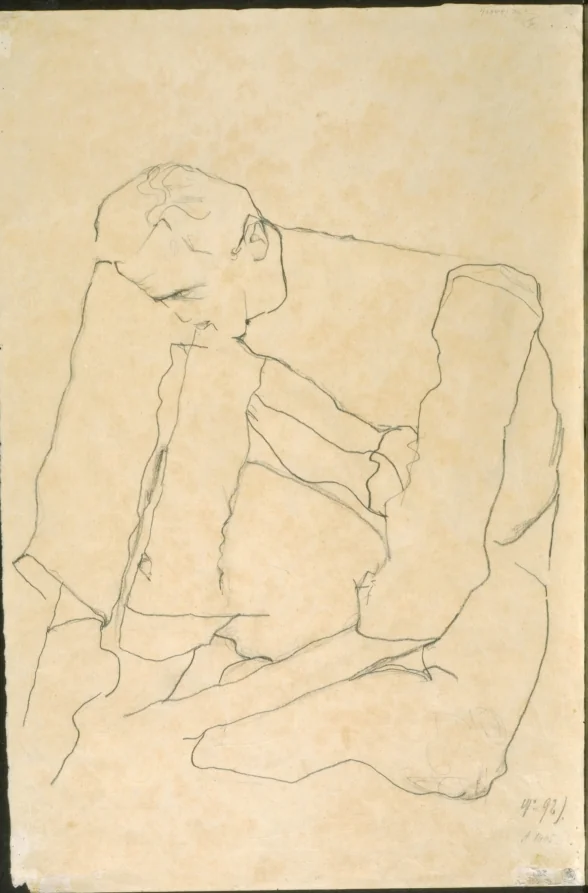
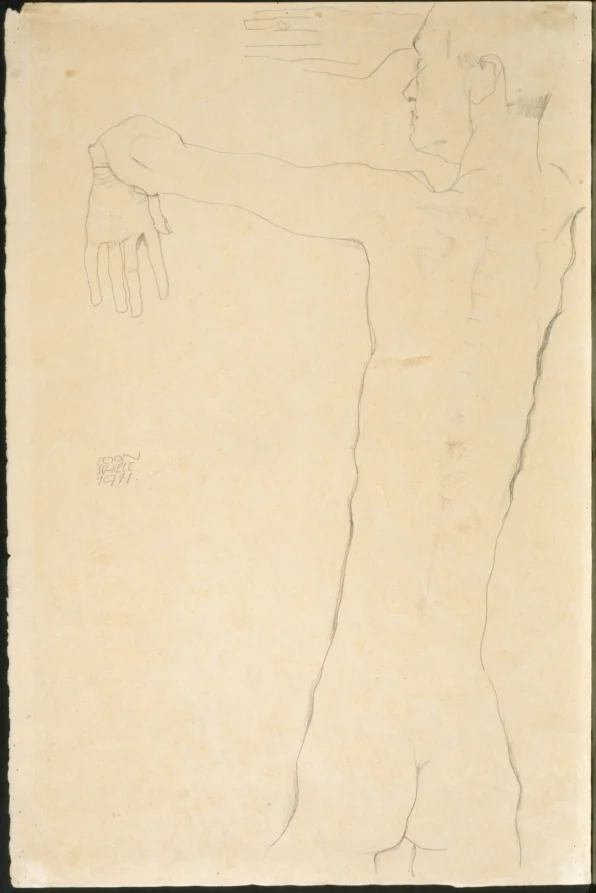
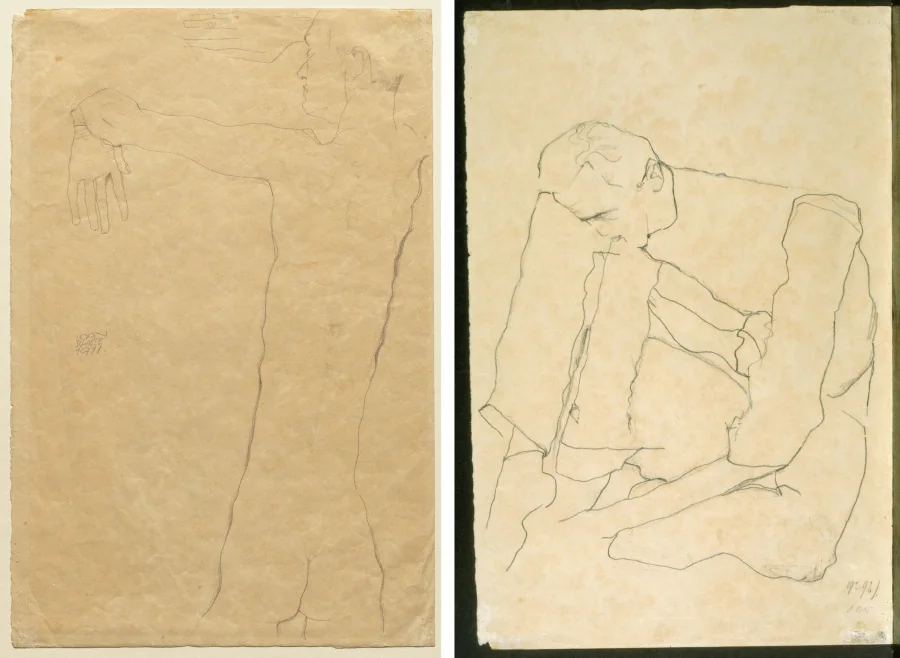
Egon Schiele, the Austrian Expressionist whose brief, incendiary career produced some of the most raw and psychologically charged figural art of the 20th century, created this double-sided drawing in 1911. The recto shows a nude man with raised arms, the verso a seated man—both executed in graphite with Schiele's characteristic angular, nervy line. 1911 was a pivotal year: Schiele was 21, recently expelled from the Vienna Academy of Fine Arts, and living in the Bohemian town of Krumau (Český Krumlov) with his mistress Wally Neuzil. The same year, he would be forced to leave Krumau after conservative townspeople objected to his lifestyle and his habit of drawing local children in the nude.
The recto figure—arms raised, body exposed in a gesture that suggests both surrender and defiance—exemplifies Schiele's signature approach to the human figure. The body is elongated, the ribcage prominent, the muscles drawn as taut, expressive lines rather than smooth anatomical volumes. Schiele distorts anatomy not from ignorance but from expressive necessity: the contorted pose, the sharp angles, the exposed genitals, the hands with their splayed, spidery fingers—all were deliberate strategies to convey psychological states of vulnerability, alienation, and existential exposure.
The verso figure, a seated man, is drawn with equal intensity. The pose is more contained, but the treatment is similarly confrontational: the figure's gaze is direct, his posture tense, his genitals drawn with unflinching honesty. The graphite medium allowed Schiele his preferred speed and directness—a line that could be as sharp as a blade or as soft as a caress, generated from the shoulder in sweeping arcs that left no room for correction.
Schiele's work in 1911 was pushing the boundaries of what society considered acceptable. In 1912, he would be arrested on charges of abducting a minor and distributing pornographic images; though the more serious charges were dropped, a judge famously burned one of his drawings in the courtroom. Yet Schiele persisted, producing the most concentrated body of work of any artist of his generation before his death in the 1918 influenza pandemic at age 28.
Cultural Impact
Schiele's figural drawings represent Expressionism's most radical investigation of the human body as a vehicle for psychological expression. His angular, distorted figures and unflinching eroticism challenged every convention of Viennese society and academic art. This double-sided sheet, with two nude male studies on recto and verso, captures the raw intensity and technical brilliance that made Schiele a central figure in Austrian Expressionism, alongside his mentor Gustav Klimt and his contemporary Oskar Kokoschka. His influence resonates through Neo-Expressionism and contemporary figuration.
Why It Matters
A raw, electrifying double-sided drawing from Schiele's most intense period, capturing the human body as a site of psychological expression and existential exposure.