Description
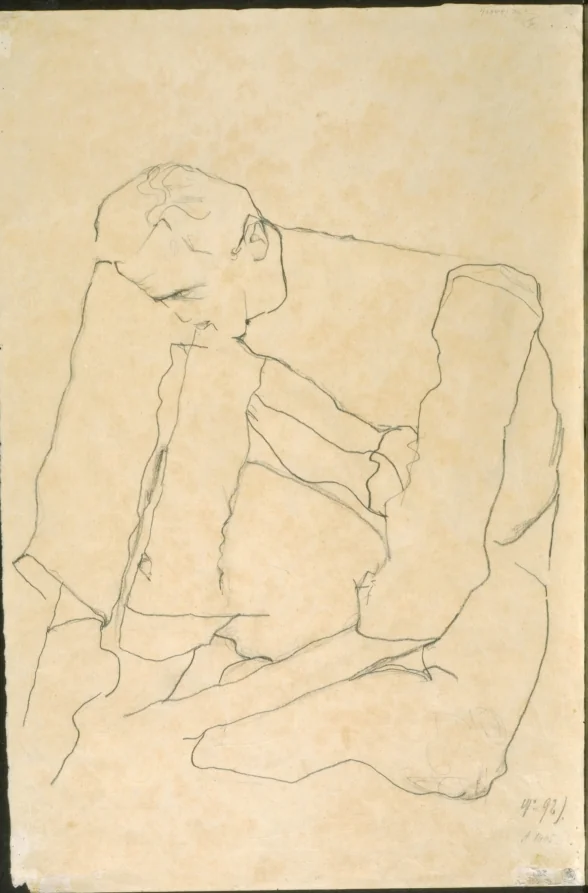
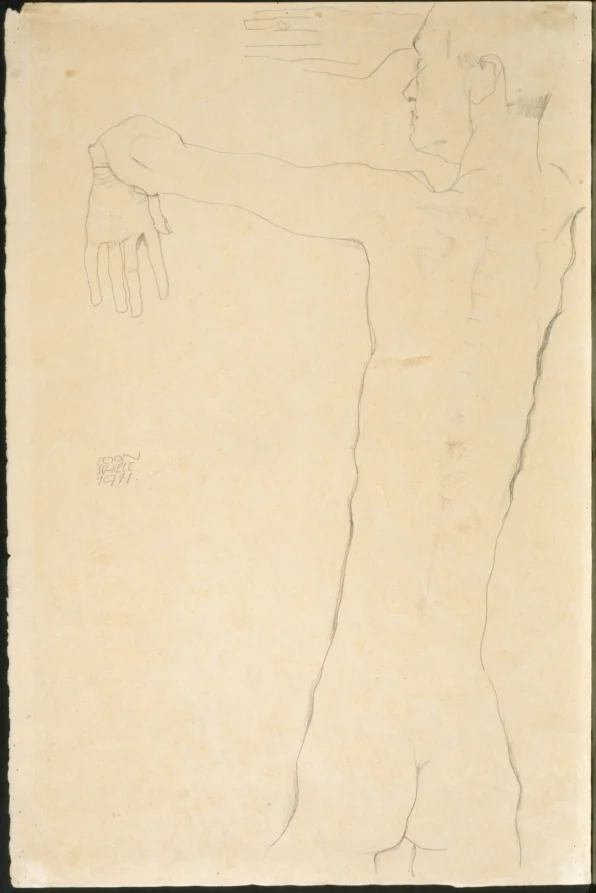
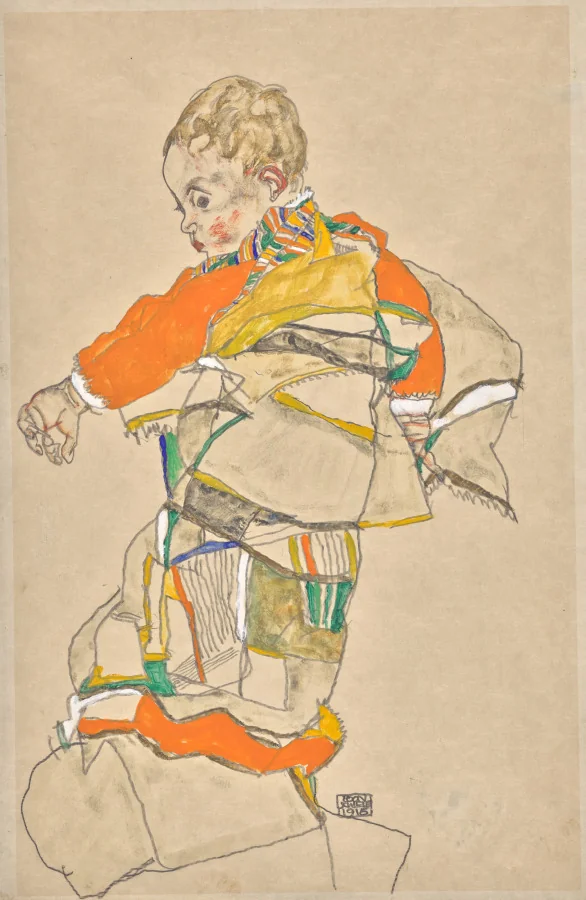
Egon Schiele depicted a small child, the son of a friend, in this drawing devoid of setting. The child teeters at an awkward angle, seemingly unsupported but for a multipatterned fabric wrap that occupies the artist’s primary interest. This contorted pose is typical of Schiele’s many drawings of people in which he explored the expressive capacity of the human form, often using the body to indicate their psychic state (see another drawing by Schiele nearby). He died in the Spanish influenza epidemic in 1918 at age 28, leaving a vast number of drawings.
Provenance
Lederer family, Vienna, sold to Walter Feilchenfeldt, Zurich (by 1917-before 1959); (Walter Feilchenfeldt, Zurich, sold to Severance and Greta Millikin, Cleveland, OH) (?-1959); Severance and Greta Millikin, Cleveland, OH, given to the Cleveland Museum of Art, Cleveland, OH (1959-1964); The Cleveland Museum of Art, Cleveland, OH (1964-)
Accession Number
1964.285
Medium
Gouache, watercolor, and graphite
Dimensions
Sheet: 49.9 x 32.2 cm (19 5/8 x 12 11/16 in.)
Classification
Drawing
Credit Line
Severance and Greta Millikin Collection
Tags
Drawing Early Modern (1901–1950) Watercolor Graphite & Pencil Gouache Austrian Color: White
Background & Context
Background Story
Egon Schiele (1890-1918) was an Austrian painter known for the angular, expressive manner that makes him one of the most important painters of Austrian Expressionism. Portrait of a Child (Anton Peschka, Jr.) from 1916 depicts the young son of Schiele's brother-in-law in the angular, expressive manner that distinguishes Schiele's best portraits from the more conservative portrait painting of his Viennese contemporaries. The 1916 date places this in Schiele's mature period, when he was producing the angular, expressive portraits that are his most accomplished works.
Cultural Impact
Portrait of a Child is important in Schiele's mature oeuvre because it demonstrates the angular, expressive manner that he brought to portrait subjects as one of the most important painters of Austrian Expressionism. Schiele's child portraits—combining angular drawing with expressive color and psychological intensity—represent one of the most important contributions to 20th-century portrait painting, and Portrait of a Child shows this manner at its most accomplished.
Why It Matters
Portrait of a Child is Schiele's angular Expressionism: the young Anton Peschka, Jr. rendered in the angular, expressive manner that makes Schiele one of the most important painters of Austrian Expressionism. The 1916 portrait combines angular drawing with expressive color and psychological intensity.