Accession Number
1959.304.b
Medium
graphite
Dimensions
Sheet: 48.2 x 31.9 cm (19 x 12 9/16 in.)
Classification
Drawing
Credit Line
Gift of Mr. and Mrs. Severance A. Millikin
Tags
Color: White
Background & Context
Background Story
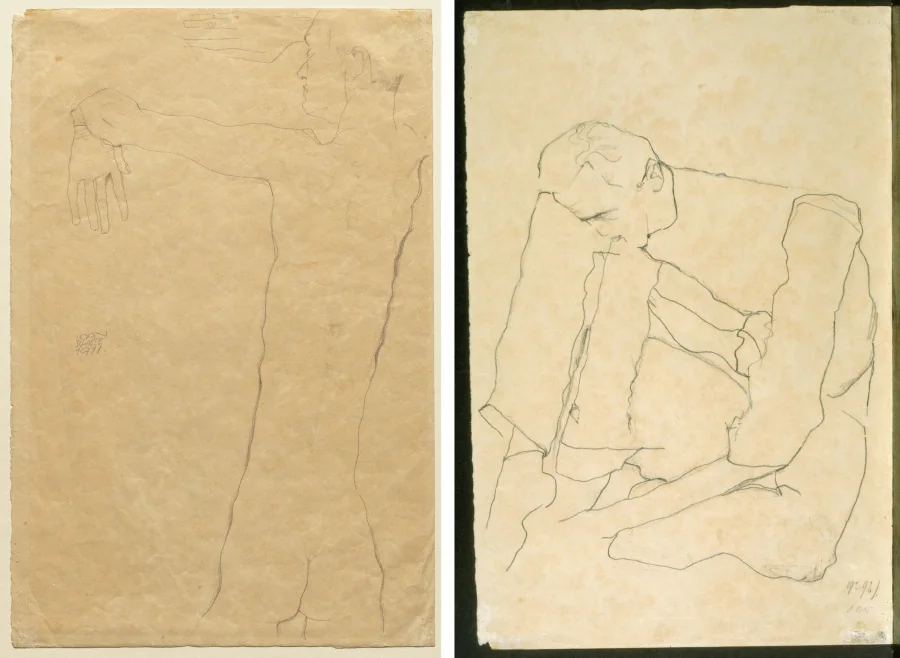
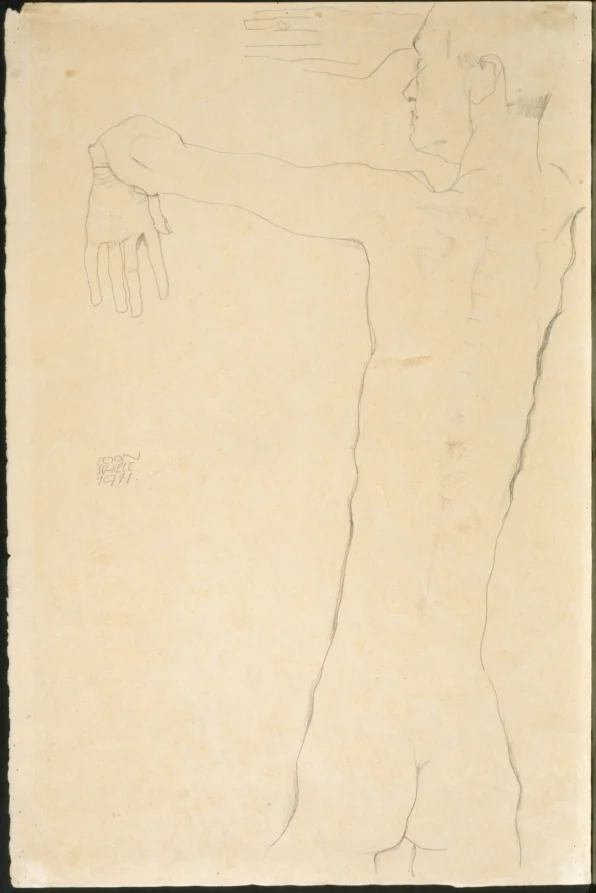
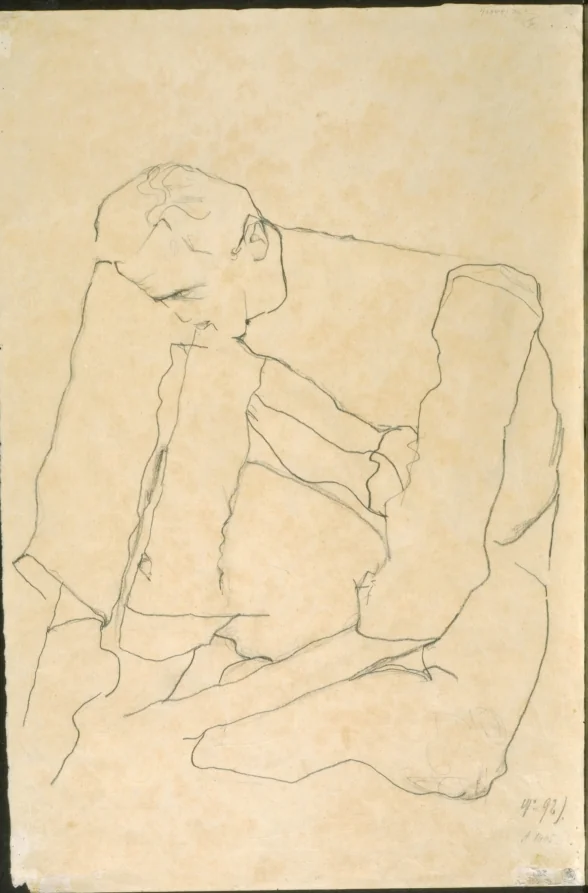
The verso of Egon Schiele's double-sided 1911 drawing depicts a seated male nude, executed in the same urgent, expressive graphite line as the recto figure. While the recto presents the body in an open, exposed posture with arms raised, the verso figure is more contained—seated, knees drawn up, one arm resting across the body in a gesture that suggests self-protection or introspection. Together, the two sides of the sheet represent complementary states of being: exposure and withdrawal, confrontation and reflection.
Schiele's seated figure is compressed into the picture plane, filling the available space with an angular mass of elbows, knees, and ribcage. The body is not relaxed but taut, the muscles drawn as if electrified. The face, turned slightly, meets the viewer with a direct, unsettling gaze. Schiele's graphic shorthand is fully in evidence: the hair indicated by rapid zigzag strokes, the eyes reduced to dark slits, the body contoured by a line that seems to tremble with nervous energy.
This drawing shares the sheet with 'Nude Man with Raised Arms' (310474), and the conjunction of the two poses on a single sheet of paper—one standing and exposed, the other seated and self-contained—suggests that Schiele was exploring a range of bodily states and emotional conditions within a single drawing session. The practice of working on both sides of the paper was not unusual for Schiele, who was often impoverished and forced to conserve materials.
1911 was also the year Schiele began to develop the symbolic and allegorical dimensions of his work, moving beyond pure figuration toward compositions that explored themes of life, death, and sexuality. The seated man, with his drawn-up knees and inward-turning posture, can be read as a figure of contemplation or melancholy—a mood that would dominate much of Schiele's work as the First World War approached. By 1918, when he died at 28, Schiele had produced over 300 paintings and thousands of drawings, making him one of the most prolific and uncompromising artists of his generation.
Cultural Impact
The verso drawing completes one of Schiele's most significant double-sided sheets, offering insight into his working process and thematic range. Where the recto presents the body as exposed and theatrical, the verso shows it as interior and vulnerable—two poles of human experience that Schiele explored repeatedly. Together, these drawings represent the fullest expression of early Expressionist figuration, in which the body becomes a vehicle for psychological exploration. Schiele's treatment of the seated male nude directly influenced later artists' investigations of the body as a site of anxiety and alienation.
Why It Matters
The introspective counterpart to the recto's exposed nude, this seated figure completes Schiele's exploration of the body as a vehicle for psychological states—withdrawn, vulnerable, and deeply human.