Accession Number
1959.304.a
Medium
graphite
Dimensions
Sheet: 48.2 x 31.9 cm (19 x 12 9/16 in.)
Classification
Drawing
Credit Line
Gift of Mr. and Mrs. Severance A. Millikin
Tags
Color: White
Background & Context
Background Story
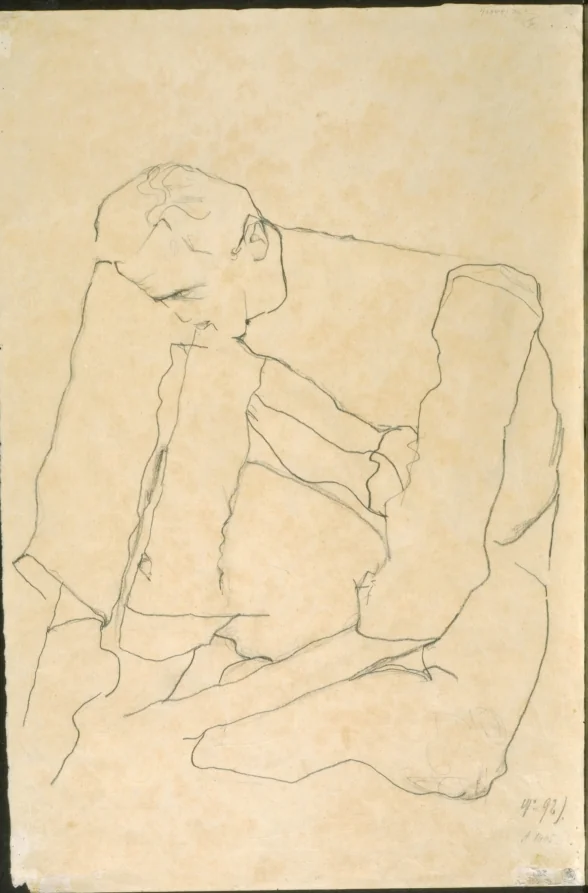
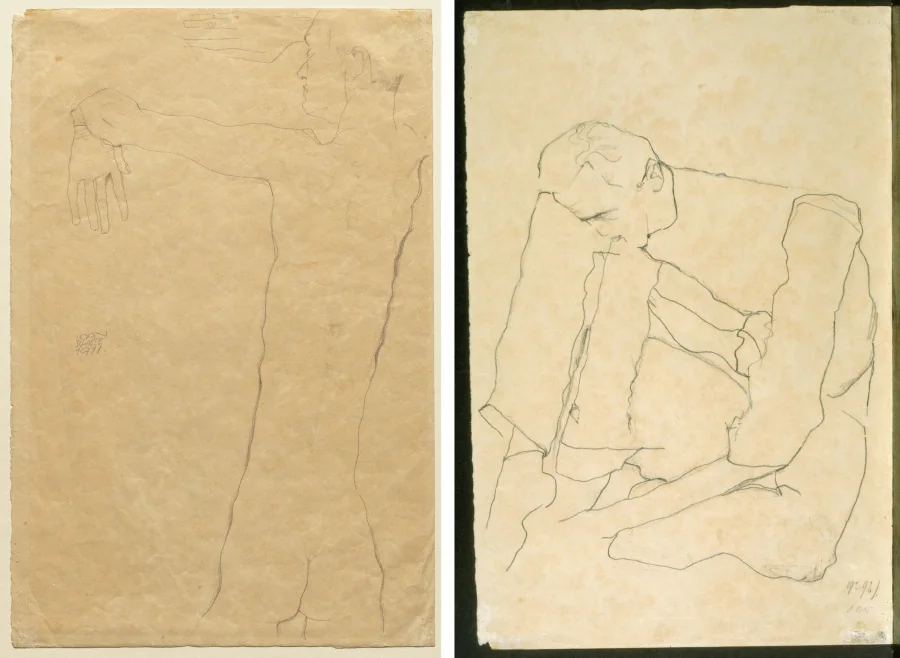
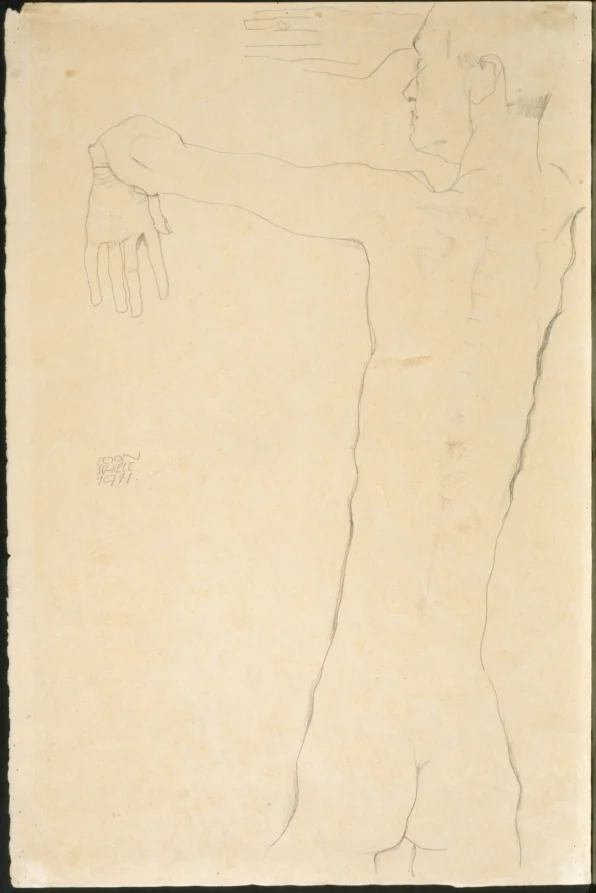
This graphite drawing by Egon Schiele, dated to 1911, is the recto of the double-sided sheet that also includes 'Seated Man (verso)' (Cleveland 310475). The subject is a nude man with raised arms, depicted with the raw, angular intensity that defines Schiele's mature style. At 21, Schiele had fully broken from the decorative elegance of his mentor Gustav Klimt and developed his own expressive language—one based on twisted postures, exposed flesh, and an unflinching confrontation with sexuality and mortality.
The figure stands with arms raised above his head, elbows bent, hands splayed in Schiele's characteristic gesture. The pose opens the body to the viewer, exposing the torso, the ribcage, the genitals—nothing is hidden. Schiele's line is both precise and expressive: a contour that swells and tapers, that bends and breaks, that follows the anatomy only to distort it for emotive effect. The ribcage is schematic, a series of arcs; the muscles of the abdomen are reduced to tense lines; the fingers, elongated and claw-like, seem to grasp at the air.
1911 was a year of both freedom and persecution for Schiele. He had left Vienna's conservative artistic establishment and settled in Krumau with Wally, his model and lover. But the provincial town proved hostile; locals were scandalized by his open relationship with an unmarried woman and his practice of drawing nude models, including children. The drawings from this year—especially the nudes—carry the charge of an artist working under siege, determined to record the truth of the body regardless of social consequences.
Schiele's nudes are never merely anatomical; they are portraits of the soul through the flesh. The raised arms suggest many states—surrender, ecstasy, supplication, the posture of a prisoner or a saint. The figure's eyes, barely indicated, seem to meet the viewer's with a mixture of defiance and vulnerability. This is not a classical nude but a modern one—naked, anxious, exposed to the existential void.
Cultural Impact
This drawing, together with its verso companion, represents the peak of Schiele's early mature period, when his expressive figuration reached its most radical intensity. Schiele's nudes revolutionized the genre by rejecting idealization in favor of psychological and physical truth. His influence on later figurative art—from Francis Bacon to Tracey Emin—testifies to the enduring power of his vision. The drawing also documents the crisis between the artist and society in early 20th-century Vienna, where the boundaries of artistic expression were being contested.
Why It Matters
An electrifying example of Schiele's radical figuration, this nude study uses every contour and angle to convey psychological intensity and existential vulnerability.