Description
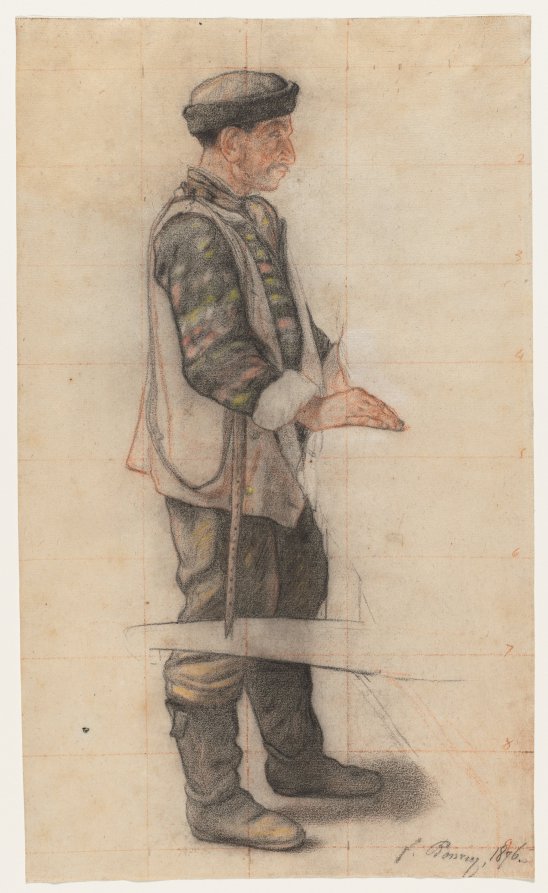
The subject of the woman at the piano was a recurrent theme in Bonvin’s oeuvre. The pianist depicted here was likely Céline Prunaire, a 21-year-old musician who married the much older artist in 1860. Although the meticulously rendered composition celebrates the grace and propriety of the young woman, the happiness of the couple’s union was fleeting. Prunaire left the artist after fewer than three years, never to return. The pink carnation at her feet suggests a note of foreboding to the image, perhaps intended to allude to the ephemeral nature of music and sentimental bonds.
Provenance
P&D Colnaghi & Co., Ltd., London, "French Drawings: Post Neo-Classicism," Spring Exhibition 1975 (lot #25, repr.); Williams & Son, London, December 11, 1975.
Accession Number
2010.166
Medium
fabricated black chalk with touches of brown and red chalk and stumping
Dimensions
Sheet: 42 x 30.5 cm (16 9/16 x 12 in.)
Classification
Drawing
Credit Line
Bequest of Muriel Butkin
Tags
Drawing Impressionist & Modern (1851–1900) French Color: Brown
Background & Context
Background Story
Woman at the Spinet (c. 1860-1870) depicts one of the most characteristic interior subjects of the Dutch Golden Age tradition—a woman playing a keyboard instrument in a domestic interior. The spinet, a small keyboard instrument that was the domestic equivalent of the harpsichord, was the instrument that 17th-century Dutch households owned for private musical enjoyment, and its presence in Bonvin's painting connects his Realist method to the Dutch interior tradition that was one of its most important precedents. Bonvin's treatment of the woman at the spinet demonstrates his ability to render interior spaces with the same precision that his still-life training provided: the instrument's details, the woman's posture, and the specific quality of interior light are all rendered with an attention to texture and weight that give the scene its physical authenticity. The 1860-70 date places this during Bonvin's most productive period, when his interior scenes were being recognized as significant contributions to the Realist movement. The spinet subject also connects Bonvin to the broader tradition of music painting—from Vermeer's music lessons to the 19th-century interiors that continued the tradition—arguing that domestic music-making deserves the same artistic attention that more public musical performance received.
Cultural Impact
Bonvin's interior genre paintings influenced how domestic music-making was represented in 19th-century French art, connecting the Realist tradition to the Dutch interior precedent. The paintings influenced later interior painters who similarly found subjects in domestic music-making. Woman at the Spinet influenced how the relationship between Dutch precedent and French Realism was understood, documenting the tradition that Bonvin's work continued.
Why It Matters
This painting matters because it connects Bonvin's Realist method to the Dutch interior tradition that was its most important precedent—the woman at the spinet is rendered with the same observational precision that the Dutch Golden Age brought to domestic music scenes, arguing that the Realist commitment to everyday experience continues a tradition that Academic painting had interrupted but not destroyed.