Provenance
Zwemmer Gallery, London [Tokyo 1985]. Given by Joel Starrels, Chicago, to the Art Institute, 1961.
Accession Number
87627
Medium
Brush and black ink and black watercolor on tan wove paper, laid down on tan wove card
Dimensions
43.7 × 25.8 cm (17 1/4 × 10 3/16 in.)
Classification
pen and ink drawings
Credit Line
Gift of Mr. Joel Starrels
Background & Context
Background Story
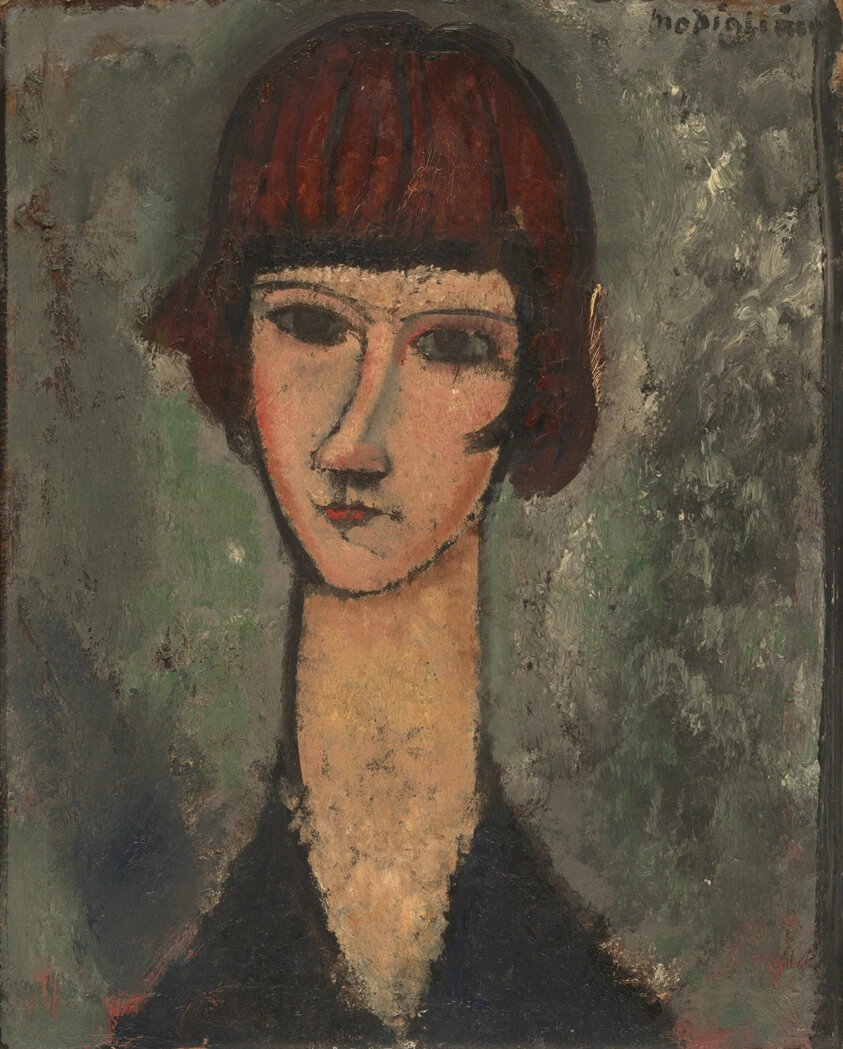
"Portrait of a Young Woman" is one of Modigliani's most accomplished ink drawings, executed in brush and black ink and black watercolor on tan wove paper laid down on tan wove card during the period when he was producing the series of portraits and caryatids that established his reputation as the great poet of modern beauty. The composition shows a young woman's face in three-quarter view, her features rendered with the elongation and simplification that Modigliani had developed from his study of African masks, Cycladic sculpture, and Mannerist portraiture, the neck extended, the eyes almond-shaped, the mouth a small, sensuous curve. The technique is extraordinarily fluid: the brush moves with calligraphic freedom, creating lines that vary from thick, assertive strokes in the hair and clothing to delicate, almost trembling marks in the face, suggesting both the artist's confidence and his vulnerability. The black watercolor adds tonal depth that makes the image feel more painterly than a pure line drawing, the washes creating shadows that suggest volume without sacrificing the flat, decorative quality that Modigliani valued. The tan wove paper provides a warm, sympathetic ground that makes the black ink appear rich and velvety, enhancing the sensuous appeal of the image. Art historians have compared this drawing to the painted portraits of Modigliani's most productive period (1916–1919), noting that the drawings often achieve a greater intimacy and immediacy than the oils, the directness of the medium allowing a closer connection between artist and sitter. The work also demonstrates Modigliani's extraordinary productivity as a draftsman: he produced thousands of such drawings during his brief career, many of them given away or sold for a few francs to buy food or drugs.
Cultural Impact
This ink drawing achieved painted tonal depth through brush-and-wash calligraphic freedom, using tan-paper warmth to make elongated Mannerist-African beauty feel intimate and immediately sensuous.
Why It Matters
It matters because Modigliani drew a woman's face and made the paper feel like skin—proving that even a few francs of ink could hold more beauty than a wall of oil.