Provenance
Private Collection, Paris [according to Patani 1992]. Amy McCormick (1880-1939), Chicago, by 1930 [Chicago 1930]; by descent to her husband, Col. Robert R. McCormick (1880-1955), Chicago; given to the Art Institute, 1942.
Accession Number
45254
Medium
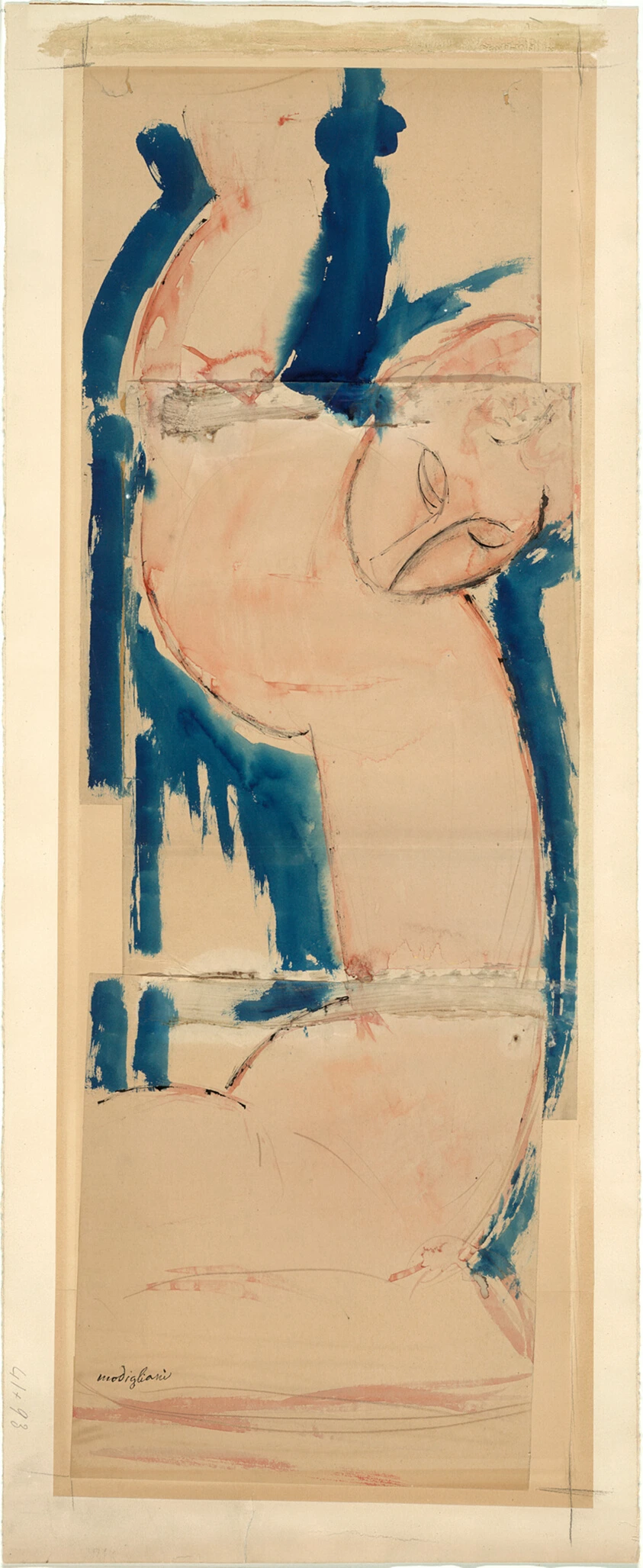
Watercolor, over graphite on buff wove paper, laid down on tan wove paper, laid down on cream wove card
Dimensions
Primary support: 53.7 × 41 cm (21 3/16 × 16 3/16 in.); Secondary support: 55.7 × 43 cm (21 15/16 × 16 15/16 in.); Trimmed: 56.1 × 43.2 cm (22 1/8 × 17 1/16 in.)
Classification
watercolor
Credit Line
Amy McCormick Memorial Collection
Background & Context
Background Story
"Caryatid" is one of Modigliani's most important sculptural drawings, executed around 1913 in watercolor over graphite on buff wove paper and documenting the artist's lifelong ambition to create stone sculptures of standing female figures that would rival the archaic Greek caryatids he had studied in the Louvre. The composition shows a standing woman in the pose of a column, her body supporting an invisible architectural burden, the forms simplified and elongated to suggest both human grace and structural necessity. The technique is delicate and deliberate: the watercolor washes create a soft, atmospheric tone that makes the figure feel like a ghost of stone, a memory of sculpture rather than a study for it, while the visible graphite underdrawing reveals the artist's process of establishing proportions and posture before applying color. The buff wove paper provides a warm, neutral ground that enhances the sense of antiquity, the color suggesting the patina of aged marble or weathered limestone. The c. 1913 date places this work in the period of Modigliani's most intense sculptural activity, when he was carving directly in stone in the tradition of Rodin and Brancusi, and the drawings served both as independent works and as plans for carvings that were often abandoned due to lack of funds or materials. Art historians have connected this drawing to the broader tradition of the caryatid in Western art, from the Erechtheion of the Athenian Acropolis to the neoclassical architecture of the nineteenth century, noting that Modigliani's treatment transforms architectural support into pure aesthetic contemplation, the burden-bearing figure liberated from function into beauty. The work also demonstrates the influence of Constantin Brancusi, whom Modigliani met in Paris: the reduction of the figure to essential volumes, the polished surfaces, and the emphasis on verticality all suggest the Romanian sculptor's impact on the younger artist.
Cultural Impact
This c. 1913 watercolor ghosted stone sculpture into atmospheric drawing, using buff-paper patina and visible graphite process to make architectural burden-bearing transform into pure aesthetic verticality.
Why It Matters
It matters because Modigliani drew a woman as a column and made her look like she was holding up the sky—proving that even paper could feel like marble if the proportions were ancient enough.