Provenance
Private Collection, Paris [according to Patani 1992]. Amy McCormick (1880-1939), Chicago, by 1930 [Chicago 1930]; by descent to her husband, Col. Robert R. McCormick (1880-1955), Chicago; given to the Art Institute, 1942.
Accession Number
45257
Medium
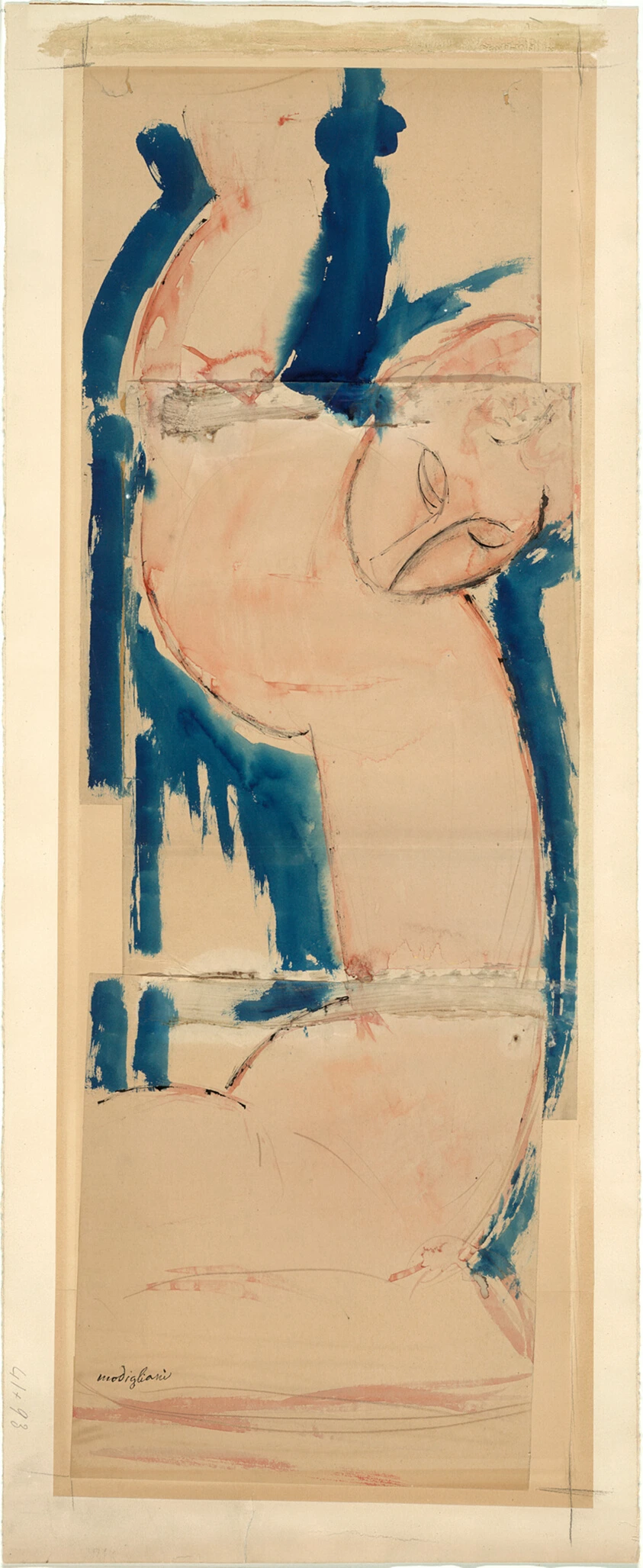
Watercolor, with pen and black ink, graphite, and touches of brown crayon on tan wove paper (pieced), laid down on tan wove paper, laid down on cream wove paper
Dimensions
Primary support overall: 82.1 × 28.9 cm (32 3/8 × 11 7/16 in.); Secondary support: 84.1 × 31.2 cm (33 1/8 × 12 5/16 in.); Tertiary support: 90 × 36.7 cm (35 7/16 × 14 1/2 in.)
Classification
watercolor
Credit Line
Amy McCormick Memorial Collection
Background & Context
Background Story
Amedeo Modiglianis Caryatid: Rose and Blue from 1912-14 belongs to a series of works in which the artist explored the female figure as architectural support, drawing on the ancient Greek tradition of caryatids, sculpted female figures that serve as columns in classical buildings. Modigliani conceived an ambitious plan for a temple of beauty supported by caryatids, and between 1909 and 1914 he produced numerous drawings, watercolors, and related sculptures developing this theme. In this work, the caryatid is rendered with the artists characteristic simplification of form: the elongated neck and stylized features that would become his signature are already present, but here applied to a figure who serves a structural function rather than a purely portrait function. The rose and blue color scheme adds an unexpected decorative warmth to the architectural form, suggesting that Modiglianis caryatids were meant to be sensuous beings rather than cold supports. The mixed media technique, combining watercolor with pen, ink, graphite, and crayon, reveals the artist working through compositional ideas with the freedom and spontaneity that drawing permits.
Cultural Impact
Modiglianis caryatid series represents one of the most sustained meditations on the relationship between the human figure and architectural form in modern art. The series influenced Art Deco design, modernist sculpture, and the broader 20th-century exploration of how the body could serve as both structural element and expressive subject.
Why It Matters
A watercolor study from Modiglianis caryatid series that explores the intersection of the female form and architectural function, blending classical references with the artists modernist simplification and decorative sensibility.