Provenance
Mary and Leigh Block, Chicago, by 1970 [du Plessix 1970]; given to the Art Institute of Chicago, 1988.
Accession Number
110994
Medium
Graphite on ivory wove paper, dry-mounted to ivory wove card
Dimensions
43.4 × 26.6 cm (17 1/8 × 10 1/2 in.)
Classification
graphite
Credit Line
Gift of Mary and Leigh Block
Background & Context
Background Story
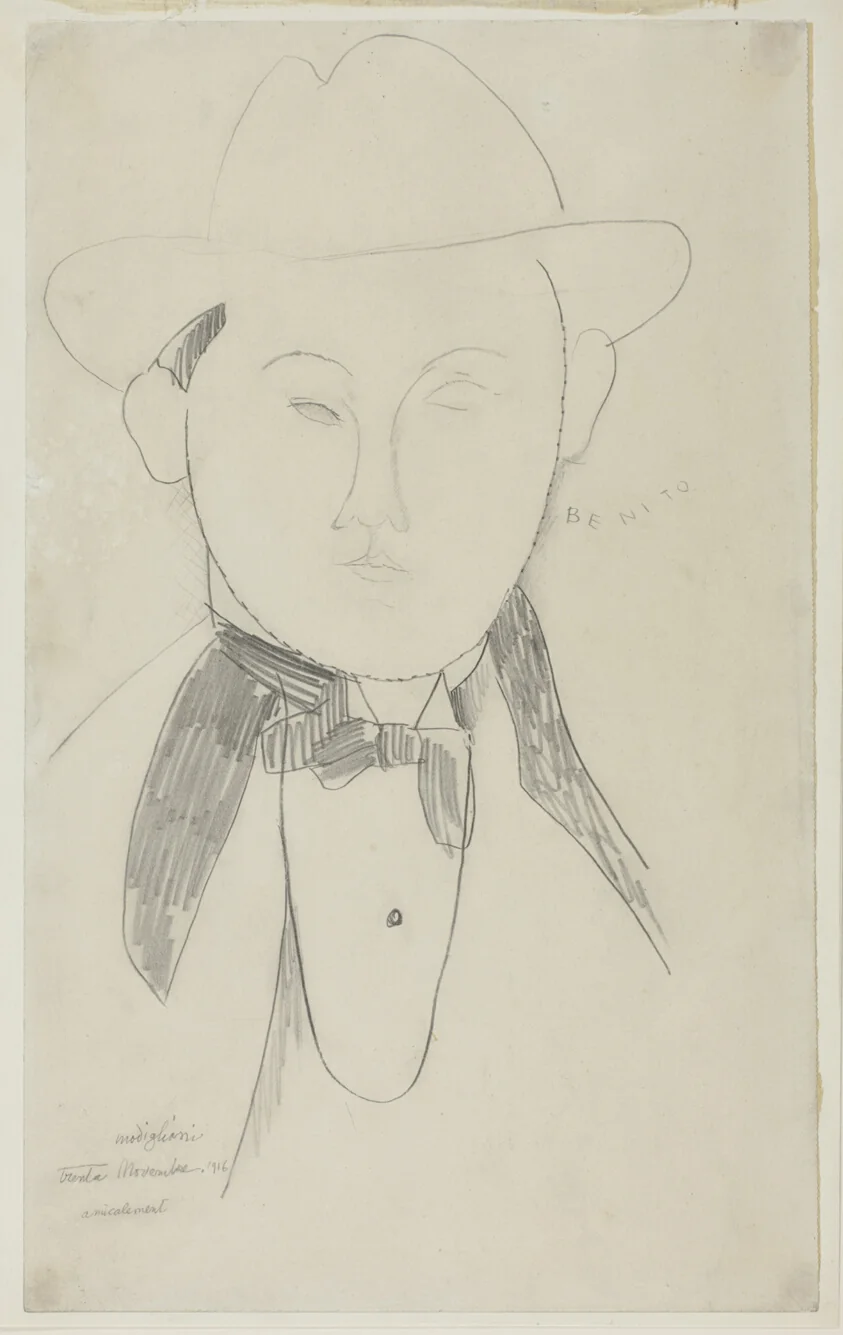
Amedeo Modigliani's "Benito" (1916) is a graphite portrait drawing of a figure from the artist's circle in bohemian Montparnasse. The sitter, known only as "Benito," was likely a fellow artist, model, or caf├® habitué from the vibrant artistic community that gathered around the cafes of Montparnasse in the years before and during World War I. Modigliani's portrait style in this drawing is immediately recognizable: the elongated oval of the face, the long, straight nose, the small mouth, and the simplified, searching eyes. The graphite medium allows Modigliani to work with extraordinary precision, yet the drawing retains a sense of spontaneity and life. Modigliani produced hundreds of portrait drawings throughout his brief career, often exchanging them for a meal or a drink at the cafes he frequented. These drawings were his currency in the bohemian economy of Montparnasse, and they constitute a remarkable visual record of the artists, poets, and characters who populated that legendary community. "Benito" dates from 1916, a year when Modigliani was producing some of his finest graphic work while struggling with poverty, illness, and the effects of his excessive lifestyle.
Cultural Impact
Modigliani's portrait drawings of the Montparnasse community form an invaluable visual chronicle of one of the most creative periods in modern art history, capturing the faces of the men and women who made Paris the capital of the avant-garde.
Why It Matters
This portrait of an obscure figure from Modigliani's circle demonstrates the artist's extraordinary ability to invest every subject, whether famous or forgotten, with the same refined, elegant vision—a democratization of beauty that defines his art.